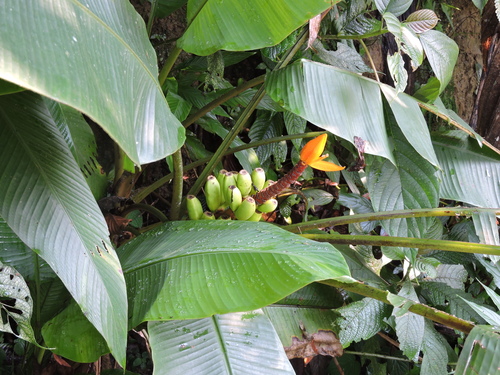
Musa basjoo
Siebold.&Zucc.
Japanese Banana

(c) Degtyarev Nikolai Ivanovich, some rights reserved (CC BY-NC), uploaded by Degtyarev Nikolai Ivanovich

(c) Krzysztof Ziarnek, Kenraiz, some rights reserved (CC BY-SA)

(c) Shigeru-a24, some rights reserved (CC BY-SA)
What to Eat
Edible parts: Nectar
The nectar of the flowers is sweet and drinkable.
Where to Find It
E. Asia - Japan.
TEMPERATE ASIA: China (south)
How to Identify
Musa basjoo is an evergreen Perennial growing to 3 m (9ft) by 2 m (6ft). See above for USDA hardiness. It is hardy to UK zone 8. It is in leaf all year. The species is monoecious (individual flowers are either male or female, but both sexes can be found on the same plant). Suitable for: light (sandy), medium (loamy) and heavy (clay) soils and prefers well-drained soil. Suitable pH: mildly acid, neutral and basic (mildly alkaline) soils. It cannot grow in the shade. It prefers moist soil.
How to Grow
Requires a rich soil and a sunny sheltered position. The large leaves are very easily torn by the wind. This species is only hardy in the milder areas of Britain and even there will require protection in colder winters. It thrives and fruits in south-western Britain where it survived the very severe winters of 1985 to 1987. Plants are herbaceous and die down after flowering, forming new shoots from the roots. Cultivated in Japan as a fibre plant.
Propagation: Seed - best sown as soon as it is ripe in a warm greenhouse. The seed usually germinates rapidly. Pre-soak stored seed for 72 hours in warm water, if it is still floating then it is not viable. Sow in a warm greenhouse in spring, planting one large seed in each pot. Germination usually takes place within 2 - 24 weeks at 22°c. Grow the plants on in the greenhouse for at least 3 years before trying them outdoors. The seed remains viable for 2 years. Removal of suckers as the plant comes into growth in spring.
Medicinal Uses
Diuretic Febrifuge Sialagogue. The roots are diuretic, febrifuge and sialagogue. A decoction is used in the treatment of beriberi, constipation, jaundice, dropsy, restlessness due to heat, leucorrhoea and croton bean poisoning. The leaves are diuretic.
Other Uses
FibreA fibre is obtained from the leaf stems. Used for cloth, sails etc. The fibre can also be used for making paper The leaves are harvested in summer and are soaked in water for 24 hours prior to cooking. The fibres are cooked for 2 hours with lye and then beaten in a ball mill for 4½ hours before being made into paper.