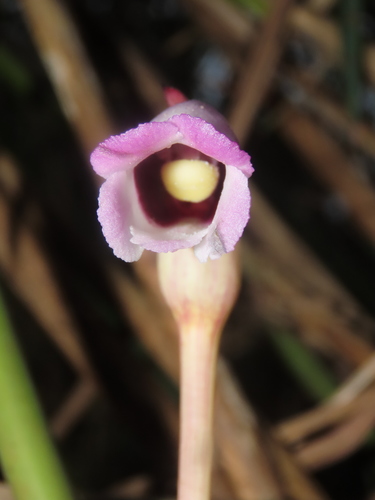
Orobanche tuberosa
Hook.
Ground Cone

GBIF

GBIF

GBIF
What to Eat
Edible parts: Root
Root. The potato-like stem bases were occasionally peeled and eaten raw as a snack by some North American Indian tribes.
Where to Find It
Western N. America - British Columbia to N. California.
Coming Soon
How to Identify
Orobanche tuberosa is a PERENNIAL growing to 0.1 m (0ft 5in). The species is hermaphrodite (has both male and female organs). Suitable for: light (sandy), medium (loamy) and heavy (clay) soils and prefers well-drained soil. Suitable pH: mildly acid, neutral and basic (mildly alkaline) soils. It can grow in full shade (deep woodland) semi-shade (light woodland) or no shade. It prefers moist soil.
How to Grow
We have very little information on this species and do not know if it will be hardy in Britain, though judging by its native range it should succeed outdoors in most parts of the country. It requires a well-drained soil and should succeed in sun or shade. A fully parasitic plant lacking in chlorophyll, it is entirely dependant upon its host plant for obtaining nutrient. According to, the correct name for this species is Boschniakia hookeri.
Propagation: Seed - we have no information on this species but suggest sowing the seed in a greenhouse in a pot containing a host plant. The seed is probably best sown as soon as it is ripe if this is possible. It might also be possible to sow the seed in situ around a host plant.
Medicinal Uses
Miscellany. The roots have been used in the treatment of coughs.
Other Uses
Miscellany. None known