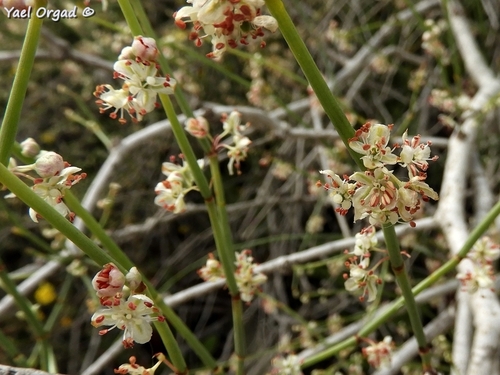
Polygonum convolvulus
L.
Black Bindweed

Brigham Young University

US Forest Service - Tonto National Forest (USFS-TNF)

Utah State University
What to Eat
Edible parts: Seed
Seed - ground into a powder and used as a gruel or mixed with cereals. The seed coat should be removed before use, this has caused mechanical injury to the digestive systems of animals who have eaten the seed. The seed is rather small and fiddly to utilize.
Known Hazards
Where to Find It
Europe, including Britain, from Norway south and east to N. Africa and temperate Asia.
TEMPERATE ASIA: Afghanistan, Cyprus, Iran, Israel, Jordan, Lebanon, Syria, Turkey, Russian Federation-Ciscaucasia (Ciscaucasia), Armenia, Azerbaijan, Georgia, Russian Federation (Dagestan), Russian Federation (Buryatia, Gorno-Altay, Tyva, Respublika, Yakutia-Sakha, Altay, Krasnoyarsk, Chita, Irkutsk, Kemerovskaja oblast, Kurganskaja oblast, Novosibirsk, Omsk, Tomsk, Tyumen), Kazakhstan, Kyrgyzstan, Tajikistan, Turkmenistan, Uzbekistan, Mongolia, Russian Federation (Kamcatskij kraj, Primorye, Sakhalin), China (Anhui Sheng, Gansu Sheng, Guizhou Sheng, Hebei Sheng, Heilongjiang Sheng, Henan Sheng, Hubei Sheng, Jiangsu Sheng, Jilin Sheng, Liaoning Sheng, Nei Mongol Zizhiqu, Ningxia Huizi Zizhiqu, Qinghai Sheng, Shaanxi Sheng, Shandong Sheng, Shanxi Sheng, Sichuan Sheng, Xinjiang Uygur Zizhiqu, Xizang Zizhiqu, Yunnan Sheng), Korea, Taiwan TROPICAL ASIA: Bhutan, India (north), Nepal, Pakistan EUROPE: Denmark, Finland, United Kingdom, Ireland, Norway, Sweden, Austria, Belgium, Switzerland, Czech Republic, Germany, Hungary, Netherlands, Poland, Slovakia, Russian Federation (European part), Belarus, Moldova, Ukraine (incl. Krym), Albania, Bulgaria, Bosnia and Herzegovina, Greece (incl. Crete), Croatia, Italy (incl. Sardinia, Sicily), North Macedonia, Malta, Montenegro, Romania, Serbia, Slovenia, Spain (incl. Baleares), France (incl. Corsica), Portugal AFRICA: Algeria, Egypt, Libya, Morocco
How to Identify
Polygonum convolvulus is a ANNUAL growing to 1.2 m (4ft). It is in flower from July to October. The species is hermaphrodite (has both male and female organs) and is pollinated by Insects. The plant is self-fertile. Suitable for: light (sandy), medium (loamy) and heavy (clay) soils. Suitable pH: mildly acid, neutral and basic (mildly alkaline) soils. It can grow in semi-shade (light woodland) or no shade. It prefers moist soil.
How to Grow
Succeeds in an ordinary garden soil but prefers a moisture retentive not too fertile soil in sun or part shade. A scrambling climbing plant, it is often a troublesome weed of agricultural fields. Plants seem to be immune to the predations of rabbits.
Propagation: Seed - sow spring in situ.