Euterpe edulis
Mart.
Assai palm, Jucara palm, Para palm
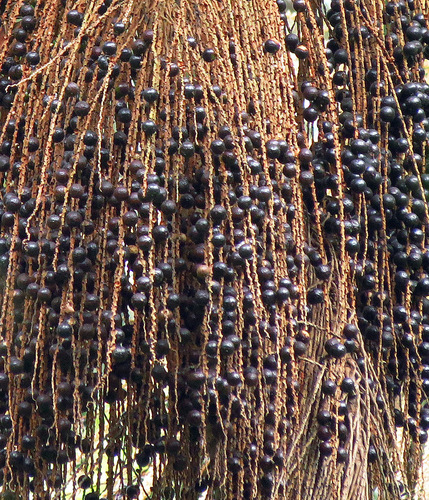
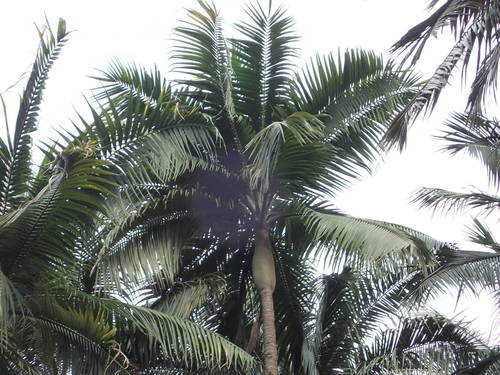
(c) Rodrigo Paiva Lázaro, some rights reserved (CC BY-NC), uploaded by Rodrigo Paiva Lázaro

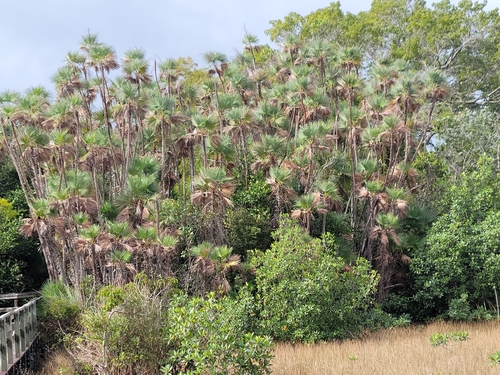
(c) Damon Tighe, some rights reserved (CC BY-NC), uploaded by Damon Tighe
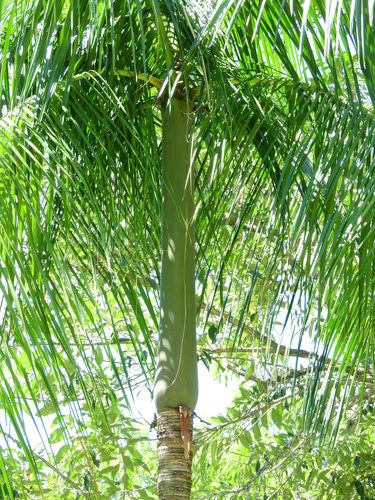
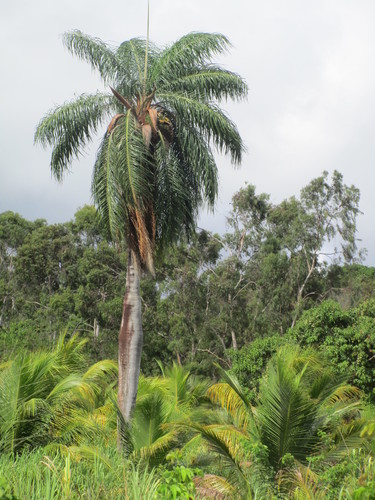
(c) Nelson Wisnik, some rights reserved (CC BY-NC), uploaded by Nelson Wisnik
What to Eat
Edible parts: Seeds, Fruit, Cabbage, Palm heart
The unexpanded leaves and crown bud are eaten raw or cooked — crunchy with a sweet flavour, they are considered a tropical delicacy and are sometimes called 'Millionaires salad' on account of their price. Harvesting them kills the plant, as it cannot produce side-shoots. The fruit, about 12mm in diameter, has a thin, fleshy, fibrous pulp and is made into a high-calorie juice or used in ice cream. The seeds can be crushed in water to produce a drink called Assai.
Where to Find It
A tropical plant. It suits the hot, wet tropical lowlands. It can grow under dark conditions. They suit subtropical and temperate locations. They like a rich, well-drained soil. It grows from sea level to 1,000 m altitude. It suits hardiness zones 11-12.
Asia, Australia, Argentina, Brazil*, Ecuador, Guyana, India, Malaysia, Paraguay, SE Asia, Singapore, South America, Sri Lanka,
How to Identify
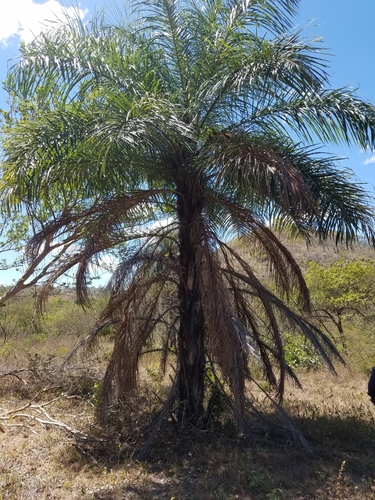
A tall palm. It grows to 10 m high. The trunk is slender. It is 12 cm across. The trunks are light grey or brown and has prominent rings of leaf base scars. These are darker and widely spaced. The crown-shaft is prominent. It is 1 m long. The leaves are dark green and have leaflets along the stalk. They are fine and feathery. They are crowded and drooping. The fruit are small, round and black to brown. They are 1-1.4 cm across. They droop in clusters below the crown-shaft.
Nutrition Score: 52/100
| Part | Moisture | kJ | kcal | Protein | Vit A | Vit C | Iron | Zinc |
|---|---|---|---|---|---|---|---|---|
| Fruit | 68.6 | 476 | 116 | 2.1 | — | 2.1 | 1.1 | 1 |
| Fruit | 90.2 | — | — | — | — | 186 | — | — |
How to Grow
A plant of moist tropical and subtropical climates, where it is found at elevations from sea level to around 1,200 metres. It grows in areas where the temperatures never fall below 10c, the average annual rainfall is 1,500mm or more and the driest month has 25mm or more rain. Grows best in a warm, sheltered, and moist site that is well drained. It likes filtered sunlight when young, but can take full sun as it matures. Prefers a pH in the range 4.5 - 5, tolerating 4.1 - 5.6. A fast-growing plant. Utilizing the plant for its edible apical bud always leads to its eventual death since the palm is unable to form side branches and thus is unable to grow any more. This has led to plant populations coming under pressure in some areas. Spacing: 6-8 ft. (1.8-2.4 m); 8-10 ft. (2.4-3 m); 10-12 ft. (3-3.6 m). They are grown commercially for palm hearts in Brazil.
Propagation: Seed viability is short — less than three months — so sow as soon as ripe in a partially shaded nursery seedbed. Pre-soak in cold water for 24 hours before sowing. Germination rates of around 80% or more can be expected, with sprouting occurring within 30–70 days. The seed germinates rapidly and grows quickly.
Medicinal Uses
The juice squeezed from the young stem is applied to wounds to stop bleeding.
Other Uses
The fruit has potential for producing alcohol as a petrol substitute. The wood is lightweight, hard, and long-lasting in dry conditions. Though of low overall quality, it is used locally in rural construction for rafters, beams, water troughs, and posts, and as a source of cellulose.
Wikipedia
Source ↗Euterpe edulis, commonly known as juçara, jussara (an archaic alternative spelling), açaí-do-sul or palmiteiro, is a palm species in the genus Euterpe. It is now predominantly used for hearts of palm. It is closely related to the açaí palm (Euterpe oleracea), a species cultivated for its fruit and superior hearts of palm. The larvae of Caligo brasiliensis are reported to feed on E. edulis. Although it was formerly widely harvested in Brazil for hearts of palm, it is now uncommon in the wild and no longer harvested commercially due to past overharvesting. This could cause it to fall extinct.
Production
Plants grow slowly. A tree produces about 1,200-2,500 seeds each year.
Other Information
They are grown commercially for palm hearts in Brazil.
Notes
There are between 7 and 18 Euterpe species. It has antioxidant properties.
Names & Synonyms
Acai-do-sul, Acaf, Coco-de-jissara, Coco-de-palmito, Coco-de-ripa, Coco-de-usara, Ensarova, Icara, Imi pu'e, Jacara, Jicara, Jocara, Jucura, Jucara-branca, Jucara-vermelho, Jucoara, Jussara palm, Palmeteiro-doce, Palmiteiro, Palmito-doce, Ripa, Ripeira, Ucara palm, Yayih
References (44)
- Ambasta, S.P. (Ed.), 2000, The Useful Plants of India. CSIR India. p 215
- Arora, R. K., 2014, Diversity in Underutilized Plant Species - An Asia-Pacific Perspective. Bioversity International. p 103
- Balick, M.J. and Beck, H.T., (Ed.), 1990, Useful palms of the World. A Synoptic Bibliography. Colombia p 81, 121, 159, 347, 396, 479, 561,
- Blomberry, A. & Rodd, T., 1982, Palms. An informative practical guide. Angus & Robertson. p 100
- Bortolotto, I. M., et al, 2018, Lista preliminar das plantas alimenticias nativas de Mato Grosso do Sul, Brasil. Iheringia, Serie Botanica, Porto Alegre, 73 (supl.):101-116
- Brack, P., et al, 2020, Frutas nativas do Rio Grande do Sul, Brasil: riqueza e potencial alimentício. Native fruits of Rio Grande do Sul, Brazil: richness and potential as food. Rodriguésia 71: e03102018.
- Brazil: Biodiversity for Food and Nutrition. http://www.b4fn.org/countries/brazil/
- Burkill, I.H., 1966, A Dictionary of the Economic Products of the Malay Peninsula. Ministry of Agriculture and Cooperatives, Kuala Lumpur, Malaysia. Vol 1 (A-H) p 1003
- Coradin, L. et al (Eds), 2011, Especies Nativas da Flora Brasileira de Valor Economico Atual ou Potencial. Brasilia MMA. p 1178
- Cundall, P., (ed.), 2004, Gardening Australia: flora: the gardener's bible. ABC Books. p 592
- Darley, J.J., 1993, Know and Enjoy Tropical Fruit. P & S Publishers. p 83
- De Castro, E. R., 2007, Fenologia reprodutiva do Palmito Euterpe edulis (Arecaceae) e sua influencia na abundancia de aves frugivoras na floresta Atlantica. Estado de Sao Paulo, Brasil.
- Etkin, N.L. (Ed.), 1994, Eating on the Wild Side, Univ. of Arizona. p 137, 157
- Facciola, S., 1998, Cornucopia 2: a Source Book of Edible Plants. Kampong Publications, p 28
- Fagg, C. W. et al, 2015, Useful Brazilian plants listed in the manuscripts and publications of the Scottish medic and naturalist George Gardner (1812–1849). Journal of Ethnopharmacology 161 (2015) 18–29
- Gibbons, M., 1993, Palms. Compact study Guide and Identifier. Sandstone. p 41
- Gibbons, M., 2003, A pocket guide to Palms. Chartwell Books. p 105
- Grandtner, M. M. & Chevrette, J., 2013, Dictionary of Trees, Volume 2: South America: Nomenclature, Taxonomy and Ecology. Academic Press p 246
- Haynes, J., & McLaughlin, J., 2000, Edible palms and Their Uses. University of Florida Fact sheet MCDE-00-50-1 p 6
- Hedrick, U.P., 1919, (Ed.), Sturtevant's edible plants of the world. p 304
- Henderson, A., Galeano, G and Bernal, R., 1995, Field Guide to the Palms of the Americas. Princeton. p 123
- Hibbert, M., 2002, The Aussie Plant Finder 2002, Florilegium. p 100
- Hist. nat. palm. 2:33, t. 32. 1824
- Hunter, D., et al, 2019, The potential of neglected and underutilized species for improving diets and nutrition. Planta (2019) 250:709-729
- Johnson, D.V., 1998, Tropical palms. Non-wood Forest products 10. FAO Rome. p 86, 122, 131
- Jones, D.L., 1994, Palms throughout the World. Smithtonian Institution, Washington. p 57, 214
- Jones, D.L., 2000, Palms of Australia 3rd edition. Reed/New Holland. p 157
- Kinupp, V. F., 2007, Plantas alimenticias nao-convencionais da regiao metropolitana de Porto Alegre, RS, Brazil p 63
- Kujawska, M. & Luczaj, L., 2015, Wild Edible Plants Used by the Polish Community in Misiones, Argentina. Human Ecology 43:855-869
- Leal, M. L. et al, 2018, Knowledge, use, and disuse of unconventional food plants. Journal of Ethnobiology and Ethnomedicine (2018) 14:6
- Lorenzi, H., 2002, Brazilian Trees. A Guide to the Identification and Cultivation of Brazilian Native Trees. Vol. 01 Nova Odessa, SP, Instituto Plantarum p 295
- Lorenzi, H., Bacher, L., Lacerda, M. & Sartori, S., 2006, Brazilian Fruits & Cultivated Exotics. Sao Paulo, Instituto Plantarum de Estuados da Flora Ltda. p 79
- Macmillan, H.F. (Revised Barlow, H.S., et al) 1991, Tropical Planting and Gardening. Sixth edition. Malayan Nature Society. Kuala Lumpur. p 346
- Martin, F.W. & Ruberte, R.M., 1979, Edible Leaves of the Tropics. Antillian College Press, Mayaguez, Puerto Rico. p 210
- Martins, R. C., et al, 2014, Use and Diversity of Palm (Arecaceae) Resources in Central Western Brazil. The Scientific World Journal.. Volume 2014, Article ID 942043
- Oliviera V. B., et al, 2012, Native foods from Brazilian biodiversity as a source of bioactive compounds. Food Research International 48 (2012) 170-179
- Recher, P, 2001, Fruit Spirit Botanical Gardens Plant Index. www.nrg.com.au/~recher/ seedlist.html p 7
- Riffle, R.L. & Craft, P., 2003, An Encyclopedia of Cultivated Palms. Timber Press. p 336
- Rufino, M. M. et al, 2010, Bioactive compounds and antioxidant capacities of 18 non-traditional tropical fruit from Brazil. Food Chemistry 121: 996-1002
- Schuler, S., (Ed.), 1977, Simon & Schuster's Guide to Trees. Simon & Schuster. No. 55
- USDA, ARS, National Genetic Resources Program. Germplasm Resources Information Network - (GRIN). [Online Database] National Germplasm Resources Laboratory, Beltsville, Maryland. Available: www.ars-grin.gov/cgi-bin/npgs/html/econ.pl (10 April 2000)
- Wiersema, J. H. & Leon, B., 2013, World Economic Plants. A Standard Reference CRC Press. 2nd Ed. p 297
- World Checklist of Useful Plant Species 2020. Royal Botanic Gardens, Kew
- www.colecionandofrutas.org