Euterpe oleracea
Mart.
Acai palm, Assai palm

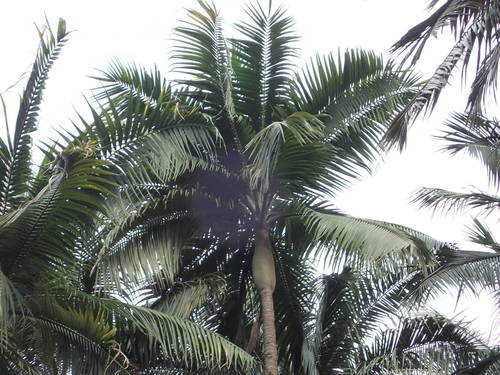
(c) Augusto Alves, some rights reserved (CC BY-NC), uploaded by Augusto Alves
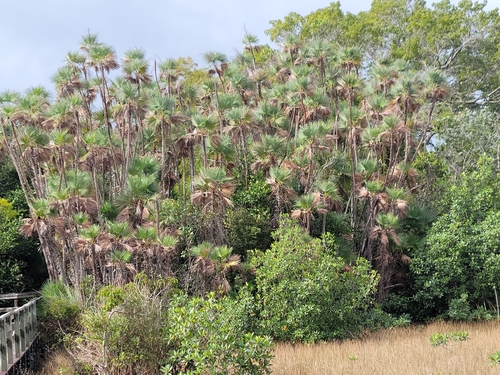
(c) Jason J. Dombroskie, some rights reserved (CC BY-NC)

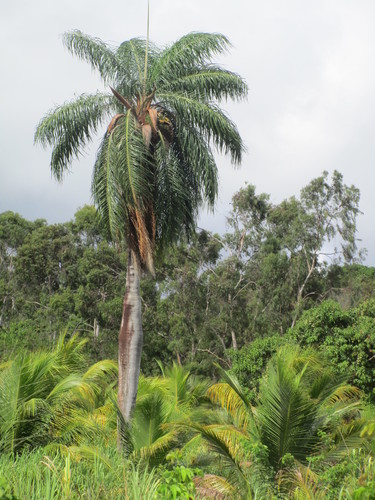
(c) Fernando, some rights reserved (CC BY-NC)
What to Eat
Edible parts: Cabbage, Fruit, Oil, Palm heart
The purplish-black fruit, around 15–25mm in diameter and borne in clusters of up to 1,000, has a thin, fibrous, fleshy pulp with little flavour on its own but is highly nutritious and rich in antioxidants. It is commonly processed into a drink popular in the Brazilian Amazon: the fruit is soaked in water to soften the outer shell, then squeezed and strained to produce a dense purple liquid served ice cold, with or without sugar and tapioca flour. This juice is also used to make ice cream, liquor, mousses, and other sweets, and is added to tapioca, cassava, and porridge. The unexpanded leaves and crown bud are eaten cooked — crunchy and sweet-flavoured, said to resemble artichokes. Harvesting the bud eventually kills that stem, though the plant can regrow from its base. An edible oil is also obtained from the seed.
Where to Find It
A tropical plant. It grows best in deep, rich soils. It can tolerate poor drainage. It often grows in swamps. It can grow in subtropical and tropical regions. It grows in areas with an annual average temperature of 26°C. The rainfall is 2750 mm per year. It suits hardiness zones 11-12. In XTBG Yunnan.
Amazon, Asia, Australia, Brazil*, Central America, China, Colombia, Costa Rica, Ecuador, French Guiana, Guianas, Guyana, Hawaii, Indonesia, Pacific, Panama, Peru, SE Asia, Singapore, South America, Suriname, Trinidad and Tobago, Venezuela,
How to Identify
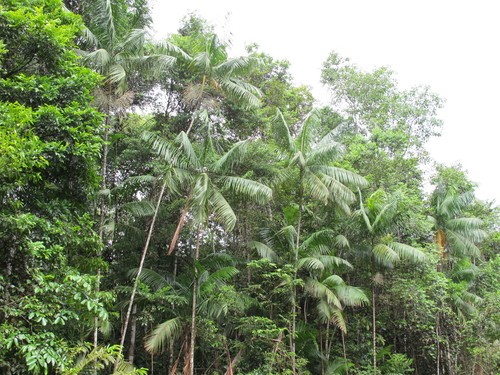
A solitary palm. It has a tall slender trunk. The trunk can be 25 m tall and 18 cm across. It can form clusters of up to 12 palms. The suckers develop at a late stage and can be suppressed while the main stalk develops. There are 8-12 leaves in each crown. The leaves are finely divided. The leaflets are about 1 m long. The leaflets droop. There are several flowering stalks. These are produced below the crown-shaft. The fruit are purplish-black. They are 1.5 cm across.
How to Grow
A plant of the moist to wet tropics, where it is found at elevations up to 3,000 metres. It grows best in areas where annual daytime temperatures are within the range 22 - 28°c, but can tolerate 16 - 32°c. It can be killed by temperatures of 5°c or lower. It prefers a mean annual rainfall in the range 1,800 - 2,300mm, but tolerates 1,200 - 3,000mm. Prefers a position sheltered from the sun with plenty of moisture. Mature plants should be able to tolerate full sun, so long as there is plenty of humidity. Prefers a rich, moist, well-drained soil. Prefers a pH in the range 5 - 5.5, tolerating 4.5 - 6.5. A moderately robust species, it usually produces multiple stems (up to 12 stems) though sometimes it only has one stem with a few suppressed suckers at the base. A fast-growing plant. Plants usually flower throughout the year but the fruit harvesting season is for only 6 months of the year.
Propagation: Seed viability is short — less than three months — so sow as soon as ripe in a partially shaded nursery seedbed. Pre-soak in cold water for 24 hours before sowing. Germination rates of around 80% or more can be expected, with sprouting occurring within 30–70 days. The seed germinates rapidly and grows quickly.
Medicinal Uses
A cold water infusion of the wood in the stem is used as an external wash for contraceptive purposes. The sap is styptic and is used to treat haemorrhages, scorpion bites, wounds, and cuts. A decoction of the leaves treats fevers, and an infusion of whole seedlings is used for shot wounds from hunting. The central bud, or heart, is roasted and applied topically to relieve scorpion sting pain; the juice from the roasted bud should be drunk at the same time. Overeating the heart or pith causes diarrhoea. The heart is also dried, pulverised, and used in a plaster to cicatrize open cuts, and the liquid extracted from the warmed heart is patted onto open wounds. The oil from the fruit treats diarrhoea. A tea from the roots is used to treat jaundice and strengthen the blood, while a tea from the seeds is used against fevers. Phenols occur in the heart of palm.
Other Uses
The leaves are used for weaving mats and similar items. The wood is moderately heavy, soft, splits easily, and has low durability when exposed to the elements. It is used locally for rustic buildings, rafters, and laths.
Wikipedia
Source ↗An evergreen tree reaching 25 m tall by 5 m wide with fast growth rate. Hardy to UK zone 10. Accommodates light sandy, medium loamy, and heavy clay soils with good drainage. Grows in semi-shade or full sun and prefers moist conditions. Suitable for mildly acid, neutral, and very acid soils.
Other Information
It is an important food in some areas in South America. The palm hearts are canned and the fruit used for acai wine.
Notes
There are between 7 and 18 Euterpe species. It possibly had benefits for obese people.
Names & Synonyms
Acai-do-para, Anare, Asai, Ceara, Huasai, Jucara, Manaka, Manicole, Naidi, Palem euterpe, Palmiche, Palmiteiro, Palmito acai, Para palm, Paraipaba, Pina palm, Pina, Pinot, Podo siri, Prasara, Ucai, Wasei
References (47)
- Balick, M.J. and Beck, H.T., (Ed.), 1990, Useful palms of the World. A Synoptic Bibliography. Colombia p 62, 63, 81, 121, 159, 208, 476, 561 (As Euterpe cuatrecasana),
- Blomberry, A. & Rodd, T., 1982, Palms. An informative practical guide. Angus & Robertson. p 100
- Brazil: Biodiversity for Food and Nutrition. http://www.b4fn.org/countries/brazil/
- Burkill, I.H., 1966, A Dictionary of the Economic Products of the Malay Peninsula. Ministry of Agriculture and Cooperatives, Kuala Lumpur, Malaysia. Vol 1 (A-H) p 1003
- Cundall, P., (ed.), 2004, Gardening Australia: flora: the gardener's bible. ABC Books. p 592
- Etkin, N.L. (Ed.), 1994, Eating on the Wild Side, Univ. of Arizona. p 121, 137
- Facciola, S., 1998, Cornucopia 2: a Source Book of Edible Plants. Kampong Publications, p 28
- Girones-Vilaplana, A., et al, 2012, New Beverages of Lemon Juice Enriched with the Exotic Berries Maqui, Acai, and Blackthorn: Bioactive Components and in Vitro Biological Properties. Journal of Agricultural and Food Chemistry. 60:6571-6580
- Grandtner, M. M., 2008, World Dictionary of Trees. Wood and Forest Science Department. Laval University, Quebec, Qc Canada. (Internet database http://www.wdt.qc.ca)
- Grandtner, M. M. & Chevrette, J., 2013, Dictionary of Trees, Volume 2: South America: Nomenclature, Taxonomy and Ecology. Academic Press p 246
- Hedrick, U.P., 1919, (Ed.), Sturtevant's edible plants of the world. p 304
- Henderson, A., Galeano, G and Bernal, R., 1995, Field Guide to the Palms of the Americas. Princeton. p 124
- Hermandez Bermejo, J.E., and Leon, J. (Eds.), 1994, Neglected Crops. 1492 from a different perspective. FAO Plant Production and Protection Series No 26. FAO, Rome. p18
- Hibbert, M., 2002, The Aussie Plant Finder 2002, Florilegium. p 100
- Hist. nat. palm. 2:29, t. 28-30. 1824
- Hunter, D., et al, 2019, The potential of neglected and underutilized species for improving diets and nutrition. Planta (2019) 250:709-729
- Janick, J. & Paul, R. E. (Eds.), 2008, The Encyclopedia of Fruit & Nuts. CABI p 127
- Johnson, D.V., 1998, Tropical palms. Non-wood Forest products 10. FAO Rome. p 93, 122, 131
- Johnson, M. and Colquhoun, A., 1996, Preliminary Ethnobotanical Survey of Kurupukari: An Amerindian Settlement of Central Guyana. Economic Botany, Vol. 50, No. 2, pp. 182-194
- Jones, D.L., 1994, Palms throughout the World. Smithtonian Institution, Washington. p 52, 57, 214
- Jones, D.L., 2000, Palms of Australia 3rd edition. Reed/New Holland. p 157
- Kew Plants of the World Online
- Leal, M. L. et al, 2018, Knowledge, use, and disuse of unconventional food plants. Journal of Ethnobiology and Ethnomedicine (2018) 14:6
- Lopez-Diago, D. & Garcia, N., 2021, Wild edible fruits of Colombia. Biota ColomBiana 22 (2) p 31
- Lorenzi, H., 2002, Brazilian Trees. A Guide to the Identification and Cultivation of Brazilian Native Trees. Vol. 01 Nova Odessa, SP, Instituto Plantarum p 296
- Lorenzi, H., Bacher, L., Lacerda, M. & Sartori, S., 2006, Brazilian Fruits & Cultivated Exotics. Sao Paulo, Instituto Plantarum de Estuados da Flora Ltda. p 80
- Maas, P.J. M., Non-Timber Forest Products of the North-West District of Guyana Part 2. The 85 most important NTFP species. p 94
- Macmillan, H.F. (Revised Barlow, H.S., et al) 1991, Tropical Planting and Gardening. Sixth edition. Malayan Nature Society. Kuala Lumpur. p 346
- Marcia, M. J., et al, 2011, Palm Uses in Northwestern South America: A Quantitative Review. Bot. Rev. (2011) 77:462-570
- Martin, F.W. & Ruberte, R.M., 1979, Edible Leaves of the Tropics. Antillian College Press, Mayaguez, Puerto Rico. p 96, 210
- Paz, F. S., et al, 2021, Edible Fruit Plant Species in the Amazon Forest Rely Mostly on Bees and Beetles as Pollinators. Journal of Economic Entomology, XX(XX), 2021, 1–13
- PROSEA handbook Volume 9 Plants yielding non-seed carbohydrates. p 188
- PROSEA (Plant Resources of South East Asia) handbook, Volume 2, 1991, Edible fruits and nuts.
- Riffle, R.L. & Craft, P., 2003, An Encyclopedia of Cultivated Palms. Timber Press. p 337
- Roa, J. A. G. & Boada, D. S. G., 2018, Fundación para el Fortalecimiento de la Fruticultura y Plantas Alimenticias no Convencionales en Colombia.
- Rufina, M. S. M., et al, 2009, Free radical-scavenging behaviour of some north-east Brazilian fruits in a DPPH system. Food Chemistry 114:693-695
- Rufino, M. M., et al, 2010, Bioactive compounds and antioxidant capacities of 18 non-traditional tropical fruit from Brazil. Food Chemistry 121: 996-1002
- Rufino, M. M., et al, 2009, Quality for fresh consumption and processing of some non-traditional tropical fruits from Brazil. Fruits, Vol. 64, p 361-370
- Smith, N., Mori, S.A., et al, 2004, Flowering Plants of the Neotropics. Princeton. p 418
- Sukarya, D. G., (Ed.) 2013, 3,500 Plant Species of the Botanic Gardens of Indonesia. LIPI p 779
- Torre, de la L., et al, 2008, Enciclopedia de las Plantas Útiles del Ecuador. Herbario QCA. Pontificia Universidad Católica del Ecuador. p 201
- Tomchinsky, B., et al, 2021, Food Composition Data: Edible Plants from the Amazon. in M. C. M. Jacob, U. P. Albuquerque (eds.), Local Food Plants of Brazil, Ethnobiology, Springer p 275
- Udani, J. K., et al, 2011, Effects of Acai (Euterpe oleracea Mart.) verry preparation on etabolic parameters in a healthy overweight population: A pilot study. Nutrition Journal. 10:45
- USDA, ARS, National Genetic Resources Program. Germplasm Resources Information Network - (GRIN). [Online Database] National Germplasm Resources Laboratory, Beltsville, Maryland. Available: www.ars-grin.gov/cgi-bin/npgs/html/econ.pl (10 April 2000)
- van Roosmalen, M.G.M., 1985, Fruits of the Guianan Flora. Utrecht Univ. & Wageningen Univ. p 349
- Villachica, H., (Ed.), 1996, Frutales Y hortalizas promisorios de la Amazonia. FAO, Lima. p 35
- World Checklist of Useful Plant Species 2020. Royal Botanic Gardens, Kew