Fagus lucida
Rehder. & E.H.Wilson.
Guang ye shui qing gang
(c) zhangqianyi, some rights reserved (CC BY-NC)

(c) yuu kii, some rights reserved (CC BY-NC)

(c) yuu kii, some rights reserved (CC BY-NC)
What to Eat
Edible parts: Coffee, Leaves, Oil, Seeds
Young leaves can be eaten raw and have a very nice mild flavour, though they turn tough quickly, so only the youngest should be used. New growth typically appears during two 3-week periods each year — once in spring and once in mid-summer. The seed can be eaten raw or cooked and is rich in oil, though it should not be eaten in large quantities. It can be dried and ground into a powder to use alongside cereal flours in bread, cakes, and similar baked goods. An edible semi-drying oil is obtained from the seed. The roasted seed makes a coffee substitute.
Known Hazards
Where to Find It
Temperate. In China it grows in forests on mountain slopes between 800-2000 m altitude. Arboretum Tasmania.
Asia, Australia, China, Tasmania,
How to Identify
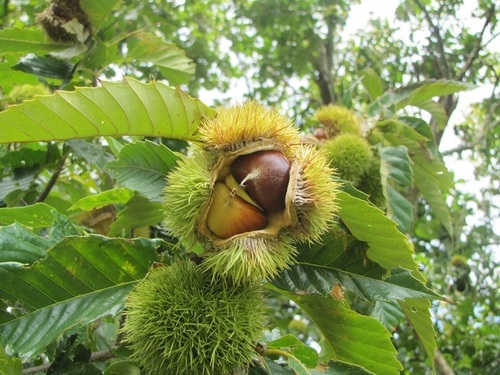
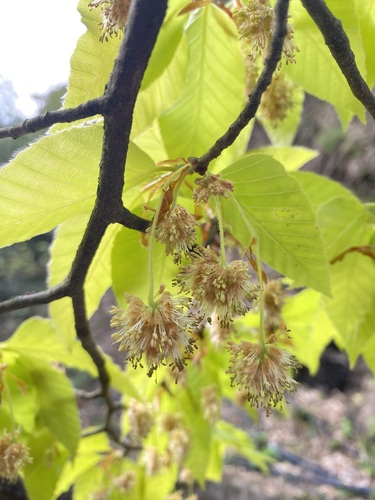
A tree. It grows up to 25 m tall. The leaf stalk is o.6-2 cm across. The leaf blade is oval and 5-11 cm long. It has silky hairs underneath near the veins. Leaves are bright green. The base is wedge shaped or rounded. The edges are slightly wavy. There are 8-12 secondary veins on each side of the midrib. These end in small teeth. The fruit stalk is 0.5-1.5 cm long. The cup is 1-1.5 cm across. The fruit is a nut.
How to Grow
Thrives on a light or medium soil, doing well on chalk, but ill-adapted for heavy wet soils. Young trees are very shade tolerant, but are subject to frost damage so are best grown in a woodland position which will protect them. Although very cold hardy, this species requires hotter summers than are normally experienced in Britain so is not usually a success here and is very slow growing. Trees have surface-feeding roots and also cast a dense shade. This greatly inhibits the growth of other plants and, especially where a number of the trees are growing together, the ground beneath them is often almost devoid of vegetation.
Propagation: Seed viability is short, so sow as soon as it is ripe in autumn in a cold frame, protecting it from mice. Seeds germinate in spring. Once large enough to handle, prick seedlings into individual pots and grow on in a greenhouse through at least their first winter, then plant out in late spring or early summer after the last expected frosts. Seedlings are slow-growing in the early years and very susceptible to late frost damage. Seed can also be sown in an outdoor seedbed in autumn; seedlings may remain in the open ground for up to three years before transplanting, though they do best moved to their final positions as soon as possible with some protection from spring frosts.
Medicinal Uses
None known.
Other Uses
An edible semi-drying oil is obtained from the seed.
Wikipedia
Source ↗Fagus lucida is a species of tree in the family Fagaceae. It is a tree up to 25 metres (82 ft) tall native to southern and eastern China. Seeds and young leaves are edible.
Notes
There are 10 Fagus species.
Names & Synonyms
References (3)
- Huang Chengjiu, Zhang Yongtian, Bartholomew, B., Fagaceae, Flora of China.
- Plants for a Future database, The Field, Penpol, Lostwithiel, Cornwall, PL22 0NG, UK. http://www.scs.leeds.ac.uk/pfaf/
- C. S. Sargent, Pl. wilson. 3:191. 1916
More from Fagaceae