Fagus orientalis
Lipsky
Oriental beech
(c) Houman Doroudi 𐏃𐎻𐎶𐎴 𐎯𐎽𐎮, some rights reserved (CC BY-NC)
(c) Nikita Tiunov, some rights reserved (CC BY-NC-SA)

(c) jimclark, some rights reserved (CC BY-NC)
What to Eat
Edible parts: Coffee, Leaves, Oil, Seeds, Nuts
Young leaves can be eaten raw and have a very nice mild flavour, though they turn tough quickly, so only the youngest should be used. New growth typically appears during two 3-week periods each year — once in spring and once in mid-summer. The seed can be eaten raw or cooked and is rich in oil, though it should not be eaten raw in large quantities. It can be dried and ground into a powder to use alongside cereal flours when making bread, cakes, and similar baked goods. An edible semi-drying oil is also obtained from the seed.
Known Hazards
Where to Find It
It is native to S.W. Asia and S.E. Europe. Temperate. It needs a warm climate. It suits hardiness zones 6-9. Arboretum Tasmania.
Armenia, Asia, Azerbaijan, Australia, Caucasus, Europe, Georgia, Greece, Iran, Mediterranean, Middle East, Tasmania, Turkey, Türkiye,
How to Identify
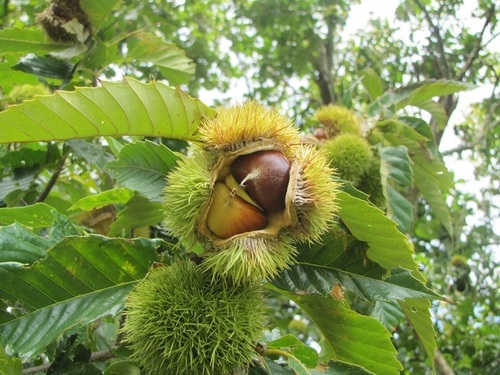
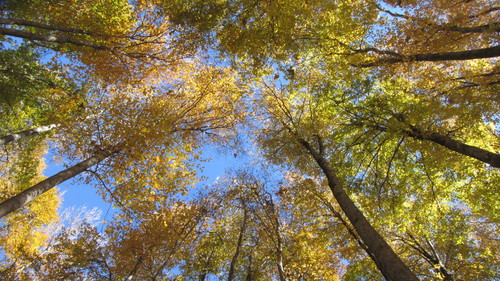
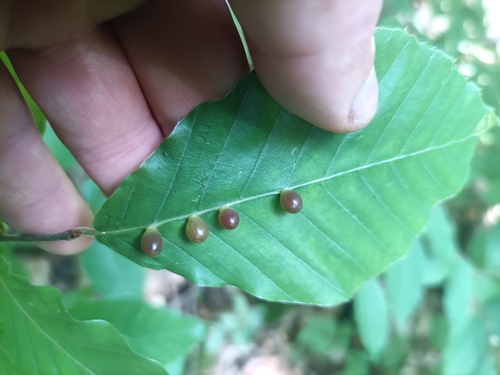
A deciduous tree. It can grow to 20-30 m high. It can spread to 15 m across. The bark is grey and smooth but sometimes with furrows. The leaves are longer than Fagus sylvatica. They are narrowly oval and 12 cm long by 6 cm wide. They have about 8-12 pairs of veins. They are dark green and smooth above and with silky hairs on the veins underneath. They turn brown in autumn. The male and female flowers occur in separate clusters on the same plant. Male are yellow and female are green. The fruit is a bristly husk 2.5 cm long. It splits open into 4 lobes. It encloses 1-3 seeds. They are small and edible.
How to Grow
Thrives on a light or medium soil, doing well on chalk, but ill-adapted for heavy wet soil. Fairly tolerant of most conditions, this is the most successful non-native species of Fagus in Britain. Young trees are very shade tolerant, but are subject to frost damage so are best grown in a woodland position which will protect them. Hybridizes in nature with F. sylvatica. Large mature trees at Kew produced a very good crop of seed in 1999. Trees have surface-feeding roots and also cast a dense shade. This greatly inhibits the growth of other plants and, especially where a number of the trees are growing together, the ground beneath them is often almost devoid of vegetation.
Propagation: Seed viability is short, so sow as soon as it is ripe in autumn in a cold frame, protecting it from mice. Seeds germinate in spring. Once large enough to handle, prick seedlings into individual pots and grow on in a greenhouse through at least their first winter, then plant out in late spring or early summer after the last expected frosts. Seedlings are slow-growing in the early years and very susceptible to late frost damage. Seed can also be sown in an outdoor seedbed in autumn; seedlings may remain in the open ground for up to three years before transplanting, though they do best moved to their final positions as soon as possible with some protection from spring frosts.
Medicinal Uses
None known.
Other Uses
An edible semi-drying oil is obtained from the seed.
Wikipedia
Source ↗Fagus orientalis, the Oriental beech, is a deciduous tree in the family Fagaceae. It is native to Thrace in the southeastern Balkans in Europe, and Turkey in Western Asia.
Production
It is fast growing.
Notes
There are 10 Fagus species.
Names & Synonyms
Chinariki, Hatchareni, Kayin, Ts'ipeli
References (17)
- Bussman, R. W., et al, 2016, A comparative ethnobotany of Khevsureti, Samtskhe-Javakheti, Tusheti, Svaneti, and Racha-Lechkhumi, Republic of Georgia (Sakartvelo), Caucasus. Journal of Ethnobiology and Ethnomedicine (2016) 12:4
- Bussman, R. W. et al, 2017, Ethnobotany of Samtskhe-Javakheti, Sakartvelo (Republic of Georgia), Caucasus. Indian Journal of Traditional Knowledge Vol. 16(1) pp 7-24
- Bussman, R. W., et al, 2021, Unity in diversity—food plants and fungi of Sakartvelo (Republic of Georgia), Caucasus. Journal of Ethnobiology and Ethnomedicine (2021) 17:72 p 7
- Bussman, R. W., et al, 2021, Unity in diversity—food plants and fungi of Sakartvelo (Republic of Georgia), Caucasus. Journal of Ethnobiology and Ethnomedicine (2021) 17:72 p 9
- Coombes, A.J., 2000, Trees. Dorling Kindersley Handbooks. p 151
- Cundall, P., (ed.), 2004, Gardening Australia: flora: the gardener's bible. ABC Books. p 596
- Ertug, F, Yenen Bitkiler. Resimli Türkiye Florası -I- Flora of Turkey - Ethnobotany supplement
- Etherington, K., & Imwold, D., (Eds), 2001, Botanica's Trees & Shrubs. The illustrated A-Z of over 8500 trees and shrubs. Random House, Australia. p 322
- Heywood, V.H., Brummitt, R.K., Culham, A., and Seberg, O. 2007, Flowering Plant Families of the World. Royal Botanical Gardens, Kew. p 148
- Nanagulyan, S., et al, 2020, Wild plants and fungi sold in the markets of Yerevan (Armenia). Journal of Ethnobiology and Ethnomedicine 16:26
- Pieroni, A., et al, 2020, Wild food plants traditionally gathered in central Armenia: archaic ingredients or future sustainable foods? Environment, Development and Sustainability. Springer p 8
- Plants for a Future database, The Field, Penpol, Lostwithiel, Cornwall, PL22 0NG, UK. http://www.scs.leeds.ac.uk/pfaf/
- Postman, J. D., et al, 2012, Recent NPGS Coordinated Expeditions in the Trans-Caucasus Region to Collect Wild Relatives of Temperate Fruit and Nut Crops. In Acta Horticulturae Number 948 p 191-198 (As Fagus sylvatica subsp. orientalis)
- Rivera, D. et al, 2006, Gathered Mediterranean Food Plants - Ethnobotanical Investigations and Historical Development, in Heinrich M, Müller WE, Galli C (eds): Local Mediterranean Food Plants and Nutraceuticals. Forum Nutr. Basel, Karger, 2006, vol 59, pp 18–74
- Sfikas, G., 1984, Trees and shrubs of Greece. Efstathiadis Group. Athens. p 156
- Trudy Imp. S.-Peterburgsk. Bot. Sada 14(2):300. 1898
- Young, J., (Ed.), 2001, Botanica's Pocket Trees and Shrubs. Random House. p 376
More from Fagaceae