Aiphanes minima
(Gaertn.) Burret
Coyure palm, Corozo, Macaw palm

(c) Magne Flåten, some rights reserved (CC BY-NC-SA), uploaded by Magne Flåten
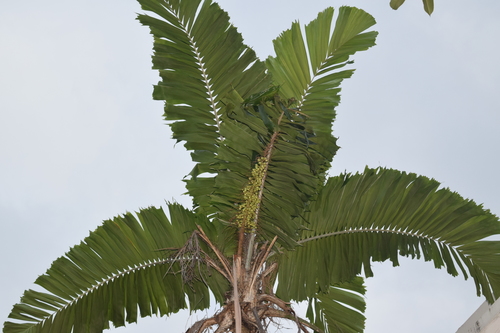
(c) Steve Maldonado Silvestrini, some rights reserved (CC BY-NC), uploaded by Steve Maldonado Silvestrini

(c) Steve Maldonado Silvestrini, some rights reserved (CC BY-NC), uploaded by Steve Maldonado Silvestrini
What to Eat
Edible parts: Fruit, Seeds
Aiphanes minima is widely planted as an ornamental. The endosperm of the seeds is edible and is similar in taste to that of a coconut.
Where to Find It
It is a tropical plant. They need organically rich soils. It grows in dense rainforests. It can grow in deep shade. It grows between 800-1700 m altitude. It suits hardiness zones 10-11.
Asia, Australia, Barbados, Caribbean, Central America, Dominica, Dominican Republic, Indonesia, Lesser Antilles, Martinique, Puerto Rico, SE Asia, St Lucia, Tropical America, West Indies*,
How to Identify
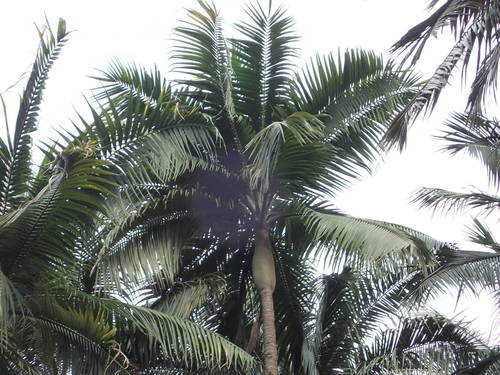
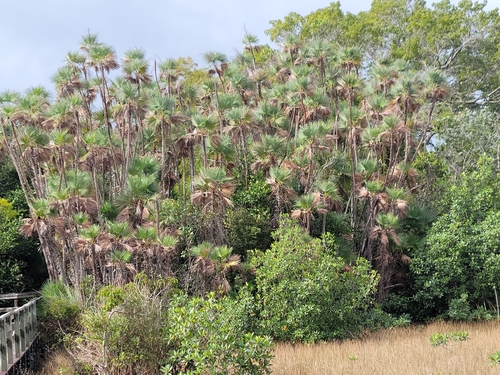
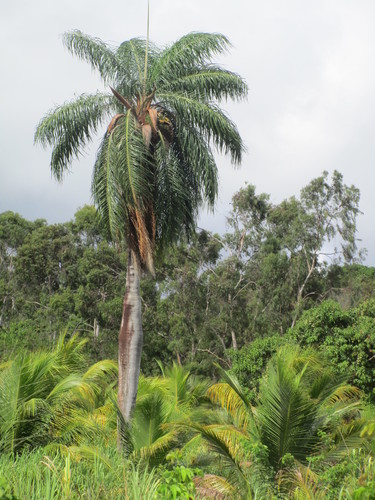
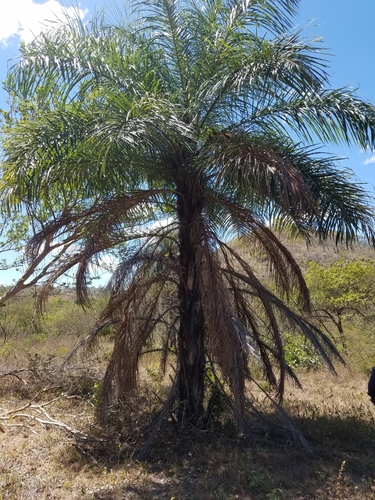
A single stemmed spiny palm. The trunk can be 8 m tall. It can be 13 cm across. The trunk has spines which point upwards. The leaves are feather-like. The leaves are 2 m long. There are about 40 leaflets. These are 50 cm long by 5 cm wide. The long narrow segments are irregular at the ends. There are black spines on both surfaces of the leaflets. They are bright green and glossy above and paler underneath. The outer edges are irregular. It has separate male and female flowers on the same plant. The flowers are cream and have a fragrance. The flowering stalk is a simple spike which hangs down. It is about 1 m long. There can be 1,700 fruit on a stalk. The fruit are round and red. They are about 1.5 cm across. The kernel is similar to a coconut and is thick, white and edible.
How to Grow
Plants are grown from seed. Seed germinate readily. Plants need protection from the sun when young.
Propagation: Seed - germinates easily when sown fresh.
Wikipedia
Source ↗Aiphanes minima is a spiny palm tree which is native to the insular Caribbean from Hispaniola to Grenada, and widely cultivated elsewhere. Usually 5–8 metres (16–26 ft) tall, it sometimes grows as an understorey tree and only 2 m (6.6 ft) in height.
Other Information
The fruit are especially eaten by children.
Notes
There are about 38 Aiphanes species. They grow in tropical America.
Names & Synonyms
Coyor, Grigri, Gwigwi, Palem makau
References (16)
- Borchsenius, F., and Bernal, R., 1996, Aiphanes (Palmae) Flora Neotropica. Vol. 70, pp 1-94.
- Fern, K., 2012, Tropical Species Database http://theferns.info/tropical/ (As Aiphanes acanthophylla)
- Grandtner, M. M., 2008, World Dictionary of Trees. Wood and Forest Science Department. Laval University, Quebec, Qc Canada. (Internet database http://www.WDT.QC.ca)
- Henderson, A., Galeano, G and Bernal, R., 1995, Field Guide to the Palms of the Americas. Princeton. p 174
- James, A., 2009, Notes on the Uses of Dominica's Native Palms. Palms, Vol. 53(2): p 62
- Jones, D.L., 2000, Palms of Australia 3rd edition. Reed/New Holland. p 113
- Jones, D.L., 1994, Palms throughout the World. Smithtonian Institution, Washington. p 122 (As Aiphanes luciana)
- Little, E. L. & Wadsworth, F. H., 1964, Common Trees of Puerto Rico and the Virgin Islands. USDA Agriculture Handbook No. 249 (As Aiphanes acanthophylla)
- Llamas, K.A., 2003, Tropical Flowering Plants. Timber Press. p 91
- Menninger, E.A., 1977, Edible Nuts of the World. Horticultural Books. Florida p 125
- Notizbl. Bot. Gart. Berlin-Dahlem 11:558. 1932
- Riffle, R.L. & Craft, P., 2003, An Encyclopedia of Cultivated Palms. Timber Press. p 24, 247
- Sukarya, D. G., (Ed.) 2013, 3,500 Plant Species of the Botanic Gardens of Indonesia. LIPI p 748
- Wickens, G.E., 1995, Edible Nuts. FAO Non-wood forest products. FAO, Rome. p 162
- Wiersema, J. H. & Leon, B., 2013, World Economic Plants. A Standard Reference CRC Press. 2nd Ed. p 29
- World Checklist of Useful Plant Species 2020. Royal Botanic Gardens, Kew