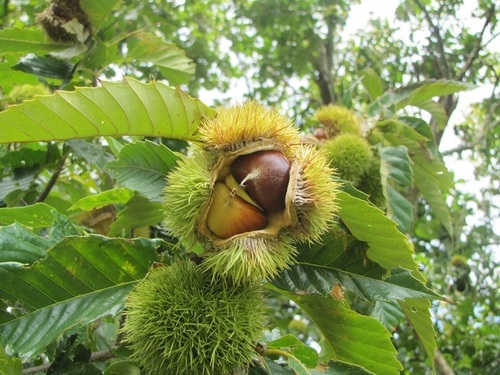
Fagus sylvatica
L.
Beech, European beech, English beech
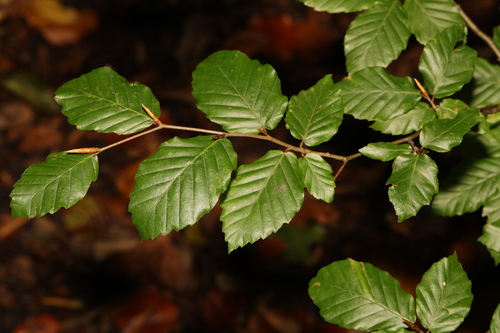
no rights reserved, uploaded by Stephen James McWilliam
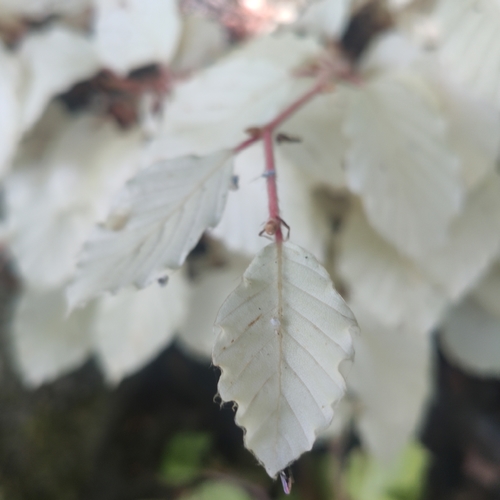
(c) kbs_64, some rights reserved (CC BY-NC)

(c) Jakob Fahr, some rights reserved (CC BY-NC), uploaded by Jakob Fahr
What to Eat
Edible parts: Nuts, Seeds, Leaves, Seeds - oil, Wood - flavouring, Sap, Flower buds
Young leaves are good eaten raw and work well in a mixed salad, though they become tough quickly, so only the youngest leaves should be picked. New growth typically appears during two 3-week periods each year — once in spring and once in mid-summer. The seed can be eaten raw or cooked and has a pleasant sweet flavour, though it is rather small and fiddly. It can also be dried and ground into a powder for use with cereal flours in bread, cakes, and similar baked goods. The seed is rich in oil and contains 17–20% of an edible semi-drying oil that stores well without going rancid and is considered equal in delicacy to olive oil; it is used as a salad dressing and for cooking. The seed should not be eaten in large quantities, as it contains a deleterious principle, and the seed residue is poisonous. The roasted seed is used as a coffee substitute.
Known Hazards
Where to Find It
It is a temperate plant. It is a native of Europe. It needs a well drained soil. It can grow in alkaline soils. It suits hardiness zones 5-9. Arboretum Tasmania. National Arboretum Canberra.
Albania, Australia, Balkans, Bosnia, Britain, Bulgaria, Czech Republic, Europe, France, Greece, Haiti, Hungary, India, Italy, Luxembourg, Macedonia, Mediterranean, Netherlands, Norway, North America, Norway, Romania, Scandinavia, Slovakia, Slovenia, Spain, Sweden, Switzerland, Tasmania, USA, West Indies,
How to Identify
A tall tree. It grows to 20-30 m high. It can spread 12-18 m wide. The bark is silver grey at maturity. The crown is dense, spreading and oval. The leaves are oval and young leaves are clear green then turn dark green before becoming golden then copper and brown. The leaves are 10 cm long by 6 cm wide. They have a short abrupt point. They have a wavy edge which may have small teeth. There are 5-8 side veins to the leaf. It loses its leaves during the year. The flowers are separately male and female. Male flowers are yellow and in drooping balls. The female flowers are greenish and in clusters. The nuts are small and triangular shaped. They are edible. There are many named varieties. There is a weeping variety of common beech. The branches are thick and hang down.
How to Grow
Thrives on a light or medium soil, doing well on chalk, but ill-adapted for a heavy wet soil. Prefers a calcareous soil but succeeds in acid soils though it does not make such a fine tree in such a situation. Succeeds in almost any soil and any pH, it is also very tolerant of a wide range of climatic conditions so long as there is sufficient rainfall. Established trees are drought tolerant. Very wind tolerant but dislikes salt. Trees are shallow rooted and this might make them less wind resistant. Trees have two growth periods a year, each of about 3 weeks in duration. The first is in spring around the end of April, the second is in summer, around the end of July. Trees are often slow growing and also can be very slow to establish after transplanting. However, in good conditions they are capable of growing up to a metre in a year. Young trees are very shade tolerant, but are subject to frost damage to their flowers and young leaves and so are best grown in a woodland position which will protect them. An important food plant for many caterpillars, it has 64 species of associated insects. Trees have a heavy canopy and cast a dense shade, very few other species can grow in a dense beech wood and on suitable soils it becomes the dominant species. Very intolerant of coppicing, trees producing none or only very weak growth afterwards and this is soon smothered by other plants. Plants are very tolerant of light pruning however and if this is carried out in late summer the plants will retain their dead leaves over winter. There are many named forms selected for their ornamental value. Those forms with purple leaves prefer a position in full sun whilst forms with yellow leaves prefer some shade. This species is notably resistant to honey fungus. A sprouting standard sending up shoots from the base.
Propagation: Seed viability is short, so sow as soon as it is ripe in autumn in a cold frame, protecting it from mice. Seeds germinate in spring. Once large enough to handle, prick seedlings into individual pots and grow on in a greenhouse through at least their first winter, then plant out in late spring or early summer after the last expected frosts. Seedlings are slow-growing in the early years and very susceptible to late frost damage. Seed can also be sown in an outdoor seedbed in autumn; seedlings may remain in the open ground for up to three years before transplanting, though they do best moved to their final positions as soon as possible with some protection from spring frosts.
Medicinal Uses
The bark is antacid, antipyretic, antiseptic, antitussive, expectorant, and odontalgic. A tar or creosote obtained by dry distillation of the branches is stimulating and antiseptic; it is used internally as a stimulating expectorant and externally as a treatment for various skin diseases. Pure creosote has been used to relieve toothache but should not be used without expert guidance. The plant is used in Bach flower remedies, with the prescribing keywords being 'Intolerance', 'Criticism', and 'Passing judgements'.
Other Uses
A semi-drying oil from the seed is used as a fuel for lighting, as a lubricant, and for polishing wood. Note that the seed residue is poisonous. Leaf buds harvested in winter and dried on their twigs can be used as toothpicks. Autumn-gathered leaves serve as a stuffing material for mattresses. The wood is hard, heavy, strong, and very durable, though it is not suited to outdoor use and is often attacked by a small beetle; uses include furniture, flooring, and turnery. It makes excellent fuel, burning with a lot of heat, and yields a charcoal known as 'Carbo Ligni Pulveratus'. The wood has also been used as a source of creosote, tar, methyl alcohol, and acetic acid. This plant acts as a dynamic accumulator, gathering minerals and nutrients from the soil and storing them in a more bioavailable form for use as fertilizer or to improve mulch.
Wikipedia
Source ↗Fagus sylvatica, the European beech or common beech, is a large deciduous tree in the beech family with smooth silvery-grey bark, large leaf area, and a short trunk with low branches. It is native to much of Europe, growing in humid climates. The species is cultivated as an ornamental. Although slightly toxic due to the tannins and alkaloids they contain, the nuts are consumed by animals and humans. The trees are also used for timber.
Production
Plants grow slowly. Grafted trees produce in 3-4 years. The nuts are collected after falling.
Other Information
The fruit are eaten by children.
Notes
There are 10 Fagus species.
Names & Synonyms
Ahu, Beuk, Bikfa, Bok, Buk, Bukev, Bukk, Bukva, Bukvica, Faggio, Faya, Haya, Hayuco, Majusfa, Pagoa
References (54)
- Abbet, C., et al, 2014, Ethnobotanical survey on wild alpine food plants in Lower and Central Valais (Switzerland). Journal of Ethnopharmacology 151 (2014) 624–634
- Ambasta, S.P. (Ed.), 2000, The Useful Plants of India. CSIR India. p 219
- Bremness, L., 1994, Herbs. Collins Eyewitness Handbooks. Harper Collins. p 55
- Brickell, C. (Ed.), 1999, The Royal Horticultural Society A-Z Encyclopedia of Garden Plants. Convent Garden Books. p 433
- Brown, D., 2002, The Royal Horticultural Society encyclopedia of Herbs and their uses. DK Books. p 212
- Crawford, M., 2012, How to grow Perennial Vegetables. Green Books. p 75
- Coombes, A.J., 2000, Trees. Dorling Kindersley Handbooks. p 152
- Cundall, P., (ed.), 2004, Gardening Australia: flora: the gardener's bible. ABC Books. p 596 (Also as Fagus sylvatica var. pendula)
- Denes, A., et al, 2012, Wild plants used for food by Hungarian ethnic groups living in the Carpathian Basin. Acta Societatis Botanicorum Poloniae 81 (4): 381-396
- Etherington, K., & Imwold, D., (Eds), 2001, Botanica's Trees & Shrubs. The illustrated A-Z of over 8500 trees and shrubs. Random House, Australia. p 322
- Facciola, S., 1998, Cornucopia 2: a Source Book of Edible Plants. Kampong Publications, p 115
- Flowerdew, B., 2000, Complete Fruit Book. Kyle Cathie Ltd., London. p
- Girard, N. J., 2020, Sustainable Foraging of Wild Edible Plants in Norway. A Biocultural Approach. M. Sc. thesis Norwegian University. p 131
- Glowinski, L., 1999, The Complete Book of Fruit Growing in Australia. Lothian. p 137
- Gouldstone, S., 1978, Australian and New Zealand Guide to food bearing plants. Books for Pleasure. p 44
- Gouldstone, S., 1983, Growing your own Food-bearing Plants in Australia. Macmillan p 135
- Harris, E & J., 1983, Field Guide to the Trees and Shrubs of Britain. Reader's Digest. p 72
- Hedrick, U.P., 1919, (Ed.), Sturtevant's edible plants of the world. p 305
- Hibbert, M., 2002, The Aussie Plant Finder 2002, Florilegium. p 101 (As Fagus sylvatica var. pendula)
- Irving, M., 2009, The Forager Handbook, A Guide to the Edible Plants of Britain. Ebury Press p 55
- Joyce, D., 1998, The Garden Plant Selector. Ryland, Peters and Small. p 111
- Kermath, B. M., et al, 2014, Food Plants in the Americas: A survey of the domesticated, cultivated and wild plants used for Human food in North, Central and South America and the Caribbean. On line draft. p 365
- Krochmal, A. & Krochmal, C., 1982, Uncultivated Nuts of The United States. United States Department of Agriculture Forest Service. p 22
- Little, E.L., 1980, National Audubon Society Field Guide to North American Trees. Alfred A. Knopf. p 381
- Lord, E.E., & Willis, J.H., 1999, Shrubs and Trees for Australian gardens. Lothian. p 55
- Luczaj, L., 2012, Ethnobotanical review of wild edible plants of Slovakia. Acta Societatis Botanicorum Poloniae 81(4):245-255
- Lyle, S., 2006, Discovering fruit and nuts. Land Links. p 201
- Mabey, R., 1973, Food for Free. A Guide to the edible wild plants of Britain, Collins. p 33, 83
- Menendez-Baceta, G., et al, 2012, Wild edible plants traditionally gathered in Gorbeialdea (Biscay, Basque Country) Genetic Resources and Crop Evolution 59:1329-1347
- Menninger, E.A., 1977, Edible Nuts of the World. Horticultural Books. Florida p 17
- Michael, P., 2007, Edible Wild Plants and Herbs. Grub Street. London. p 19
- Morley, B. & Everard, B., 1970, Wild Flowers of the World. Ebury press. Plate 12
- Nedelcheva A., 2013, An ethnobotanical study of wild edible plants in Bulgaria. EurAsian Journal of BioSciences 7, 77-94
- Paoletti, M.G., Dreon, A.L., and Lorenzoni, G.G., 1995, Pistic, Traditional Food from Western Friuli, NE Italy. Economic Botany 49(1) pp 26-30
- Pardo-de-Santayana, M., et al, 2005, The gathering and consumption of wild edible plants in the Campoo (Cantabria, Spain). International Journal of Food Sciences and Nutrition. 56(7): 529-542
- Pardo-de-Santayana, M., et al, 2007, Traditional knowledge of wild edible plants used in the northwest of the Iberian Peninsula (Spain and Portugal): a comparative study. Journal of Ethnobiology and Ethnomedicine 2007, 3:27
- Pieroni, A., 1999, Gathered wild food plants in the Upper Valley of the Serchio River (Garfagnana), Central Italy. Economic Botany 53(3) pp 327-341
- Pieroni, A. et al, 2013, One century later: the folk botanical knowledge of the last remaining Albanians of the upper Reka Valley, Mount Korab, Western Macedonia. Journal of Ethnobiology and Ethnomedicine. 9:22
- Pieroni, A. & Soukand, R., 2017, The disappearing wild food and medicinal plant knowledge in a few mountain villages of North-Eastern Albania. Journal of Applied Botany and Food Quality 90, 58 - 67
- Plants for a Future database, The Field, Penpol, Lostwithiel, Cornwall, PL22 0NG, UK. http://www.scs.leeds.ac.uk/pfaf/
- Plants of Haiti Smithsonian Institute http://botany.si.edu/antilles/West Indies
- Redzic, S. J., 2006, Wild Edible Plants and their Traditional Use in the Human Nutrition in Bosnia-Herzegovina. Ecology of Food and Nutrition, 45:189-232
- Ryan, S., 2008, Dicksonia. Rare Plants Manual. Hyland House. p 26
- Sansanelli, S., et al, 2014, Wild food plants traditionall consumed in the area of Bologna (Emilia Romagna region, Italy). Journal of Ethnobiology and Ethnomedicine 10:69
- Schuler, S., (Ed.), 1977, Simon & Schuster's Guide to Trees. Simon & Schuster. No. 110
- Sfikas, G., 1984, Trees and shrubs of Greece. Efstathiadis Group. Athens. p 156
- Simkova, K. et al, 2014, Ethnobotanical review of wild edible plants used in the Czech Republic. Journal of Applied Botany and Food Quality 88, 49-67
- Sp. pl. 2:998. 1753
- Svanberg, I. et al, 2012, Uses of tree saps in northern and eastern parts of Europe. Acta Societatis Botanicorum Poloniae 81 (4): 343-357
- Tardio, J., et al, Ethnobotanical review of wild edible plants in Spain. Botanical J. Linnean Soc. 152 (2006), 27-71
- van Wyk, B., 2005, Food Plants of the World. An illustrated guide. Timber press. p 153
- Vorstenbosch, T., et al, 2017, Famine food of vegetal origin consumed in the Netherlands during World War II. Journal of Ethnobiology and Ethnomedicine (2017) 13:63
- Wickens, G.E., 1995, Edible Nuts. FAO Non-wood forest products. FAO, Rome. p 125
- Young, J., (Ed.), 2001, Botanica's Pocket Trees and Shrubs. Random House. p 377
More from Fagaceae