Firmiana simplex
(L.) W. Wight.
Chinese parasol tree, Phoenix tree, Japanese varnish tree, Chinese bottle tree
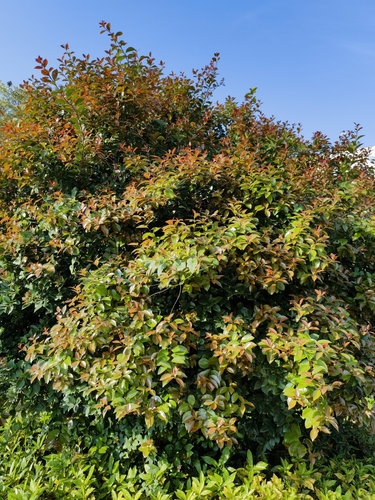
(c) 庄一晖, some rights reserved (CC BY-NC), uploaded by 庄一晖
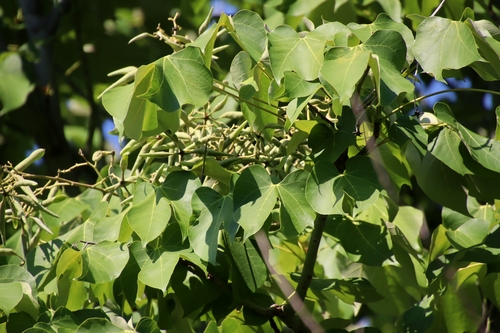
(c) Ron Stephens, some rights reserved (CC BY-NC), uploaded by Ron Stephens

(c) Milo Pyne, some rights reserved (CC BY-NC), uploaded by Milo Pyne
What to Eat
Edible parts: Seeds, Root tuber, Latex, Gum
The seeds are edible roasted and have an oily texture.
Where to Find It
It is a subtropical plant. It is native to E Asia. It can grow in light shade. It needs wind protection. It can tolerate salt spray. It can stand very light frosts. It is best in well drained loams. It can tolerate fairly acid or alkaline soils. It suits hardiness zones 7-10. Hobart Botanical Gardens. In Sichuan and Yunnan.
Africa, Asia, Australia, Britain, China*, Europe, Himalayas, India, Indochina, Japan, Korea, Malaysia, Myanmar, Nepal, North America, Pakistan, Philippines, SE Asia, Sri Lanka, Sudan, Taiwan, Tasmania, USA, Vietnam,
How to Identify
A tree. It can have several stems. It loses its leaves during the year. It grows to 20 m high. It spreads 10 m wide. It has smooth bark. It is green but ages to grey. The leaves have 3-7 lobes. They are arranged like fingers on a hand. They are 30 cm across. They turn soft yellow before falling. The flowers are small and cream. They are in large groups on the ends of branches and in the axils of leaves. The fruit are reddish, papery, leaf-like follicles. These split and expose the seeds before they drop.
Nutrition Score: 64/100
| Part | Moisture | kJ | kcal | Protein | Vit A | Vit C | Iron | Zinc |
|---|---|---|---|---|---|---|---|---|
| Seeds dried | 2.5 | 2228 | 533 | 20 | — | — | 4.8 | — |
How to Grow
Plants are grown from seed. The seed should be sown as soon as they ripen. The pulp should be washed from the seed. Seedlings should be grown for one year before planting out. They are easy to transplant. Trees should be spaced 6-10 m apart.
Propagation: Sow seed as soon as it is ripe in a warm greenhouse. Stored seed can be sown in early spring in a greenhouse and usually germinates within two months. Prick seedlings into individual pots once large enough to handle and grow on under glass for at least their first winter. Plant out into permanent positions in late spring or early summer after the last expected frosts, with some cold protection recommended for at least the first winter outdoors.
Medicinal Uses
The plant is astringent and used as a salve. The seed is antiphlogistic, expectorant, and refrigerant. A decoction of the roots is used to reduce swellings. A lotion made from the leaves is used in the treatment of carbuncles, haemorrhoids, and sores.
Other Uses
A fibre obtained by retting the bark is used for coarse cordage and cloth. A hair wash is made from the leaves and fibre. The wood is used for making furniture and coffins.
Wikipedia
Source ↗Firmiana simplex, commonly known as the Chinese parasol tree, or wutong (Chinese: 梧桐; pinyin: wútóng; jap.: godō), is a tree in the family Malvaceae, formerly in the family Sterculiaceae, in the order Malvales, and native to Asia. It grows up to 16 m (52 ft) tall.
Notes
There are 12 Firmiana species. Also put in the family Sterculiaceae.
Names & Synonyms
Kadaya, Kudal, Kullu, Kuthada, Sardol, Thondi, Vennaali, Wutong
References (23)
- Arinathan, V., et al, 2007, Wild edibles used by Palliyars of the western Ghats, Tamil Nadu. Indian Journal of Traditional Knowledge. 6(1) pp 163-168 (As Sterculia urens)
- Cundall, P., (ed.), 2004, Gardening Australia: flora: the gardener's bible. ABC Books. p 605
- Dobriyal, M. J. R. & Dobriyal, R., 2014, Non Wood Forest Produce an Option for Ethnic Food and Nutritional Security in India. Int. J. of Usuf. Mngt. 15(1):17-37 (As Sterculia urens)
- Etherington, K., & Imwold, D., (Eds), 2001, Botanica's Trees & Shrubs. The illustrated A-Z of over 8500 trees and shrubs. Random House, Australia. p 329
- Flora of Pakistan. www.eFloras.org
- Food Composition Tables for use in East Asia FAO http://www.fao.org/infoods/directory No. 331
- Hanelt, P. (Ed.), Mansfeld's Encyclopedia Vol. 4 (As Sterculia urens)
- Hibbert, M., 2002, The Aussie Plant Finder 2002, Florilegium. p 102
- Hu, Shiu-ying, 2005, Food Plants of China. The Chinese University Press. p 545
- Jadhav, R., et al, 2015, Forest Foods of Northern Western Ghats: Mode of Consumption, Nutrition and Availability. Asian Agri-History Vol. 19, No. 4: 293-317 (As Sterculia urens)
- Little, E.L., 1980, National Audubon Society Field Guide to North American Trees. Alfred A. Knopf. p 602
- Lord, E.E., & Willis, J.H., 1999, Shrubs and Trees for Australian gardens. Lothian. p 56
- Lyle, S., 2006, Discovering fruit and nuts. Land Links. p 208
- Pandy, R. K. & Saini, S. K., 2007, Edible plants of tropical forests among tribal communities of Madhya Pradesh. Indian Journal of Traditional Knowledge. 6(1), pp 185-190 (As Sterculia urens)
- Plants for a Future database, The Field, Penpol, Lostwithiel, Cornwall, PL22 0NG, UK. http://www.scs.leeds.ac.uk/pfaf/
- Ryan, S., 2008, Dicksonia. Rare Plants Manual. Hyland House. p 27
- Saidulu, P. et al, 2015, Ethnobotanical Knowledge Studied in Pocharam Wildlife Sanctuary, Telangana, India. Not Sci Biol, 2015, 7(2):164 -170
- Toppo, P. et al, 2016, Wild edible plants of Dhamtari district of Chhattisgarh, India. Van Sangyan Vol. 3, No. 4 (As Sterculia urens)
- U.S.D.A. Bur. Pl. Industr. Bull. 142:67. 1909
- Valder, P., 1999, The Garden Plants of China. Florilegium. p 286
- World Checklist of Useful Plant Species 2020. Royal Botanic Gardens, Kew
- www.worldagroforestrycentre.org/treedb/ (As Sterculia urens)
- Yesodharan, K. & Sujana, K. A., 2007, Wild edible plants traditionally used by the tribes in the Parambokulam Wildlife Sanctuary, Kerala, India. Natural Product Radiance 6(1) pp 74-80