Glycine max
(L.) Merr
Soybean, Soya
(c) 靜心耕食園, some rights reserved (CC BY-NC), uploaded by 靜心耕食園
no rights reserved, uploaded by 葉子

(c) Theo Crazzolara, some rights reserved (CC BY)
What to Eat
Edible parts: Seeds, Leaves, Spice, Vegetable
The mature seeds are a globally important source of oil and protein. They can be eaten whole in soups and stews, ground into flour for blending with cereal flours or making noodles, or roasted and ground into a nutty powder called 'Kinako' used in Japanese confections. Sprouted seeds are eaten raw or added to cooked dishes, and toasted seeds make a peanut-like snack. The seed is also fermented into foods such as miso and tempeh, and processed into soya milk — a valuable protein supplement in infant feeding that also yields curds and cheese. Seeds contain around 20% oil and 30–45% protein. All seeds on a plant mature at essentially the same time, accompanied by rapid leaf drop and stem drying. Average yield is about 1,700 kg/ha, with high-yielding cultivars under favourable conditions capable of more than doubling that figure. Immature seeds can be cooked like peas or eaten raw in salads. The strongly roasted, ground seeds serve as a coffee substitute. Young seedpods are cooked and used like French beans. An edible semi-drying oil extracted from the seeds is used in cooking, as a salad dressing, and in the manufacture of margarine and shortening. Young leaves can be eaten raw or cooked.
Known Hazards
Where to Find It
It is a temperate plant. It suits lowland areas. It can be grown from sea level to 2,100 m altitude. Many varieties will not flower in the tropics (short days). It needs fertile soil. The best soil acidity is pH 5.5 to 7.0. It is damaged by frost. In Nepal it grows to 1800 m altitude. It suits hardiness zones 7-8. In Yunnan.
Afghanistan, Africa, Angola, Argentina, Asia, Australia, Balkans, Bangladesh, Benin, Bhutan, Bolivia, Brazil, Bulgaria, Burkina Faso, Burundi, Cambodia, Cameroon, Canada, Caribbean, Caucasus, Central Africa, Central America, Central Asia, Chile, China, Colombia, Congo DR, Cook Islands, Côte d'Ivoire, Cuba, Czech Republic, Dominican Republic, East Africa, East Timor, Ecuador, Egypt, Ethiopia, Europe, Fiji, France, Georgia, Ghana, Guatemala, Guyana, Haiti, Hawaii, Himalayas, Hungary, India, Indochina, Indonesia, Iran, Iraq, Italy, Ivory Coast, Jamaica, Japan, Kazakhstan, Kenya, Korea, Kyrgyzstan, Laos, Liberia, Madagascar, Malawi, Malaysia, Manchuria, Mauritius, Mediterranean, Mexico, Middle East, Mongolia, Morocco, Mozambique, Myanmar, Nepal, New Zealand, Nigeria, North Africa, North America, Northeastern India, Pacific, Pakistan, Papua New Guinea, PNG, Paraguay, Peru, Philippines, Korea, Romania, Russia, Rwanda, SE Asia, Senegal, Serbia, Sikkim, Slovakia, Slovenia, South Africa, Southern Africa, South America, South Sudan, Spain, Sri Lanka, Sudan, Switzerland, Taiwan, Tajikistan, Tanzania, Tasmania, Thailand, Timor-Leste, Turkey, Türkiye, Uganda, Uruguay, USA, Venezuela, Vietnam, West Africa, West Indies, West Timor, Yugoslavia, Zambia, Zimbabwe,
How to Identify
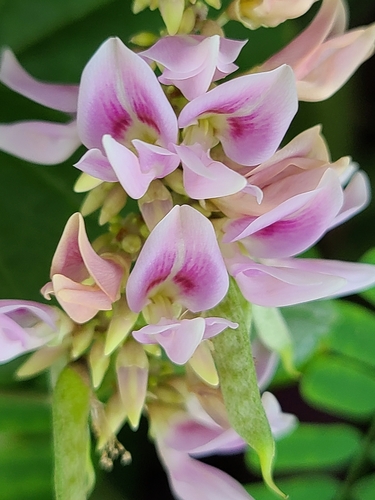
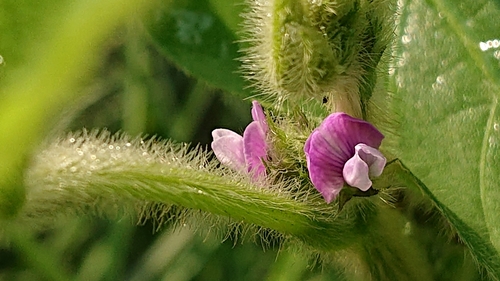
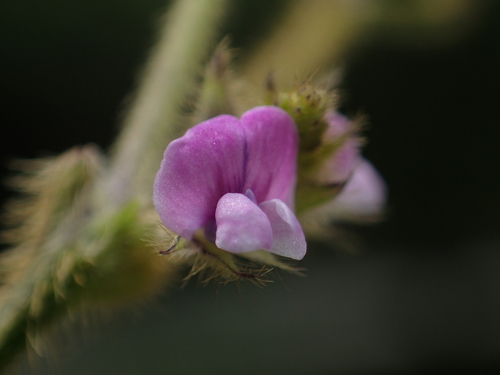
A small erect bean up to 60 cm tall. It grows each year from seed. Straggling kinds can occur. Stems, leaves and pods are softly hairy. The leaves have 3 leaflets. The leaflets have stalks. Flowers are small and white or blue. They occur in groups in the axils of leaves. The pods are broad, flat and hairy. Pods have 2-4 seeds. The seeds can be yellow to black.
Nutrition Score: 72/100
| Part | Moisture | kJ | kcal | Protein | Vit A | Vit C | Iron | Zinc |
|---|---|---|---|---|---|---|---|---|
| Seeds | 9 | 1701 | 407 | 33.7 | 55 | — | 6.1 | — |
| Immature Seeds | 68 | 584 | 140 | 13 | 16 | 27 | 3.8 | 0.9 |
| Seeds sprouted | 79.5 | 339 | 81 | 8.5 | 1 | 8.3 | 1.3 | 1 |
How to Grow
It is grown from seed. Seeds need to be inoculated with bacteria before planting. The correct one is Bradyrhizobium japonicum. Plants need to be about 20 cm apart.
Propagation: Pre-soak seed for 12 hours in warm water, then sow in early spring in a greenhouse at 12–16°C; germination should occur within two weeks. Once large enough to handle, prick seedlings out into individual pots and plant out in late spring or early summer after the last expected frosts. Seed can also be pre-soaked for 12 hours and sown in situ in late spring, though yields will be poor unless the summer is very hot.
Medicinal Uses
The fermented seed is weakly diaphoretic and stomachic, used to treat colds, fevers, headaches, insomnia, irritability, and a stuffy sensation in the chest. Bruised leaves are applied externally to snakebite. The flowers are used in treating blindness and opacity of the cornea. Stem ash is applied to granular haemorrhoids or fungal growths on the anus. Immature seedpods are chewed to a pulp and applied to corneal and smallpox ulcers. The seed is considered antidotal and is regarded as beneficial to the healthy functioning of the bowels, heart, kidneys, liver, and stomach. Seed sprouts are constructive, laxative, and resolvent, exhibiting oestrogen-like activity in the body as well as antispasmodic properties; they are used to treat oedema, dysuria, chest fullness, decreased perspiration, the initial stages of flu, and arthralgia. A decoction of the bark or root is astringent. Soybean diets are valued for treating acidosis. Because soybean oil has a high proportion of unsaturated fatty acids, it is recommended — alongside safflower and poppy seed oil — to combat hypercholesterolaemia. Commercial lecithin derived from soybean is reported to contain a potent vasopressor and is used medicinally as a lipotropic agent. Soybean is a major starting material for stigmasterol, once known as an antistiffness factor, and sitosterol, a soy by-product used to replace diosgenin in some antihypertensive drugs.
Other Uses
The seeds yield up to 20% of a semi-drying oil (described as non-drying in some reports) with a wide range of industrial applications, including the manufacture of paints, linoleum, oilcloth, printing inks, soap, insecticides, and disinfectants. Lecithin phospholipids, obtained as a by-product of oil processing, are used as wetting and stabilising agents in food, cosmetic, pharmaceutical, leather, paint, plastic, soap, and detergent industries. Both the meal and soybean protein are used in producing synthetic fibre, adhesives, textile sizing, waterproofing materials, fire-fighting foam, and many other products. The plant is sometimes grown as a green manure. The straw can be made into paper, which is stiffer than wheat straw paper. The plant is an excellent biomass source; seed oil can be used as a diesel fuel and the stems can be burnt as fuel.
Wikipedia
Source ↗An annual herb growing to 0.6 m tall, hardy to UK zone 8. Hermaphrodite flowers bloom July to September, pollinated by insects. Requires full sun and well-drained light sandy to medium loamy soil across mildly acidic to basic pH ranges. Prefers moist conditions and fixes nitrogen in soil.
Production
Plants flower about 8 weeks after sowing and pods mature about 16 weeks after sowing. Often plants are pulled up and hung up before threshing out the seed.
Other Information
These beans can be found in small amounts in many places throughout the country of Papua New Guinea. Soybean is a major food plant in warm temperate and subtropical zones. Over 100 million tons are produced each year. It is widely cultivated.
Notes
There are 10 Glycine species.
Names & Synonyms
Bekan, Ber-hrum, Bhatamas, Bhatmas, Da hou, Daizu, Dau-nanh, Dekeman, Edu mame, Feve de soja, Fore-keli Frijol soya, Gadele, Hak dau, Hsan-to-nouk, Huang dou, Jaa jang, Kacang kedalai, Kacang soya, Kachang bulu rimau, Kachang jepun, Kachang kedele, Kadele, Kedalai, Manchurian bean, Mao dau, Nga-see, Peayak, Pe-bok, Pe-ngapi, Sanndaek sieng, Soia, Soja bean, Sojabohne, Soya bean, Tai dau, Thua lueang, Tor nor klee, Tua luang, Utaw, Wong dau
References (82)
- Ambasta, S.P. (Ed.), 2000, The Useful Plants of India. CSIR India. p 239
- Anderson, E. F., 1993, Plants and people of the Golden Triangle. Dioscorides Press. p 212
- Bianchini, F., Corbetta, F., and Pistoia, M., 1975, Fruits of the Earth. Cassell. p 234 (As Soja hispida)
- Bremness, L., 1994, Herbs. Collins Eyewitness Handbooks. Harper Collins. p 251
- Brown, D., 2002, The Royal Horticultural Society encyclopedia of Herbs and their uses. DK Books. p 224
- Burkill, I.H., 1966, A Dictionary of the Economic Products of the Malay Peninsula. Ministry of Agriculture and Cooperatives, Kuala Lumpur, Malaysia. Vol 1 (A-H) p 1096
- Bussman, R. W., et al, 2016, A comparative ethnobotany of Khevsureti, Samtskhe-Javakheti, Tusheti, Svaneti, and Racha-Lechkhumi, Republic of Georgia (Sakartvelo), Caucasus. Journal of Ethnobiology and Ethnomedicine (2016) 12:4
- Bussman, R. W. et al, 2017, Ethnobotany of Samtskhe-Javakheti, Sakartvelo (Republic of Georgia), Caucasus. Indian Journal of Traditional Knowledge Vol. 16(1) pp 7-24
- Bussman, R. W., et al, 2021, Unity in diversity—food plants and fungi of Sakartvelo (Republic of Georgia), Caucasus. Journal of Ethnobiology and Ethnomedicine (2021) 17:72 p 9
- Cheifetz, A., (ed), 1999, 500 popular vegetables, herbs, fruits and nuts for Australian Gardeners. Random House p 68
- Chin, H. F., 1999, Malaysian Vegetables in Colour. Tropical Press. p 31
- Cobley, L.S. (rev. Steele, W.M.) 2nd Ed., 1976, An Introduction to the Botany of Tropical Crops. Longmans. p 85
- Creasy, R., 2000, The Edible Asian Garden. Periplus p 24
- Cundall, P., (ed.), 2004, Gardening Australia: flora: the gardener's bible. ABC Books. p 644
- Facciola, S., 1998, Cornucopia 2: a Source Book of Edible Plants. Kampong Publications, p 105
- Flora of Pakistan. www.eFloras.org
- Foo, J.T.S.(ed), 1996, A Guide to Common Vegetables. Singapore Science Foundation. p 84
- Fox, F. W. & Young, M. E. N., 1982, Food from the Veld. Delta Books. p 226
- French, B.R., 1986, Food Plants of Papua New Guinea, A Compendium. Asia Pacific Science Foundation p 39
- French, B.R., 2010, Food Plants of Solomon Islands. A Compendium. Food Plants International Inc. p 53
- Gangte, H. E., et al, 2013, Wild Edible Plants used by the Zou Tribe in Manipur, India. International Journal of Scientific and Research Publications, Volume 3, Issue 5
- Giller, K.E. & Dashiell, K.E., 2007. Glycine max (L.) Merr. [Internet] Record from Protabase. van der Vossen, H.A.M. & Mkamilo, G.S. (Editors). PROTA (Plant Resources of Tropical Africa), Wageningen, Netherlands. < http://database.prota.org/search.htm>. Accessed 16 October 2009.
- Grubben, G. J. H. and Denton, O. A. (eds), 2004, Plant Resources of Tropical Africa 2. Vegetables. PROTA, Wageningen, Netherlands. p 562
- Guite, C., 2016, A study of wild edible plants associated with the Paite tribe of Manipur, India, International Journal of Current Research. Vol. 8, Issue, 11, pp. 40927-40932
- Hedrick, U.P., 1919, (Ed.), Sturtevant's edible plants of the world. p 330 (As Glycine soja)
- http://palaeoworks.anu.edu.au/Nuno_PhD/04.pdf re Timor
- Hu, Shiu-ying, 2005, Food Plants of China. The Chinese University Press. p 474
- Hymowitz, T., 1979, Soybeans, in Simmonds N.W.,(ed), Crop Plant Evolution. Longmans. London. p 159
- Interpr. Herb. amboin. 274. 1917
- Jacquat, C., 1990, Plants from the Markets of Thailand. D.K. Book House p 49
- Jardin, C., 1970, List of Foods Used In Africa, FAO Nutrition Information Document Series No 2.p 25
- Jha, P. K., et al, 1996, Plant genetic resources of Nepal: A guide for plant breeders of agricultural, horticultural and forestry crops. Euphytica 87:189-210
- Khanal, R., et al, 2014, Documenting abundance and use of underutilized plant species in the mid hill region of Nepal. ECOPRINT 21: 63-71, 2014
- Kiple, K.F. & Ornelas, K.C., (eds), 2000, The Cambridge World History of Food. CUP p 434, 1855
- Kybal, J., 1980, Herbs and Spices, A Hamlyn Colour Guide, Hamlyn Sydney p 100
- Larkcom, J., 1991, Oriental Vegetables, John Murray, London, p 60
- Latham, P., 2004, Useful Plants of Bas-Congo province. Salvation Army & DFID p 139
- Lazarides, M. & Hince, B., 1993, Handbook of Economic Plants of Australia, CSIRO. p 122
- Macmillan, H.F. (Revised Barlow, H.S., et al) 1991, Tropical Planting and Gardening. Sixth edition. Malayan Nature Society. Kuala Lumpur. p 323
- Manandhar, N.P., 2002, Plants and People of Nepal. Timber Press. Portland, Oregon. p 247
- Martin, F.W. & Ruberte, R.M., 1979, Edible Leaves of the Tropics. Antillian College Press, Mayaguez, Puerto Rico. p 199
- Medhi, P. & Borthakur, S. K., 2012, Phytoresources from North Cachur Hills of Assam -3: Edible plants sold at Hflong market. Indian Journal or Natural Products and Resources. 3(1) pp 84-109
- Miguel, E., et al, 1989, A checklist of the cultivated plants of Cuba. Kulturpflanze 37. 1989, 211-357
- Molares, S. & Ladio, A., 2012, The Usefulness of Edible and Medicinal Fabaceae in Argentine and Chilean Patagonia: Environmental Availability and Other Sources of Supply. Evidence-Based Complementary and Alternative Medicine. Volume 2012, Article ID 901918, 12 pages, Hindawi Publishing Corporation.
- Mulherin, J., 1994, Spices and natural flavourings. Tiger Books, London. p 84
- Murtem, G. & Chaudhrey, P., 2016, An ethnobotanical note on wild edible plants of Upper Eastern Himalaya, India. Brazilian Journal of Biological Sciences, 2016, v. 3, no. 5, p. 63-81.
- Ochse, J.J. et al, 1931, Vegetables of the Dutch East Indies. Asher reprint. p 389 (As Glycine soja)
- Omawale, 1973, Guyana's edible plants. Guyana University, Georgetown p 108
- Owen, S., 1993, Indonesian Food and Cookery, INDIRA reprints. p 63
- Pham-Hoang Ho, 1999, An Illustrated Flora of Vietnam. Nha Xuat Ban Tre. p 949
- Phon, P., 2000, Plants used in Cambodia. © Pauline Dy Phon, Phnom Penh, Cambodia. p 318
- Plants for a Future database, The Field, Penpol, Lostwithiel, Cornwall, PL22 0NG, UK. http://www.scs.leeds.ac.uk/pfaf/
- Plants of Haiti Smithsonian Institute http://botany.si.edu/antilles/West Indies
- Purseglove, J.W., 1968, Tropical Crops Dicotyledons, Longmans. p 265
- Rashid, H. E., 1977, Geography of Bangladesh. Westview. p 262 (As Glycine hispida)
- Recher, P, 2001, Fruit Spirit Botanical Gardens Plant Index. www.nrg.com.au/~recher/ seedlist.html p 2
- Ruiters-Welcome, A. K., 2019, Food plants of southern Africa. Ph.D. thesis. Univ. of Johannesburg p 58
- Schneider, E., 2001, Vegetables from Amaranth to Zucchini: The essential reference. HarperCollins. p 66
- Segnon, A. C. & Achigan-Dako, E. G., 2014, Comparative analysis of diversity and utilization of edible plants in arid and semi-arid areas in Benin. Journal of Ethnobiology and Ethnomedicine 2014, 10:80
- Seidemann J., 2005, World Spice Plants. Economic Usage, Botany, Taxonomy. Springer. p 167
- Shah, S. K., 2014, Dietary contribution of underutilized minor crops and indigenous plants collected from uncultivated lands and forests in Nepal. in Promotion of Underutilized Indigenous Food Resources for Food Security and Nutrition in Asia and Pacific. FAO. Bangkok p 64
- Smith, A.C., 1985, Flora Vitiensis Nova, Lawaii, Kuai, Hawaii, Volume 3 p 229
- Solomon, C., 2001, Encyclopedia of Asian Food. New Holland. p 349
- Song, M., et al, 2013, Traditional knowledge of wild edible plants in Jeju Island, Korea. Indian Journal of Traditional Knowledge. 12(2) pp 177-194
- Staples, G.W. and Herbst, D.R., 2005, A tropical Garden Flora. Bishop Museum Press, Honolulu, Hawaii. p 318
- Sukenti, K., et al, 2016, Ethnobotanical study on local cuisine of the Sasak tribe in Lombok Island, Indonesia. Journal of Ethnic Foods. 3 (2016) 189-200 p 198
- Sutjaritjai, N., et al, 2019, Traditional Uses of Leguminosae among the Karen in Thailand. Plants 2019, 8, 600 p 7
- Terra, G.J.A., 1973, Tropical Vegetables. Communication 54e Royal Tropical Institute, Amsterdam, p 49
- Tindall, H.D., & Williams, J.T., 1977, Tropical Vegetables and their Genetic Resources, International Board for Plant Genetic Resources, Rome, p 77
- Tindall, H.D., 1983, Vegetables in the Tropics, Macmillan p 265
- Torre, de la, L., et al, 2008, Enciclopedia de las Plantas Útiles del Ecuador. Herbario QCA. Pontificia Universidad Católica del Ecuador. p 341
- USDA, ARS, National Genetic Resources Program. Germplasm Resources Information Network - (GRIN). [Online Database] National Germplasm Resources Laboratory, Beltsville, Maryland. Available: www.ars-grin.gov/cgi-bin/npgs/html/econ.pl (10 April 2000)
- van Wyk, B., 2005, Food Plants of the World. An illustrated guide. Timber press. p 201
- Verdcourt, B., 1979, Manual of New Guinea Legumes. Botany Bulletin No 11, Division of Botany, Lae, Papua New Guinea. p 492
- Vickery, M.L. and Vickery, B., 1979, Plant Products of Tropical Africa, Macmillan. p 23
- Welcome, A. K. & Van Wyk, B.-E., 2019, An inventory and analysis of the food plants of southern Africa. South African Journal of Botany 122 (2019) 136–179
- Wiersema, J. H. & Leon, B., 2013, World Economic Plants. A Standard Reference CRC Press. 2nd Ed. p 326
- Williams, C.N., Chew, W.Y., and Rajaratnam, J.A., 1989, Tree and Field Crops of the Wetter Regions of the Tropics. Longman, p 203
- Williamson, J., 2005, Useful Plants of Malawi. 3rd. Edition. Mdadzi Book Trust. p 122
- Woodward, P., 2000, Asian Herbs and Vegetables. Hyland House. p 75
- World Checklist of Useful Plant Species 2020. Royal Botanic Gardens, Kew
- Zeven, A. C. & de West, J. M. J., 1982, Dictionary of cultivated plants and their regions of diversity. Wageningen. p 40