Grewia flava
DC.
Brandy bush, Raisin bush

(c) gregorfeig, some rights reserved (CC BY-NC)
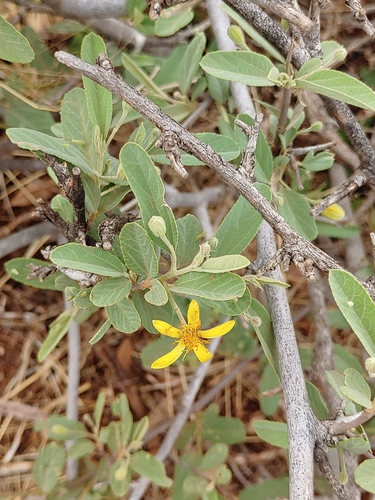
(c) Nadia van Zyl, some rights reserved (CC BY-NC), uploaded by Nadia van Zyl
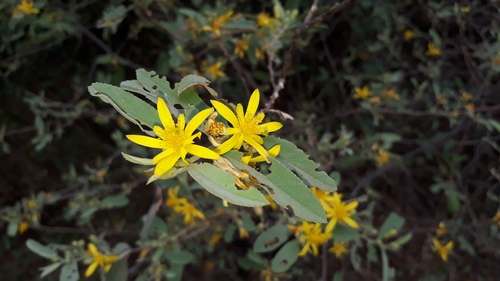
(c) Dewald du Plessis, some rights reserved (CC BY-NC), uploaded by Dewald du Plessis
What to Eat
Edible parts: Fruit, Leaves, Gum, Roots - coffee
The fruit are eaten fresh, pulped, made into porridge, jam, juice, brandy, and beer. They are also dried for storage and eaten with dried locusts. The leaves, gum, and roots (used as coffee) are also edible.
Known Hazards
Where to Find It
A tropical plant. It grows in dry bush regions. It is often on sandy or limestone soils. It is resistant to drought and frost. It grows in area with an annual rainfall between 50-600 mm. It grows between 150-1,830 m above sea level. It can grow in arid places.
Africa, Botswana, East Africa, Eswatini, Namibia, South Africa, Southern Africa, Swaziland, Zimbabwe,
How to Identify
A shrub which loses its leaves during the year. It is spreading, branched and twiggy. It can grow up to 4 m tall. Young branches are grey and hairy. The leaves are pale green and rough. They are 1.3-8 cm long and 2.5 cm wide. The tips are rounded and the base is narrowed. The base is unequal sided. The edges have fine teeth. The flowers are small and star shaped. They have narrow yellow petals. They are usually produced singly in the axils of leaves. The fruit have 1 or 2 lobes. They are hairy and red when ripe. They are edible.
Nutrition Score: 58/100
| Part | Moisture | kJ | kcal | Protein | Vit A | Vit C | Iron | Zinc |
|---|---|---|---|---|---|---|---|---|
| Fruit - dry | 9.6 | 1104 | 264 | 5 | — | — | 3.9 | 1.3 |
| Fruit | 74.7 | 377 | 90 | 2.1 | — | 29.4 | 1.2 | 0.6 |
How to Grow
Plants can be grown from seeds. Seeds must be cleaned and dried in the shade. They are soaked in hot water and left overnight. Seeds do not germinate easily. They take about 24 days to germinate. Seedlings should be transplanted at the 2 leaf stage.
Propagation: Seed - we have no specific information for this species but seed of this genus is generally best sown as soon as it is ripe. Stored seed has a hard seedcoat and may benefit from scarification before sowing in order to speed up and improve germination. This can usually be done by pouring a small amount of nearly boiling water on the seeds (being careful not to cook them!), allowing the mix to cool somewhat and then leaving it in a warm place to soak for 12 - 24 hours. Sow the seeds in situ or in a nursery seedbed or trays - do not allow the compost to become dry. Germination and early growth are usually quite quick. Cuttings - best taken with a heel.
Medicinal Uses
No medicinal uses mentioned in the data.
Other Uses
The tough bark is a source of fibre and is used for making baskets. The branchlets are used for making bowls, baskets & toothbrushes. The wood has several traditional uses, particularly for making bows and various tools.
Wikipedia
Source ↗Grewia flava, the brandy bush, wild currant, velvet raisin, or raisin tree, is a species of flowering plant in the family Malvaceae, native to southern Africa. A common shrub species, it is spreading into grasslands due to human rangeland management practices, and increasing rainfall. The berries, which are yellowish-brown and slightly lobed, are sweet and edible, but have little flesh and so are typically collected in large quantities to be eaten raw, dried or fermented into alcoholic beverages. The wood has a number of uses such as for making bows, knobkerries, traps and other tools. The desert truffle Kalaharituber pfeilii is often found in association with its roots.
Production
It is fast growing.
Other Information
It is a main food for Bushmen and Hottentots.
Notes
Fruit are high in sugar. There are about 200 Grewia species. They are mostly tropical. The fruit of most may be edible. The dried fruit are about 64% sugar and 4 % protein. These were in the Sparrmanniaceae and the Tiliaceae.
Names & Synonyms
Fluweelrosyntjie, Ini, Kxom, Liklolo, Meretlua, Moreeko, Moretlwa, Moretwa, Mpundu, Mukwane, Ngogo, Ulusizimezane, Umhlalophansi, Velvet raisin
References (41)
- Cat. pl. horti monsp. 113. 1813
- Exell, A.W. et al, (Ed), 1963, Flora Zambesiaca Vol 2 Part 1 Crown Agents, London. p 52
- FAO, 1988, Traditional Food Plants, FAO Food and Nutrition Paper 42. FAO Rome p 307
- Fox, F. W. & Young, M. E. N., 1982, Food from the Veld. Delta Books. p 351
- Grivetti, 1976, 1979,
- Grivetti, L. E., 1980, Agricultural development: present and potential role of edible wild plants. Part 2: Sub-Saharan Africa, Report to the Department of State Agency for International Development. p 79
- Heinz & Maguire, 1974,
- INFOODS:FAO/INFOODS Databases
- Jardin, C., 1970, List of Foods Used In Africa, FAO Nutrition Information Document Series No 2.p 140
- Joffe, P., 2007, Creative Gardening with Indigenous Plants. A South African Guide. Briza. p 190
- Lee, 1979,
- Leger, S., 1997, A Description of Today's Use of Plants in West Bushmanland (Namibia). German Development Service. PO Box 220035, 14061 Berlin, Germany. http://www.sigridleger.de/book/
- Long, C., 2005, Swaziland's Flora - siSwati names and Uses http://www.sntc.org.sz/flora/
- Maguire, 1978,
- Malan & Owen-Smith, 1974,
- Mannheimer, C. A. & Curtis. B.A. (eds), 2009, Le Roux and Muller's Field Guide to the Trees and Shrubs of Namibia. Windhoek: Macmillan Education Namibia. p 318
- Marshall, 1976,
- Motlhanka, D. M. T., et al, 2008, Edible Indigenous Fruit Plants of Eastern Botswana. International Journal of Poultry Science. 7(5): 457-460
- Neelo, J., et al, 2015, Ethnobotanical Survey of Woody Plants in Shorobe and Xobe Villages, Northwest Region of Botswana. Ethnobotany Research & Applications 14:367-379
- Neudeck, L. et al, 2012, The Contribution of Edible Wild Plants to Food Security, Dietary Diversity and Income of Households in Shorobe Village, Northern Botswana. Ethnobotany Research & Applications 10:449-462
- Palgrave, K.C., 1996, Trees of Southern Africa. Struik Publishers. p 570
- Palmer, E and Pitman, N., 1972, Trees of Southern Africa. Vol. 2. A.A. Balkema, Cape Town p 1438
- Peters, C. R., O'Brien, E. M., and Drummond, R.B., 1992, Edible Wild plants of Sub-saharan Africa. Kew. p 191
- Plowes, N. J. & Taylor, F. W., 1997, The Processing of Indigenous Fruits and other Wildfoods of Southern Africa. in Smartt, L. & Haq. (Eds) Domestication, Production and Utilization of New Crops. ICUC p 191
- Rodin, 1985,
- Roodt, V., 1998, Trees & Shrubs of the Okavango Delta. Medicinal Uses and Nutritional value. The Shell Field Guide Series: Part 1. Shell Botswana. p 77
- Royal Botanic Gardens, Kew (1999). Survey of Economic Plants for Arid and Semi-Arid Lands (SEPASAL) database. Published on the Internet; http://www.rbgkew.org.uk/ceb/sepasal/internet [Accessed 11th June 2011]
- Ruiters-Welcome, A. K., 2019, Food plants of southern Africa. Ph.D. thesis. Univ. of Johannesburg p 75
- Schmidt, E., Lotter, M., & McCleland, W., 2007, Trees and shrubs of Mpumalanga and Kruger National Park. Jacana Media p 402
- Silberbauer, 1965, 1981,
- Story, 1958,
- Swaziland's Flora Database http://www.sntc.org.sz/flora
- Tanaka, 1980,
- Tredgold, M.H., 1986, Food Plants of Zimbabwe. Mambo Press. p 70
- van Wyk, Be., & Gericke, N., 2007, People's plants. A Guide to Useful Plants of Southern Africa. Briza. p 44
- van Wyk, B, van Wyk, P, and van Wyk B., 2000, Photographic guide to Trees of Southern Africa. Briza. p 10, 165
- van Wyk, B-E., 2011, The potential of South African plants in the development of new food and beverage products. South African Journal of Botany 77 (2011) 857–868
- Venter, F & J., 2009, Making the most of Indigenous Trees. Briza. p 180
- Wehmeyer, A. S, 1986, Edible Wild Plants of Southern Africa. Data on the Nutrient Contents of over 300 species
- Welcome, A. K. & Van Wyk, B.-E., 2019, An inventory and analysis of the food plants of southern Africa. South African Journal of Botany 122 (2019) 136–179
- World Checklist of Useful Plant Species 2020. Royal Botanic Gardens, Kew