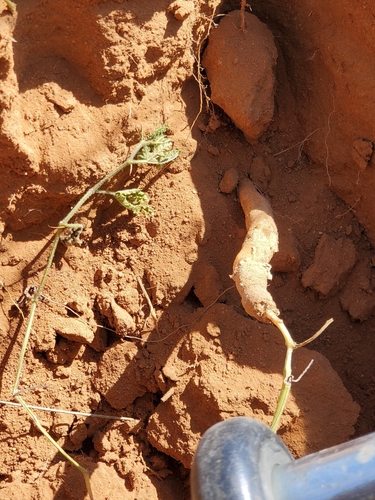
Gynostemma pentaphyllum
(Thunberg) Makino
Sweet tea vine

(c) Chen Shu, some rights reserved (CC BY-NC), uploaded by Chen Shu

(c) s921011tw, some rights reserved (CC BY-NC)
What to Eat
Edible parts: Leaves, Vegetable, Leaves - tea
The leaves and young stems are cooked and eaten as a vegetable. The leaves have a sweet taste and are also used to make tea.
Where to Find It
It is a temperate to tropical plant. It needs to be in moist, well-drained soil in part shade. It is a weed in northern China. In Yunnan. In Cairns BG.
Asia, Australia, China, Indochina, Japan*, Korea, Laos, Myanmar, SE Asia, Thailand, Vietnam,
How to Identify
A pumpkin family plant. It is an evergreen climber. The roots grow horizontally. The stems are 1 cm across. It has few branches. It has aerial roots. Each leaf has 3-7 sections spread out like fingers on a hand. The flowers are yellowish-white. The fruit are round and black. They are 6-8 mm across. The seeds are oval and 4 mm long. They have a wrinkled surface.
How to Grow
Plants are grown from seed. They need to be soaked for 24 hours before sowing.
Propagation: Pre-soak seed for 24 hours in warm water, then sow in spring in a rich compost in a greenhouse, placing 2–3 seeds per pot. Thin to the strongest seedling in each pot and grow on quickly. Plant out after the last expected frosts and protect with a frame or cloche until the plants are growing away well.
Medicinal Uses
The whole plant is a tonic herb that improves circulation, stimulates liver function, strengthens the immune and nervous systems, and reduces blood sugar and cholesterol levels. It also has sedative effects, relieving spasms and lowering blood pressure. It is used internally to treat nervous tension and exhaustion, peptic ulcer, asthma, bronchitis, diabetes, cardiovascular disease, and cancer. It was rated among the ten most important tonic herbs at a conference on traditional medicines in Beijing in 1991.
Other Uses
The plant is used in proprietary preparations for cosmetics and anti-ageing tonics.
Wikipedia
Source ↗Gynostemma pentaphyllum, also called jiaogulan (Chinese: 绞股蓝; pinyin: jiǎogǔlán; lit. 'twisting blue plant'), is a dioecious, herbaceous climbing vine of the family Cucurbitaceae (cucumber or gourd family) widely distributed in South and East Asia as well as New Guinea. Jiaogulan is used to make a sweet tea and is applied in Chinese traditional medicine.
Other Information
It is packed and exported. It is sold in local markets.
Names & Synonyms
Amacha-zuru, Amenggeichi, Co yem, Gai ya, Jiao gu lan, Jiaogulan, Kang reng, Lei ya zha kuo, Naiqmiqjavhhaq, Thutrang 5-la
References (15)
- Bot. Mag. (Tokyo) 16:179. 1902
- Brown, D., 2002, The Royal Horticultural Society encyclopedia of Herbs and their uses. DK Books. p 229
- Cao, Y., et al, 2020, Ethnobotanical study on wild edible plants used by three trans-boundary ethnic groups in Jiangcheng County, Pu’er, Southwest China. Journal of Ethnobiology and Ethnomedicine (2020) 16:66
- Cheng, Z., et al, 2022, Ethnobotanical study on wild edible plants used by Dulong people in northwestern Yunnan, China. Journal of Ethnobiology and Ethnomedicine (2022) 18:3
- Facciola, S., 1998, Cornucopia 2: a Source Book of Edible Plants. Kampong Publications, p 87
- Hani Medicine of Xishuangbanna, 1999, p 507
- Heywood, V.H., Brummitt, R.K., Culham, A., and Seberg, O. 2007, Flowering Plant Families of the World. Royal Botanical Gardens, Kew. p 117
- Hu, Shiu-ying, 2005, Food Plants of China. The Chinese University Press. p 703
- Kaewnarin, K., et al, 2014, Antioxidant and Antiglycation Activities of Some Edible and Medicinal Plants. Chiang Mai J. Sci. 2014; 41(1) : 105-116
- Kang, Y., et al, 2012, Wild food plants and wild edible fungi in two valleys on the Qinling Mountains (Shaanxi, central China) Journal of Ethnobiology and Ethnomedicine; 9:26
- Luo, B., et al, 2019, Wild edible plants collected by Hani from terraced rice paddy agroecosystem in Honghe Prefecture, Yunnan, China. Journal of Ethnobiology and Ethnomedicine 15:56
- Mueller, M., & Jungbauer, A., 2009, Culinary plants, herbs and spices - a rich source of PPARy ligands. Food Chemistry 117: 660-66
- Plants for a Future database, The Field, Penpol, Lostwithiel, Cornwall, PL22 0NG, UK. http://www.scs.leeds.ac.uk/pfaf/
- Tanaka,
- Xu, You-Kai, et al, 2004, Wild Vegetable Resources and Market Survey in Xishuangbanna, Southwest China. Economic Botany. 58(4): 647-667.