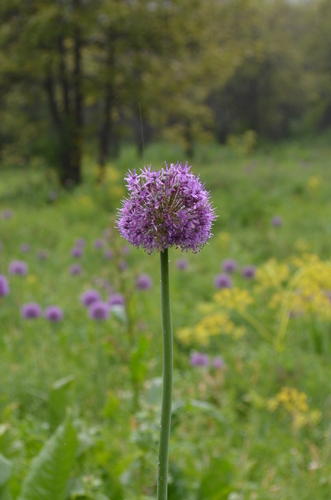
Allium synnotii
Kunth
Wild leek

iNaturalist · cc-by-nc
(c) Reuben Heydenrych, some rights reserved (CC BY-NC), uploaded by Reuben Heydenrych
(c) Reuben Heydenrych, some rights reserved (CC BY-NC), uploaded by Reuben Heydenrych

iNaturalist · cc-by-nc
(c) Reuben Heydenrych, some rights reserved (CC BY-NC), uploaded by Reuben Heydenrych
(c) Reuben Heydenrych, some rights reserved (CC BY-NC), uploaded by Reuben Heydenrych

iNaturalist · cc-by
(c) Kevin Murray, some rights reserved (CC BY), uploaded by Kevin Murray
(c) Kevin Murray, some rights reserved (CC BY), uploaded by Kevin Murray
What to Eat
Edible parts: Flowers, Leaves, Root, Bulb
The bulbs are eaten raw or cooked. The leaves are eaten raw or cooked. The flowers are used raw to flavour salads.
Where to Find It
It grows naturally in dry areas in South Africa from Clanwilliam to Riversdale and Long Kloof.
Africa, Europe, Norway, Scandinavia, South Africa, Southern Africa,
Countries: Andorra, Albania, Angola, Austria, Bosnia & Herzegovina, Belgium, Burkina Faso, Bulgaria, Burundi, Benin, Botswana, Belarus, Congo (DRC), Central African Republic, Congo (Republic), Switzerland, Cote d'Ivoire, Cameroon, Cape Verde, Cyprus, Czechia, Germany, Djibouti, Denmark, Algeria, Estonia, Egypt, Eritrea, Spain, Ethiopia, Finland, France, Gabon, United Kingdom, Ghana, Gambia, Guinea, Equatorial Guinea, Greece, Guinea-Bissau, Croatia, Hungary, Ireland, Iceland, Italy, Kenya, Comoros, Liechtenstein, Liberia, Lesotho, Lithuania, Luxembourg, Latvia, Libya, Morocco, Monaco, Moldova, Montenegro, Madagascar, North Macedonia, Mali, Mauritania, Malta, Mauritius, Malawi, Mozambique, Namibia, Niger, Nigeria, Netherlands, Norway, Poland, Portugal, Romania, Serbia, Russia, Rwanda, Seychelles, Sudan, Sweden, Slovenia, Slovakia, Sierra Leone, San Marino, Senegal, Somalia, South Sudan, Sao Tome & Principe, Eswatini, Chad, Togo, Tunisia, Tanzania, Ukraine, Uganda, South Africa, Zambia, Zimbabwe
How to Identify
An onion family bulb plant. It grows up to 60 cm high. It has a dense cluster of purple flowers.
How to Grow
It can be grown from seed or division of the bulbs. Bulbs should be planted fairly deeply.
Notes
There are about 300-700 Allium species. Most species of Allium are edible (Flora of China). All alliums are edible but they may not all be worth eating! They have also been put in the family Alliaceae.
Names & Synonyms
Allium dregeanum KunthAllium rotundum var. synnotii (G. Don) RegelAllium synnotianum Schult. & Schult.f.Alllium verrucosum G. Don
References (10)
- http://nordicfood lab/org/blog/2102/9/wild-edible-plants-an-overview (As Allium dregeanum)
- Peters, 1990, (As Allium dregeanum)
- Peters, C. R., O'Brien, E. M., and Drummond, R.B., 1992, Edible Wild plants of Sub-saharan Africa. Kew. p 8 (As Allium dregeanum)
- Plants for a Future database, The Field, Penpol, Lostwithiel, Cornwall, PL22 0NG, UK. http://www.scs.leeds.ac.uk/pfaf/ (As Allium dregeanum)
- Ruiters-Welcome, A. K., 2019, Food plants of southern Africa. Ph.D. thesis. Univ. of Johannesburg p 9
- van Wyk, Be., & Gericke, N., 2007, People's plants. A Guide to Useful Plants of Southern Africa. Briza. p 63 (As Allium dregeanum)
- van Wyk, B-E., 2011, The potential of South African plants in the development of new food and beverage products. South African Journal of Botany 77 (2011) 857–868 (As Allium dregeanum)
- Wehmeyer, A. S, 1986, Edible Wild Plants of Southern Africa. Data on the Nutrient Contents of over 300 species (As Allium dregeanum)
- Welcome, A. K. & Van Wyk, B.-E., 2019, An inventory and analysis of the food plants of southern Africa. South African Journal of Botany 122 (2019) 136–179
- World Checklist of Useful Plant Species 2020. Royal Botanic Gardens, Kew