Hemsleya amabilis
Diels
CucurbitaceaeSeeds/Nuts
iNaturalist · cc-by-nc
(c) 师傅, some rights reserved (CC BY-NC), uploaded by 师傅
(c) 师傅, some rights reserved (CC BY-NC), uploaded by 师傅

gbif · cc0
President and Fellows of Harvard College
President and Fellows of Harvard College
What to Eat
Edible parts: Seeds
The seeds are eaten.
Where to Find It
It is a temperate plant. It grows in forests between 1,800-c,000 m above sea level. In Sichuan and Yunnan.
Asia, China,
Countries: United Arab Emirates, Afghanistan, Armenia, Azerbaijan, Bangladesh, Bahrain, Brunei, Bhutan, China, Georgia, Indonesia, Israel, India, Iraq, Iran, Jordan, Japan, Kyrgyzstan, Cambodia, North Korea, South Korea, Kuwait, Kazakhstan, Laos, Lebanon, Sri Lanka, Myanmar, Mongolia, Maldives, Malaysia, Nepal, Oman, Philippines, Pakistan, Qatar, Saudi Arabia, Singapore, Syria, Thailand, Tajikistan, Timor-Leste, Turkmenistan, Turkey, Taiwan, Uzbekistan, Vietnam, Yemen
How to Identify
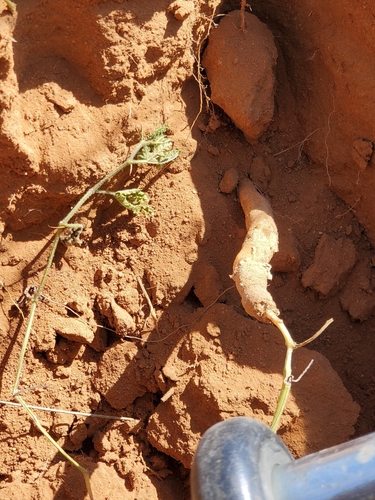
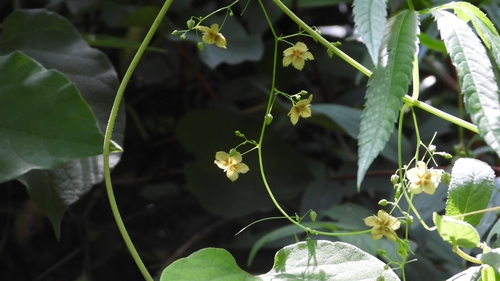
A herb. It keeps growing from year to year. It has an enlarged root tuber. It is oval. The stems and branches are very slender. It has tendrils 8-12 cm long. The leaves have 5-9 leaflets. The leaflets are narrowly sword shaped and 4-5 cm long by 1-2 cm wide. Male and female flowers are separate. The fruit is round and 12-20 mm across. The seeds are dark brown and 6-8 mm long by 5-7 mm wide.
References (2)
- Notes Roy. Bot. Gard. Edinburgh 5:106. 1912
- Yang, Si-Lin and Walters, T. W., 1992, Ethnobotany and the Economic role of the Cucurbitaceae of China. Economic Botany, Vol. 46, No. 4, pp. 349-367