Heritiera utilis
(Sprague) Sprague
Red Cedar, African almond
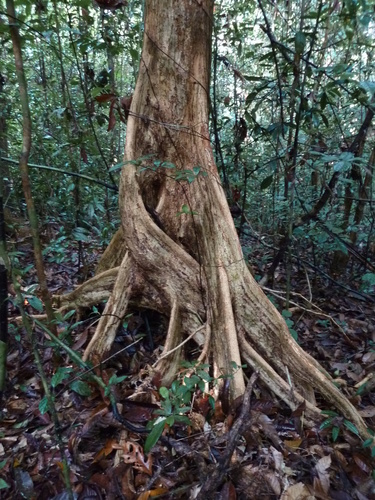
(c) Carel Jongkind, some rights reserved (CC BY-NC), uploaded by Carel Jongkind

Wikimedia Commons - Collector(s): Amarh, Amponsah

Wikimedia Commons - Jean-Pierre Chéreau & Roger Culos
What to Eat
Edible parts: Seeds - oil, Leaves, Fruit
The leaves are cooked and eaten. The seeds yield oil, and the fruit is also consumed.
Known Hazards
Where to Find It
A tropical plant. It grows in moist forests in West Africa. It needs light to grow well. It grows in regions with 1,500-2,500 mm of rain per year.
Africa, Côte d'Ivoire, Ghana, Ivory Coast, Liberia, Sierra Leone, West Africa,
How to Identify
A large tree. It grows 35 m tall. The trunk is crooked. It does not have branches for the first 20 m. It can be 150 cm or more across the trunk. It has high, thin buttresses. The crown is compact and rounded. The leaves are alternate. They can be simple or have lobes like the fingers on a hand. The leaf blade is 5-30 cm long and 2-10 cm wide if simple. There can be 5-7 leaflets. The flowers are of one sex. The male flowers are joined in a column while the female flowers are more loose. The fruit is 1-6 woody nuts. These are 2.5 cm long by 1.5 cm wide and have a large wing. The wing is 8 cm long by 3 cm wide. Probably now Tarrietia utilis
How to Grow
Plants grow from seeds. Seeds need to be planted fresh. They then germinate in 3-4 days. The seedlings have a taproot and side roots. Young leaves are simple and older leaves have 5 leaflets. Seedling leaflets are larger than mature leaflets.
Propagation: Seed - it has no dormancy and is best sown as soon as it is ripe. The seed is sown in a semi-shaded position in a nursery seedbed, leaving the wing protruding above soil level. Germination rates of 80% or more can be expected with the seeds sprouting in 3 - 14 days. Saplings are traditionally planted out when 18 - 30 months old and 1 - 1.5 metres tall, but increasingly they are being planted when 8 - 9 months old and 30 - 50cm tall. Pruning of lateral roots about one month before transplanting promotes the formation of a dense system of short lateral roots, enhancing the chance of successful establishment in the field.
Medicinal Uses
Traditional uses recorded but specific purposes not detailed in available data.
Other Uses
The bark contains tannins. The heartwood is pale pink to red-brown; it is usually distinctly demarcated from the 30 - 75mm wide band of whitish sapwood. The grain is interlocked, texture moderately coarse. The wood is oily to the touch, and there is a distinct silver grain. The wood is moderately heavy; shrinkage rates are moderately high; the timber dries fairly easy and fairly rapidly, but often with a tendency to twist and occasional end surface checking; once dry, it is moderately stable in service. The wood blunts edged tools moderately rapidly due to the presence of interlocked grain, and there is a risk of tearing in machining and of clogging due to the presence of resin. Filling is recommended to obtain a good finish. The nailing and screwing properties are good, although splitting may occur. Gluing does not cause problems. The bending properties are moderate, staining and polishing satisfactory. The heartwood is moderately durable. It is moderately resistant to fungi and termites, but resistant to dry-wood borers; the sapwood is liable to powder-post beetle attack. The heartwood is extremely resistant to preservative treatment. The wood is widely used for exterior and interior joinery, panelling, flooring, moulding, carpentry, furniture, cabinet work, stairs (inside), shipbuilding (planks, deck), and sliced veneer for interior and exterior faces of plywood. Locally, it is popular for making canoes, oars and planks for house building. It has been used for shingles.
Wikipedia
Source ↗Heritiera utilis is a species of flowering plant in the family Malvaceae (or Sterculiaceae). It is found in Ivory Coast, Gabon, Ghana, Liberia, and Sierra Leone. It is threatened by habitat loss.
Other Information
Seeds are sold in local markets,
Notes
There are about 35 Heritiera species. Also put in the family Sterculiaceae.
Names & Synonyms
Foe, Harmon, Kpanda, Niango, Niangon, Nyankom, Pableeyea, Whismore
References (15)
- Abbiw, D.K., 1990, Useful Plants of Ghana. West African uses of wild and cultivated plants. Intermediate Technology Publications and the Royal Botanic Gardens, Kew. p 49
- Adam, K.A., 2005. Heritiera utilis (Sprague) Sprague. [Internet] Record from Protabase. Louppe, D., Oteng-Amoako, A.A. & Brink, M. (Editors). PROTA (Plant Resources of Tropical Africa), Wageningen, Netherlands. < http://database.prota.org/search.htm>. Accessed 16 October 2009.
- Burkill, H. M., 1985, The useful plants of west tropical Africa, Vol. 5. Kew.
- Bull. Misc. Inform. Kew 1909:348. 1909
- Diop, A. l., et al, 2021, Cultural importance of wild edible plants in three sympatric communities: Agni, Akyé and Gwa in the Department of Alépé (Southeast of Côte d’Ivoire). Ethnobotany Research and Applications 22:35. p 7 (As Tarrietia utilis)
- FAO, 1998, Country Report Sierra Leone
- Hawthorne, W.& Marshall, C., 2013, Nimba Western Area Iron Ore Concentrator Mining Project Environmental and Social Impact Assessment. AcelorMittel Liberia. p 484
- Hwang, L. C., et al, 2020, Traditional Botanical Uses of Non-Timber Forest Products (NTFP) in Seven Counties in Liberia. ACS Symposium Series; American Chemical Society: Washington, DC, 2020.
- Jardin, C., 1970, List of Foods Used In Africa, FAO Nutrition Information Document Series No 2.p 43
- Jusu, A. & Cuni-Sanchez, A., 2017, Priority indigenous fruit trees in the African rainforest zone: insights from Sierra Leone. Genet Resour Crop Evol (2017) 64:745–760
- liberianfaunaflora.org Plant Atlas
- Polansky, C., 2018, Annex: Tree Identification and Propagation Images and text for 29 species found in Nimba County, Liberia. ACDI p 5
- Oteng-Amoako, A. A. (Ed.), 2006, 100 Tropical African Timber Trees from Ghana. Forestry Research Institute of Ghana. p 154
- Unwin, A. H., 1920, West African Forests and Forestry. Fisher Unwin Ltd. pdf on Internet p 64 (As Heritiera)
- World Checklist of Useful Plant Species 2020. Royal Botanic Gardens, Kew