Heterospathe philippinensis
Becc.
Sanakti

President and Fellows of Harvard College

President and Fellows of Harvard College

President and Fellows of Harvard College
What to Eat
Edible parts: Cabbage, Palm heart
The palm heart (cabbage) and the edible bud are cooked and eaten.
Where to Find It
It is a tropical and subtropical plant. It needs a shady position. They are widely distributed throughout the islands of the Philippines.
Asia, Australia, Pacific, Philippines, SE Asia,
How to Identify
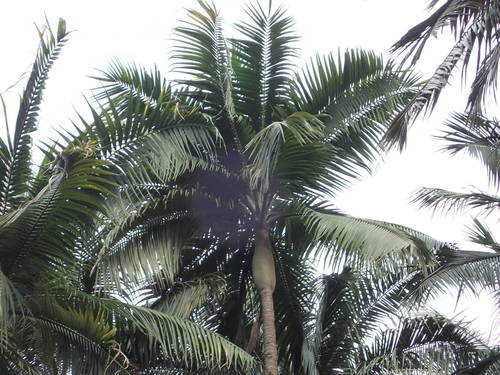
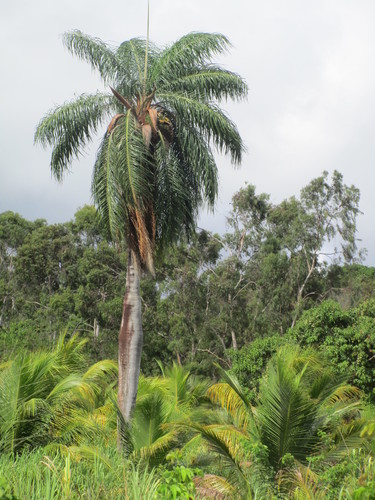
A small and slender palm 1 to 3 m high and 2 to 3 cm across the trunk. The leaves are divided into many leaflets. The largest leaflet is 25 to 30 cm long and 10 to 15 mm wide. The secondary nerves are faint. New leaves are pinkish bronze. The flower stalk has flowers along a central axis which is twice branched near the base and once branched near the tip. The fruit are oval and 10 to 11 mm long by 6 mm thick. They contract to a small point at the tip. The seed is oval and blunt.
Notes
There are about 32 Heterospathe species.
References (5)
- Hibbert, M., 2002, The Aussie Plant Finder 2002, Florilegium. p 138
- Jones, D.L., 1994, Palms throughout the World. Smithtonian Institution, Washington. p 222
- Monsalud, M.R., Tongacan, A.L., Lopez, F.R., & Lagrimas, M.Q., 1966, Edible Wild Plants in Philippine Forests. Philippine Journal of Science. p 526
- Riffle, R.L. & Craft, P., 2003, An Encyclopedia of Cultivated Palms. Timber Press. p 349
- World Checklist of Useful Plant Species 2020. Royal Botanic Gardens, Kew