Hibiscus cannabinus
L.
Vegetable kenaf, Indian hemp
(c) Wynand Uys, some rights reserved (CC BY), uploaded by Wynand Uys

(c) Frances Murray-Hudson, some rights reserved (CC BY-NC)

(c) Shin-Ming Ku, some rights reserved (CC BY-NC)
What to Eat
Edible parts: Leaves, Seeds, Pods, Fruit, Flowers, Seeds - oil, Bark, Gum, Vegetable
Young leaves are cooked and used as a potherb or added to soups. They have an acid, sorrel-like flavour. Seeds can be roasted or ground into flour and made into a type of cake. The root is edible but very fibrous, mucilaginous, and without much flavour. An edible oil is extracted from the seeds, with yields varying from 2 to 10 tonnes per hectare.
Where to Find It
A tropical plant. It is cultivated in S China. It can grow in well-drained sandy soils and in dry but seasonally waterlogged places. It grows between 15-2,130 m above sea level. It grows in areas with an annual rainfall between 500-635 mm. It can grow in arid places. It suits hardiness zones 10-12. In Yunnan.
Afghanistan, Africa, Angola, Asia, Australia, Bangladesh, Benin, Botswana, Burkina Faso, Burundi, Cameroon, Cape Verde, Central Africa, Central African Republic, CAR, Central America, Central Asia, Chad, China, Congo DR, Côte d'Ivoire, Dominican Republic, East Africa, Egypt, Eritrea, Eswatini, Ethiopia, Europe, Ghana, Greece, Guinea, Guinée, Guinea-Bissau, Haiti, Hungary, India, Indochina, Indonesia, Iran, Iraq, Ivory Coast, Jamaica, Kazakhstan, Kenya, Laos, Liberia, Madagascar, Malawi, Mali, Mediterranean, Middle East, Moldova, Mozambique, Myanmar, Namibia, Niger, Nigeria, Niue, North Africa, Northeastern India, Pakistan, Rwanda, Sahel, SE Asia, Senegal, Sierra Leone, Slovenia, Somalia, South Africa, Southern Africa, Sudan, Swaziland, Tanzania, Togo, Uganda, Ukraine, Vietnam, West Africa, West Indies, Zambia, Zimbabwe,
How to Identify
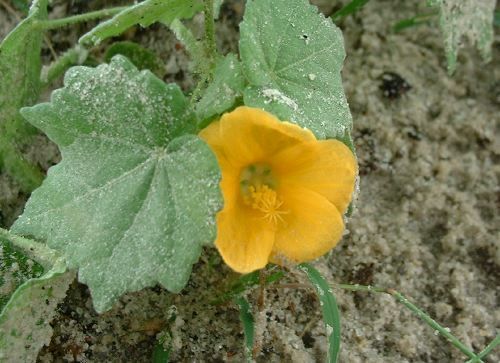
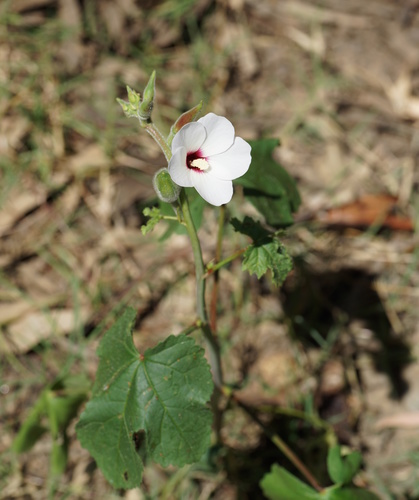
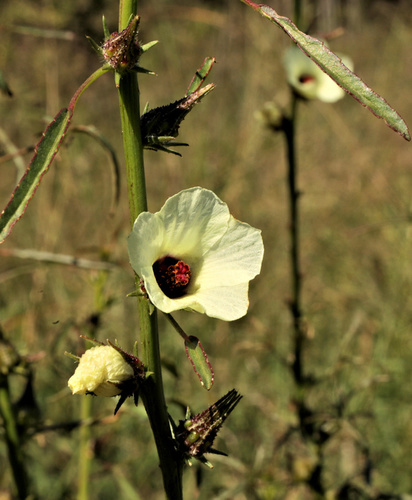
A herb. It can grow from seed each year or keep growing from year to year. It grows up to 3.5 m high. It has a few sharp spines. The leaf stalk is 6-20 cm long. The leaf blade has 2 forms. The leaves lower on the stem are heart shaped and those higher on the stem have 4-7 lobes arranged like fingers on a hand. These lobes are sword shaped and 2-12 cm long by 0.6-2 cm wide. They have teeth around the edge. They taper at the tip. The flowers are yellow, white or ivory and red at the base. They occur singly in the axils of leaves. They are large and up to 10 cm across. They have very short stalks. The fruit is a capsule about 1.5 cm across. The seeds are kidney shaped.
Nutrition Score: 63/100
| Part | Moisture | kJ | kcal | Protein | Vit A | Vit C | Iron | Zinc |
|---|---|---|---|---|---|---|---|---|
| Seeds dried | 8.1 | 1785 | 427 | 20.2 | — | — | — | — |
| Leaves | 79 | 280 | 67 | 5.5 | 34 | — | 12.1 | — |
How to Grow
Prefers a well-drained humus rich fertile soil in full sun. Tolerates most soils but prefers a light sandy soil. Plants are adapted to a wide range of soils and climatic conditions. Kenaf is reported to tolerate an annual precipitation in the range of 57 to 410cm, an annual temperature range of 11.1 to 27.5°C and a pH in the range of 4.3 to 8.2 (though it prefers neutral to slightly acid). The plant is frost-sensitive and damaged by heavy rains with strong winds. Kenaf is widely cultivated in tropical and subtropical areas of the world, where it is grown mainly as a fibre crop but also for its seeds and leaves. It is not very hardy outdoors in Britain; it requires a frost-free climate. It can, however, probably be grown as an annual. A fast-growing plant, it can be harvested in 3 - 4 months from seed. The plant requires temperatures in the range of 15 - 25°c. It succeeds as a crop as far north in N. America as Indiana, Iowa, Kansas and Nebraska. Plants are daylight sensitive, they remain vegetative and do not flower until the daylength is less than 12.5 hr/day. Two weeks of very cloudy days will induce flowering as daylength approaches 12.5 hr. The plant has a deep-penetrating taproot with deep-seated laterals. Plants, including any varieties, are partially self-fertile. Kenaf is typically harvested in late summer to early autumn when the plants reach maturity. Kenaf usually flowers in summer. Kenaf grows rapidly, reaching 2 to 3 meters (6 to 10 feet) within 4 to 5 months after planting.
Propagation: Sow seed in early spring in a warm greenhouse. Germination is usually fairly rapid. Prick seedlings into individual pots when large enough. For annual cultivation, plant out into permanent positions in early summer with frame or cloche protection until established. To grow as perennials, keep plants in the greenhouse through their first year and plant out in early summer of the following year. Take half-ripe cuttings in July or August in a frame, and overwinter in a warm greenhouse before planting out after the last expected frosts.
Medicinal Uses
The juice of the flowers, mixed with sugar and black pepper, is used to treat biliousness with acidity. The seeds are considered aphrodisiac and are added to the diet to promote weight gain. Externally, seeds are applied as a poultice for pains and bruises. The leaves are purgative, and a leaf infusion is used to treat coughs. In Ayurvedic medicine, the leaves are used for dysentery and bilious, blood, and throat disorders. Powdered leaves are applied to Guinea worms in Africa. Stem peelings have been used in the treatment of anaemia, fatigue, and lassitude.
Other Uses
Kenaf can be used for erosion control and as a cover crop to improve soil health. It accumulates minerals including selenium and boron and can be used as a bioremedial tool for removing these from contaminated soil. The stems yield a fibre that is a good jute substitute, though slightly coarser. Fibre strands measure 1.5–3 metres in length and are used for rope, cordage, canvas, sacking, carpet backing, nets, tablecloths, and similar products. For the best fibre quality, stems should be harvested shortly after flowering; the finest fibre comes from the base of the stems, so hand pulling is often preferred over machine harvesting. Average fibre yields are around 1.25 tonnes per hectare, though 2.7 tonnes has been achieved in Cuba. Stem pulp has been used in paper making. The seed contains 18–35% of a semi-drying oil similar to groundnut oil, used for burning, lubrication, soap making, and the production of linoleum, paints, and varnishes. Stems have been used as plant supports for runner beans. Soot from the stems provides a black pigment for dyes. The stem has also been used as a base for fire-drilling. Flowers attract bees, butterflies, and other pollinators with their nectar and pollen. The foliage provides habitat for beneficial insects, and leaf litter can serve as shelter for invertebrates.
Wikipedia
Source ↗Hibiscus cannabinus is a frost-tender annual or perennial growing rapidly to 1.8 m, hardy to UK zone 10. Hermaphroditic flowers appear August-September with seeds ripening October-November; insect pollination and self-fertility occur. The plant attracts wildlife, accommodates light sandy to heavy clay soils with good drainage, tolerates mildly acid to basic pH, requires full sun, and prefers moist conditions.
Other Information
Leaves are sold in markets. It is high yielding and popular.
Notes
There are about 220 Hibiscus species.
Names & Synonyms
Abirai, Amalakwang, Ambada, Ambadi, Ambari, Baguitche-de-mato, Bombajska konoplja, Da ma jin, Dare, Deccan Hemp, Ebirai, Egwanyira, Emalakany, Etoke, Folere-burure, Gamboor, Gaynaru, Gnilorbey, Gogu, Gonkura, Guinea hemp, Kanjaru, Kanuriya, Karkandji al goz, Kasini, Kikululu, Kolokondwe, Kudrum, Lubeera, Malakwang, Masinzia, Meseka tenga, Mestapat, N'coco, Nalita, Narcino-branco, Nsorogwe, Nyaduwa, Nyarogena, Ombira, Oseille indigene, Patsan, Paw sai, Pitwa, Pulichhai, Pulimanji, Pulupu kura, Pundi, Queque, Safed kudrum, Sankola, Sheria, Shougree, Sonkwe, Sosoori, Tid, Tisha, Umhlakanye, Usse, Wuya, Yeberha wayika
References (80)
- Altschul, S.V.R., 1973, Drugs and Foods from Little-known Plants. Notes in Harvard University Herbaria. Harvard Univ. Press. Massachusetts. no. 2757
- Amagloh, F. K. & Nyarko, E. S., 2012, Mineral Nutrient Content of Commonly Consumed Leafy Vegetables in Northern Ghana. African Hournal of Food, Agriculture, Nutrition and Development. Vol. 12(3): p 6397
- Ambasta, S.P. (Ed.), 2000, The Useful Plants of India. CSIR India. p 266
- Andabati, B., & Muyonga, J., 2014, Phenolic content and antioxidant activity of selected Ugandian traditional medicinal foods. African Journal of Food Science. 8(8), pp 427-434
- Anywar, G., et al, 2014, Wild Plants Used as Nutraceuticals from Nebbi District, Uganda. European Journal of medicinal Plants. 4(6):641-660
- Awas, T., 1997, A Study on the Ecology and Ethnobotany of Non-cultivated Food Plants and Wild Relatives of Cultivated crops in Gambella Region, Southwestern Ethiopia. Addis Ababa University. p 55
- Barua, U., et al, 2007, Wild edible plants of Majuli island and Darrang districts of Assam. Indian Journal of Traditional Knowledge 6(1) pp 191-194
- Batawila, K., et al, 2007, Diversite et gestion des legumes de cueillete au Togo. African Journal of Food, Agriculture, Nutrition and Development 7( 3& 4): 66
- Belem, M., et al, 2017, Strategy of Conservation and Protection of Wild Edible Plants Diversity in Burkina Faso. ANADOLU 27 (2) 2017, 82- 90
- Berihun, T. & Molla, E., 2017, Study on the Diversity and Use of Wild Edible Plants in Bullen District Northwest Ethiopia. Hindawi Journal of Botany. Article ID 8383468
- Brickell, C. (Ed.), 1999, The Royal Horticultural Society A-Z Encyclopedia of Garden Plants. Convent Garden Books. p 521
- Bukenya-Ziraba, R., 2004. Hibiscus cannabinus L. [Internet] Record from Protabase. Grubben, G.J.H. & Denton, O.A. (Editors). PROTA (Plant Resources of Tropical Africa), Wageningen, Netherlands. < http://database.prota.org/search.htm>. Accessed 16 October 2009.
- Burkill, H. M., 1985, The useful plants of west tropical Africa, Vol. 4. Kew.
- Burkill, I.H., 1966, A Dictionary of the Economic Products of the Malay Peninsula. Ministry of Agriculture and Cooperatives, Kuala Lumpur, Malaysia. Vol 1 (A-H) p 1183
- Cobley, L.S. (rev. Steele, W.M.) 2nd Ed., 1976, An Introduction to the Botany of Tropical Crops. Longmans. p 273
- CRÉAC'H,
- Cundall, P., (ed.), 2004, Gardening Australia: flora: the gardener's bible. ABC Books. p 701
- DARLINGTON & AMMAL,
- Devi, O.S., P. Komor & D. Das, 2010, A checklist of traditional edible bio-resources from Ima markets of Imphal Valley, Manipur, India. Journal of Threatened Taxa 2(11): 1291-1296
- Devi, O. S., et al, 2021, Wild edible plants associated with the people of Thoubal Khunou village and its migrated villagers. Int. J. Adv. Res. Biol. Sci. 8(9): 72-90
- Dey, A. & Mukhererjee, A., 2015, Living and Survival Amidst Hunger: Wild Edible Botanicals as a Prime Forest Productivity in the Rural Purulia District, West Bengal, India from Colonial to Present. Research Journal of Forestry 9(3): 71-86
- Dobriyal, M. J. R. & Dobriyal, R., 2014, Non Wood Forest Produce an Option for Ethnic Food and Nutritional Security in India. Int. J. of Usuf. Mngt. 15(1):17-37
- Duguma, H. T., 2020, Wild Edible Plant Nutritional Contribution and Consumer Perception in Ethiopia. Hindawi International Journal of Food Science Volume 2020, Article ID 2958623, 16 pages
- Facciola, S., 1998, Cornucopia 2: a Source Book of Edible Plants. Kampong Publications, p 147
- Fowler, D. G., 2007, Zambian Plants: Their Vernacular Names and Uses. Kew. p 45
- Fox, F. W. & Young, M. E. N., 1982, Food from the Veld. Delta Books. p 262
- Goode, P., 1989, Edible Plants of Uganda. FAO p 30
- Goode, P., 1989, Edible Plants of Uganda. FAO p 36
- Goode, P., 1989, Edible Plants of Uganda. FAO p 39
- Guil-Guerrero, J. L., et al, 2001, Edible Wild Plants. in Recent Progress in Medicinal Plants Vol. 8 Sci. Tech publishing, Texas
- Hedrick, U.P., 1919, (Ed.), Sturtevant's edible plants of the world. p 343
- J. D. Hooker & G. Bentham in W. J. Hooker, Niger Fl. 228. 1849
- Jardin, C., 1970, List of Foods Used In Africa, FAO Nutrition Information Document Series No 2.p 81 (As Hibiscus asper)
- Jardin, C., 1970, List of Foods Used In Africa, FAO Nutrition Information Document Series No 2.p 43, 81
- Kebebew, M. & Leta, G., 2016, Wild Edible Plant Bio-diversity and Utilization System in Nech Sar National Park, Ethiopia. International Journal of Bio-resource and Stress Management 2016, 7(4):885-896
- Kiran, K. C., et al, 2019, Diversity and Seasonal Availability of Potential Wild Edible Plants from Vidarbha Region of Maharashtra State, India. Int.J.Curr.Microbiol.App.Sci (2019) 8(2): 1434-1446
- Koni, J. & Bostoen, K., 2008, Noms et usages des plantes utiles chez les Nsong. (RD Congo, Bandundu, bantu B85F). University of Gothenburg
- Latham, P., 2004, Useful Plants of Bas-Congo province. Salvation Army & DFID p 149
- Lazarides, M. & Hince, B., 1993, Handbook of Economic Plants of Australia, CSIRO. p 132
- Long, C., 2005, Swaziland's Flora - siSwati names and Uses http://www.sntc.org.sz/flora/
- Lulekal, E., et al, 2011, Wild edible plants in Ethiopia: a review on their potential to combat food insecurity. Afrika Focus - Vol. 24, No 2. pp 71-121
- Lykke, A. M., Mertz, O, and Ganaba, S., 2002, Food Consumption in Rural Burkina Faso, Ecology of Food and Nutrition, 41:119-152
- Maganha, A. G., et al, 2010, Pharmacological evidences for the extracts and secondary metabolites from plants of the genus Hibiscus. Food Chemistry 118: 1-10
- Martin, F.W., & Ruberte, R.M., 1979, Edible Leaves of the Tropics. Antillian College Press, Mayaguez, Puerto Rico. p 37, 203
- Martin, F.W. & Ruberte, R.M., 1979, Edible Leaves of the Tropics. Antillian College Press, Mayaguez, Puerto Rico. p 203 (As Hibiscus asper)
- Mawunu, M., et al, 2022, Ethnobotanical uses of wild edible plants of Mucuba municipality, Angola. Natural Resources for Human Health. 2022, 0:1-10
- Mertz, O., Lykke, A. M., and Reenberg, A., 2001, Importance and Seasonality of Vegetable Consumption and Marketing in Burkina Faso. Economic Botany, 55(2):276-289
- Ojelel, S., et al, 2019, Wild edible plants used by communities in and around selected forest reserves of Teso-Karamoja region, Uganda. Journal of Ethnobiology and Ethnomedicine (2019) 15:3
- Peters, C. R., O'Brien, E. M., and Drummond, R.B., 1992, Edible Wild plants of Sub-saharan Africa. Kew. p 144
- Pham-Hoang Ho, 1999, An Illustrated Flora of Vietnam. Nha Xuat Ban Tre. p 524
- Pickering, H., & Roe, E., 2009, Wild Flowers of the Victoria Falls Area. Helen Pickering, London. p 80
- Plants for a Future database, The Field, Penpol, Lostwithiel, Cornwall, PL22 0NG, UK. http://www.scs.leeds.ac.uk/pfaf/
- Plants of Haiti Smithsonian Institute http://botany.si.edu/antilles/West Indies
- Prafulla, S., 2017, Wild Food Diversity of Nawegaon-Nagzira Tiger Reserve in Gondia-Bhandara district of Maharashtra, India. Int. J. of Life Sciences, 2017, Vol. 5 (4): 620-626
- Purseglove, J.W., 1968, Tropical Crops Dicotyledons, Longmans. p 365
- Rajkalkshmi, P. et al, 2001, Total carotenoid and beta-carotene contents of forest green leafy vegetables consumed by tribals of south India. Plant Foods for Human Nutrition 56:225-238
- Rao, M. L. S., et al, 2014, Indigenous Plant Foods which are commonly consumed by the tribal communities in Dumbriguda Area of Visakhapatnam District, Andhra Pradesh, India. Biolife. Vol 2, Issue 3
- Royal Botanic Gardens, Kew (1999). Survey of Economic Plants for Arid and Semi-Arid Lands (SEPASAL) database. Published on the Internet; http://www.rbgkew.org.uk/ceb/sepasal/internet [Accessed 3rd May 2011]
- Rubaihayo, E. B., Conservation and use of traditional vegetables in Uganda. Bioversity International.
- Ruiters-Welcome, A. K., 2019, Food plants of southern Africa. Ph.D. thesis. Univ. of Johannesburg p 76
- Salako, V. K. et al, 2013, Home gardens: an assessment of their biodiversity and potential contribution to conservation of threatened species and crop wild relatives in Benin. Genet Resour Crop Evol
- Shah, G.L., 1984, Some economically important plant of Salsette Island near Bombay. J. Econ. Tax. Bot. Vol. 5 No. 4 pp 753-765
- Singh, P.K., Singh, N.I., and Singh, L.J., 1988, Ethnobotanical Studies on Wild Edible Plants in the Markets of Manipur - 2. J. Econ. Tax. Bot. Vol. 12 No. 1 pp 113-119
- Smith, F. I. and Eyzaquirre, P., 2007, African leafy vegetables: Their role in the World Health Organization's global Fruit and Vegetables Initiative. AJFAND, Vol. 7 No. 3
- Smith, P.M., 1979, Kenaf, in Simmonds, N.W., (ed), Crop Plant Evolution. Longmans. London. p 315
- Syst. nat. ed. 10, 2:1149. 1759
- Swaziland's Flora Database http://www.sntc.org.sz/flora
- Tang ya, Malvaceae. Flora of China. Vol. 12, p 293
- Tebkew, M., et al, 2018, Uses of wild edible plants in Quara district, northwest Ethiopia: implication for forest management. Agriculture and Food Security (2018) 7:12
- Terashima, H., et al, 1992, Ethnobotany of the Lega in the Tropical Rainforest of Eastern Zaire (Congo): Part Two, Zone de Walikale, African Study Monographs, Suppl. 19:1-60
- Terra, G.J.A., 1973, Tropical Vegetables. Communication 54e Royal Tropical Institute, Amsterdam, p 50
- Terra, G. J. A., 1973, Tropical Vegetables. Communication 54e Royal Tropical Institute, Amsterdam, p 50 (As Hibiscus asper)
- Tebkew, M. et al, 2014, Underutilized wild edible plants in the Chilga District, northwestern Ethiopia: focus on wild woody plants. Agriculture & Food Security 3:12
- van Wyk, B., 2000, A Photographic Guide to Wild Flowers of South Africa. Struik Nature. p 51
- Vernon, R., 1983, Field Guide to Important Arable Weeds of Zambia. Dept of Agriculture, Chilanga, Zambia. p 52
- Vickery, M.L. and Vickery, B., 1979, Plant Products of Tropical Africa, Macmillan. p 76
- Welcome, A. K. & Van Wyk, B.-E., 2019, An inventory and analysis of the food plants of southern Africa. South African Journal of Botany 122 (2019) 136–179
- Williams, C.N., Chew, W.Y., and Rajartnam, J.A., 1989, Tree and Field Crops of the Wetter Regions of the Tropics. Longman, p 85
- Williamson, J., 2005, Useful Plants of Malawi. 3rd. Edition. Mdadzi Book Trust. p 130
- World Checklist of Useful Plant Species 2020. Royal Botanic Gardens, Kew