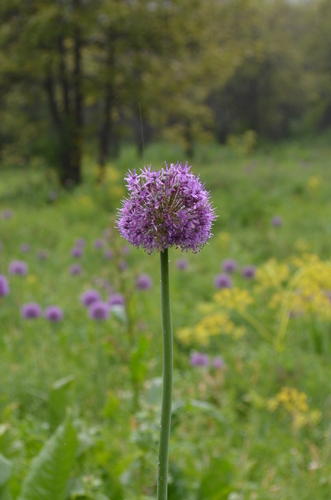
Allium geyeri
Watson
Geyer's onion, Wild Onion, Cebadilla, Omoir

(c) Bob Walker, some rights reserved (CC BY), uploaded by Bob Walker

(c) mhays, some rights reserved (CC BY-NC), uploaded by mhays
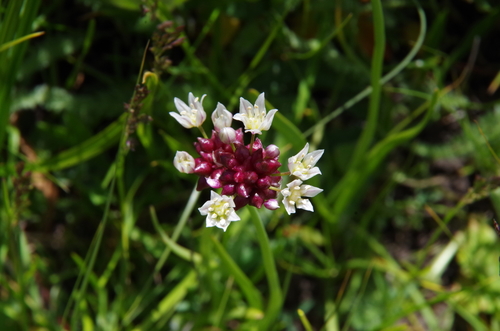
(c) Janel Johnson, some rights reserved (CC BY-NC), uploaded by Janel Johnson
What to Eat
Edible parts: Flowers, Leaves, Root, Bulb
The bulbs are edible raw or cooked and taste like small, pungent onions. They are shallow and relatively easy to dig, though typically small — up to 25mm long and 20mm in diameter. They were used primarily as an onion flavouring in soups and similar dishes, though occasionally eaten raw as well; the Navajo used them as a food source. The leaves are technically edible raw or cooked but are tough and fibrous compared to other species. The flowers are edible raw and can be used as a garnish on salads.
Known Hazards
Where to Find It
It grows naturally in low meadows and by streams in the Rocky Mountains in Western North America from Washington, Texas, Oregon, New Mexico, and Nevada. It suits hardiness zones 5-10.
Australia, Canada, North America, USA,
How to Identify
An onion family plant. A bulb plant. It grows to 45 cm high. The bulbs are 15 - 25 mm across. The bulbs are oval. The leaves are flattened and 15-50 cm long. The flowers are bell-shaped and white or pale pink. There are up to 25 flowers in a head.
How to Grow
Prefers a sunny position in a light well-drained soil. Plants are not hardy in the colder wetter conditions of N.W. Britain and are probably best grown in a bulb frame in most parts of the country. The sub-species A. geyeri tenerum forms bulbils in its flowering head. The bulbs should be planted fairly deeply. Most members of this genus are intolerant of competition from other growing plants. Grows well with most plants, especially roses, carrots, beet and chamomile, but it inhibits the growth of legumes. This plant is a bad companion for alfalfa, each species negatively affecting the other. Members of this genus are rarely if ever troubled by browsing deer.
Propagation: Sow seed in spring in a greenhouse, or as soon as it is ripe in a cold frame. Prick out seedlings into individual pots once large enough — placing three per pot will produce clumps more quickly. Grow on in the greenhouse for at least the first winter and plant out into permanent positions in spring once vigorous. The plants can also be divided in summer as they die down, and divisions can be planted directly into permanent positions if required.
Medicinal Uses
No specific medicinal uses have been recorded for this species. However, as with other members of this genus, it is considered a healthy dietary addition. Alliums contain sulphur compounds responsible for their onion flavour, and regular consumption is associated with reduced blood cholesterol, a tonic effect on the digestive system, and support for the circulatory system.
Other Uses
The plant's juice can be used as a moth repellent, and the whole plant is said to deter insects and moles.
Wikipedia
Source ↗Allium geyeri or Geyer's onion is a North American species of onion widespread in the western United States and in western Canada. It is found in the Rocky Mountain States from New Mexico to Idaho, Great Basin, the Pacific Northwest, Texas, South Dakota, Arizona, Manitoba, British Columbia, Alberta and Saskatchewan.
Notes
There are about 300-700 Allium species. Most species of Allium are edible (Flora of China). All alliums are edible but they may not all be worth eating! They have also been put in the family Alliaceae.
Names & Synonyms
Allium geyeri (Geyer’s Onion)
References (7)
- Beckstrom-Sternberg, Stephen M., and James A. Duke. "The Foodplant Database." http://probe.nalusda.gov:8300/cgi-bin/browse/foodplantdb.(ACEDB version 4.0 - data version July 1994)
- Cundall, P., (ed.), 2004, Gardening Australia: flora: the gardener's bible. ABC Books. p 126
- Facciola, S., 1998, Cornucopia 2: a Source Book of Edible Plants. Kampong Publications, p 5
- MacKinnon, A., et al, 2009, Edible & Medicinal Plants of Canada. Lone Pine. p 192
- Plants for a Future database, The Field, Penpol, Lostwithiel, Cornwall, PL22 0NG, UK. http://www.scs.leeds.ac.uk/pfaf/
- Proc. Amer. Acad. Arts 14:227. 1879
- Woodward, P., 1996, Garlic and Friends. The History, Growth and Use of Edible Alliums. Hyland House. p 192