Hibiscus caesius
F. von Mueller

(c) Troos van der Merwe, some rights reserved (CC BY-NC), uploaded by Troos van der Merwe

(c) Troos van der Merwe, some rights reserved (CC BY-NC)
What to Eat
Edible parts: Buds
The young buds are eaten raw.
Where to Find It
It is a tropical plant. It grows in northern Australia. It grows on heavy soils along stream banks. It needs an open sunny position and well drained soil.
Africa, Asia, Australia, Botswana, Namibia, Pakistan, Southern Africa,
How to Identify
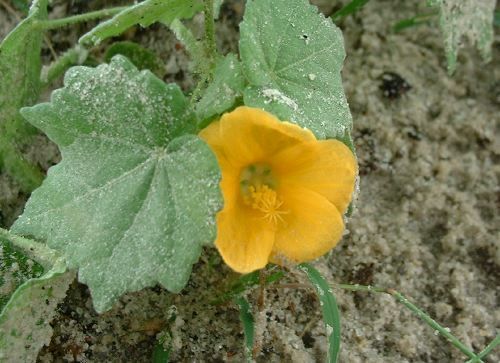
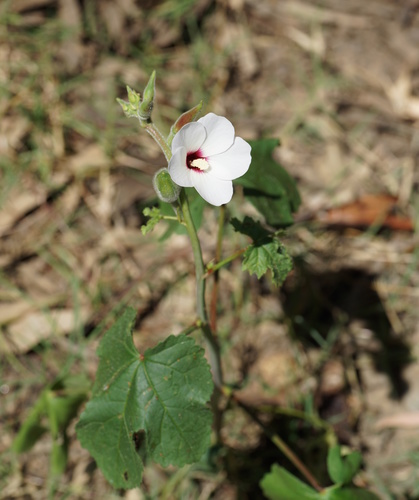
A small herb which grows each year from seed. It has a few erect stems. It grows 0.5-1.5 m high and spreads 0.5-1 m wide. The stems are smooth. The leaves are 3-7 cm long by 3-5 cm wide. They are divided into 5-7 sword shaped lobes. These are 2.5-7 cm long. They are dark green. There are teeth along the edge. The flowers are 6-8 cm across and yellow with a red blotch in the centre. The flowers occur singly in the axils of the upper leaves. The fruit is a capsule 2-2.5 cm long by 2 cm wide. It is round and hairy. The seeds are smooth.
How to Grow
Plants are grown from seed.
Production
Plants grow rapidly in the wet season.
Notes
There are about 220 Hibiscus species.
Names & Synonyms
References (4)
- Elliot, W.R., & Jones, D.L., 1990, Encyclopedia of Australian Plants suitable for cultivation. Vol 5. Lothian. p 360 (As Hibiscus pentaphyllus)
- IRVINE, (As Hibiscus pentaphyllus)
- Paczkowska, G. & Chapman, A.R., 2000, The Western Australian Flora. A Descriptive Catalogue. Western Australian Herbarium. p 290 (As Hibiscus pentaphyllus)
- Wheeler, J.R.(ed.), 1992, Flora of the Kimberley Region. CALM, Western Australian Herbarium, p 218 (As Hibiscus pentaphyllus)