Hibiscus trionum
L.
Flower-of-an-hour

(c) Dan Lory, some rights reserved (CC BY-NC), uploaded by Dan Lory
(c) Keri Charles, some rights reserved (CC BY-NC)
(c) Keri Charles, some rights reserved (CC BY-NC)
What to Eat
Edible parts: Leaves, Root, Pods, Flowers, Seeds, Vegetable, Flowers - tea
Young leaves and young shoots can be eaten raw or cooked. The roots are edible but highly fibrous, with a mucilaginous texture and very little flavour.
Known Hazards
Where to Find It
It suits tropical, subtropical and temperate regions. It does best in a sunny position. It does not occur in hot humid tropical rainforest zones. It suits drier warmer places. It can grow in hot arid zones with a marked dry season. It grows between 2-2,635 m above sea level. It can grow in arid places. It suits hardiness zones 10-12. Tasmania Herbarium.
Afghanistan, Africa, Albania, Algeria, Armenia, Asia, Australia, Austria, Azerbaijan, Balkans, Botswana, Britain, Bulgaria, Burkina Faso, Canada, Caribbean, Caucasus, Central Africa, Central Asia, Chad, China, Cyprus, Czech Republic, East Africa, Egypt, Eswatini, Ethiopia, Europe, France, Georgia, Germany, Greece, Hungary, India, Iran, Israel, Italy, Jamaica, Japan, Kazakhstan, Kenya, Korea, Kyrgyzstan, Lesotho, Libya, Madagascar, Malaysia, Mali, Mediterranean, Middle East, Moldova, Mongolia, Mozambique, Myanmar, Namibia, New Caledonia, New Zealand, Niger, North Africa, Oman, Pakistan, Palestine, Poland, Portugal, Romania, Sahel, Saudi Arabia, SE Asia, Senegal, Slovakia, Slovenia, Somalia, South Africa, Southern Africa, Spain, Sudan, St Helena, Swaziland, Syria, Tajikistan, Tanzania, Tasmania, Turkey, Türkiye, Turkmenistan, Uganda, Ukraine, USA, Uzbekistan, West Africa, West Indies, Yemen, Yugoslavia, Zambia, Zimbabwe,
How to Identify
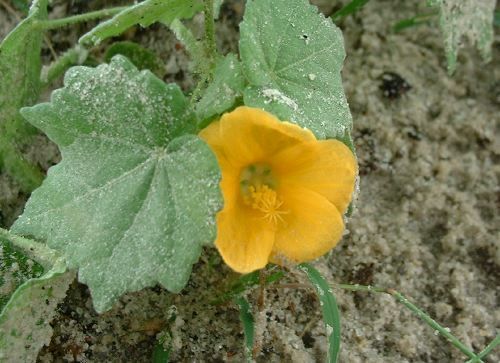
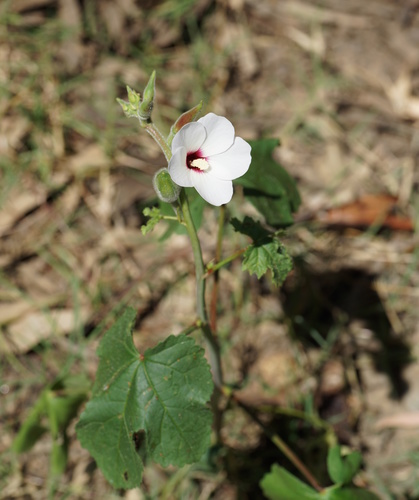
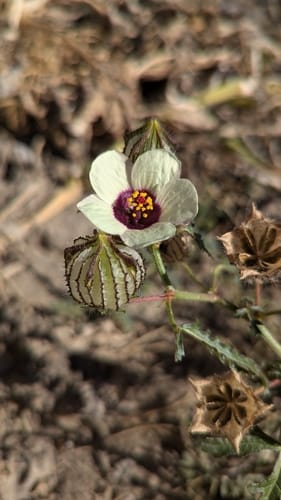
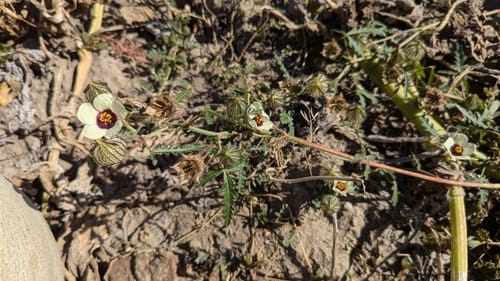
An annual herb. It can be erect or lie over. It is 25-70 cm high. The leaves are alternate. The leaf stalk is 2-4 cm long. The leaf blade has 3-5 lobes arranged like fingers on a hand. The leaf blade is 3-6 cm across. The central lobe is longer. The leaf blade is covered with coarse star like hairs. The flowers occur singly in the axils of leaves. They are yellow and purple at the base. They are like a Hibiscus flower. The fruit is a capsule which is about 1 cm across. It is a hairy five celled capsule. There are many black seeds.
Nutrition Score: 74/100
| Part | Moisture | kJ | kcal | Protein | Vit A | Vit C | Iron | Zinc |
|---|---|---|---|---|---|---|---|---|
| Leaves | 6.3 | 1263 | 302 | 26.7 | — | — | 79.8 | 5.7 |
| Shoots | — | — | 21 | — | — | 21.8 | 9.4 | — |
| Pods | — | — | — | — | — | — | — | — |
How to Grow
Prefers a well-drained humus rich fertile soil in a sheltered position in full sun. A very ornamental plant, it is an annual or short-lived perennial. Not very frost-tolerant, if started off early in a warm greenhouse it can be grown as an annual in Britain, flowering and setting seed in its first year.
Propagation: Sow seed in early spring in a warm greenhouse; germination is usually fairly rapid. Prick seedlings into individual pots when large enough to handle. For annual cultivation, plant out in early summer with frame or cloche protection until established. For perennial cultivation, grow on in the greenhouse for the first year and plant out in early summer of the following year. Half-ripe cuttings taken in July or August can be rooted in a frame, overwintered in a warm greenhouse, and planted out after the last expected frosts.
Medicinal Uses
The flowers are diuretic and are used in the treatment of itch and painful skin diseases. The dried leaves are regarded as stomachic.
Other Uses
The nectar- and pollen-rich flowers attract bees and butterflies. The plant provides some food and habitat for wildlife through its edible calyces and foliage, and can support beneficial insects through its leaf litter, though it is not a primary bird nesting site. The plant is not known for pest-deterrent properties.
Wikipedia
Source ↗Hibiscus trionum, commonly called flower-of-an-hour, bladder hibiscus, bladder ketmia, bladder weed, puarangi and venice mallow, is an annual plant native to the Old World tropics and subtropics. It has spread throughout southern Europe both as a weed and cultivated as a garden plant. It has been introduced to the United States as an ornamental where it has become naturalized as a weed of cropland and vacant land, particularly on disturbed ground.
Notes
There are about 220 Hibiscus species. Chemical composition (seed pods): Protein (crude) = 21.0% (dry). Fat = 0.8% (dry). Fibre (crude) = 8.4% (dry). Ash (insoluble) = 10.9% (dry). Carbohydrate (soluble): Starch = 7.3% (dry). Sucrose = 8.1% (dry). D-glucose = Ø% (dry). D-fructose = 0.7% (dry). Amino acids (g [16g N]-1): Aspartic acid = 14.4g. Threonine = 2.9g. Serine = 3.4g. Glutamic acid = 18.4g. Proline = 9.2g. Alanine = 3.8g. Valine = 4.1g. Cysteine (performic acid oxidation) = 0.6g. Methionine (performic acid oxidation) = 1.7g. Isoleucine = 2.9g. Leucine = 4.7g. Tyrosine = 2.3g. Phenylalanine = 3.2g. Lysine = 4.0g. Histidine = 1.7g. Arginine = 6.5g. Minerals: Sulphur = 0.27% (dry). Potassium = 0.65% (dry). Magnesium = 0.68% (dry). Calcium = 1.45% (dry). Na = 0.01% (dry). K = 2.51% (dry). Zinc = 94 mg/kg-1 (dry). Iron = 218 mg/kg- 1 (dry). Manganese = 35 mg/kg-1 (dry). Copper = 12 mg/kg-1 (dry).
Names & Synonyms
Bladder Hibiscus, Bladder Ketnia, Delelemukhwayo, Delelevhalemba, Etoke, Hatmi cicegi, Kihasihasy, Navadni oslez, Terblansbossie, Trailing hollyhock, Venice mallow, Waika sara, Ye xi gu miao
References (39)
- ABDELMUTI,
- Ambasta, S.P. (Ed.), 2000, The Useful Plants of India. CSIR India. p 268
- Bosch, C.H., 2004. Hibiscus trionum L. [Internet] Record from Protabase. Grubben, G.J.H. & Denton, O.A. (Editors). PROTA (Plant Resources of Tropical Africa), Wageningen, Netherlands. < http://database.prota.org/search.htm>. Accessed 16 October 2009.
- Brickell, C. (Ed.), 1999, The Royal Horticultural Society A-Z Encyclopedia of Garden Plants. Convent Garden Books. p 523
- Burkill, H. M., 1985, The useful plants of west tropical Africa, Vol. 4. Kew.
- Cundall, P., (ed.), 2004, Gardening Australia: flora: the gardener's bible. ABC Books. p 704
- Dashorst, G.R.M., and Jessop, J.P., 1998, Plants of the Adelaide Plains & Hills. Botanic Gardens of Adelaide and State Herbarium. p 102
- Elliot, W.R., & Jones, D.L., 1990, Encyclopedia of Australian Plants suitable for cultivation. Vol 5. Lothian. p 363
- Flora of Pakistan. www.eFloras.org
- Goode, P., 1989, Edible Plants of Uganda. FAO p 30
- Grubben, G. J. H. and Denton, O. A. (eds), 2004, Plant Resources of Tropical Africa 2. Vegetables. PROTA, Wageningen, Netherlands. p 328
- Hibbert, M., 2002, The Aussie Plant Finder 2002, Florilegium. p 139
- Hussey, B.M.J., Keighery, G.J., Cousens, R.D., Dodd, J., Lloyd, S.G., 1997, Western Weeds. A guide to the weeds of Western Australia. Plant Protection Society of Western Australia. p 174
- Hu, Shiu-ying, 2005, Food Plants of China. The Chinese University Press. p 541
- Khasbagan, Hu-Yin Huai, and Sheng-Ji pei, 2000, Wild Plants in the Diet of Athorchin Mongol Herdsmen in Inner Mongolia. Economic Botany 54(4): 528-536
- Lamp, C & Collet F., 1989, Field Guide to Weeds in Australia. Inkata Press. p 138
- Lazarides, M. & Hince, B., 1993, Handbook of Economic Plants of Australia, CSIRO. p 132
- Lim, T. K., 2015, Edible Medicinal and Non Medicinal Plants. Volume 9, Modified Stems, Roots, Bulbs. Springer p 47
- Long, C., 2005, Swaziland's Flora - siSwati names and Uses http://www.sntc.org.sz/flora/
- Magwede, K., van Wyk, B.-E., & van Wyk, A. E., 2019, An inventory of Vhavenḓa useful plants. South African Journal of Botany 122 (2019) 57–89
- Matthews, J., 1987, New Zealand Native Plants for your Garden. Pacific Publishers, p 58
- Ogle, B. M. & Grivetti, L. E., 1984, Legacy of the Chameleon: Edible Wild Plants in the Kingdom of Swaziland, Southern Africa. A Cultural, Nutritional Study. Part 4 - Nutritional Analysis and Conclusions. Ecology of Food and Nutrition. Vol 17, pp 431-64
- Paczkowska, G. & Chapman, A.R., 2000, The Western Australian Flora. A Descriptive Catalogue. Western Australian Herbarium. p 290
- Peters, C. R., O'Brien, E. M., and Drummond, R.B., 1992, Edible Wild plants of Sub-saharan Africa. Kew. p 145
- Plants for a Future database, The Field, Penpol, Lostwithiel, Cornwall, PL22 0NG, UK. http://www.scs.leeds.ac.uk/pfaf/
- Polat, R., et al, 2015, Survey of wild food plants for human consumption in Elazig (Turkey). Indian Journal of Traditional Knowledge. Vol. 1(1): 69-75
- Polat, R., et al, 2017, Survey of wild food plants for human consumption in Bingol, (Turkey). Indian Journal of Traditional Knowledge. Vol. 16(3) July 2017, pp. 378-384
- READ,
- Royal Botanic Gardens, Kew (1999). Survey of Economic Plants for Arid and Semi-Arid Lands (SEPASAL) database. Published on the Internet; http://www.rbgkew.org.uk/ceb/sepasal/internet [Accessed 3rd May 2011]
- Ruiters-Welcome, A. K., 2019, Food plants of southern Africa. Ph.D. thesis. Univ. of Johannesburg p 76
- Sp. pl. 2:697. 1753
- Swaziland's Flora Database http://www.sntc.org.sz/flora
- Tang ya, Malvaceae. Flora of China. p
- Urgamal, M., Oyuntsetseg, B., Nyambayar, D. & Dulamsuren, Ch. 2014. Conspectus of the vascular plants of Mongolia. (Editors: Sanchir, Ch. & Jamsran, Ts.). Ulaanbaatar, Mongolia. “Admon“ Press. 334pp. (p. 79-90).
- Vernon, R., 1983, Field Guide to Important Arable Weeds of Zambia. Dept of Agriculture, Chilanga, Zambia. p 52
- Wehmeyer, A. S, 1986, Edible Wild Plants of Southern Africa. Data on the Nutrient Contents of over 300 species
- Welcome, A. K. & Van Wyk, B.-E., 2019, An inventory and analysis of the food plants of southern Africa. South African Journal of Botany 122 (2019) 136–179
- Wheeler, J.R.(ed.), 1992, Flora of the Kimberley Region. CALM, Western Australian Herbarium, p 222
- World Checklist of Useful Plant Species 2020. Royal Botanic Gardens, Kew