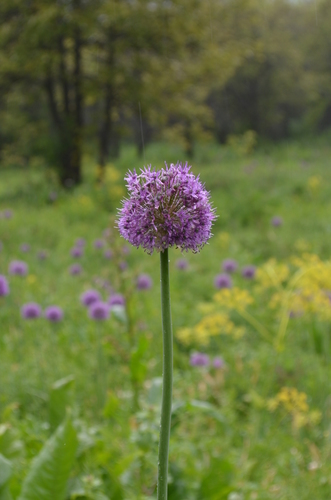
Allium oschaninii
O. Fedtsch.
Oschanina onion, French gray shallot

(c) orzimat, some rights reserved (CC BY-NC)
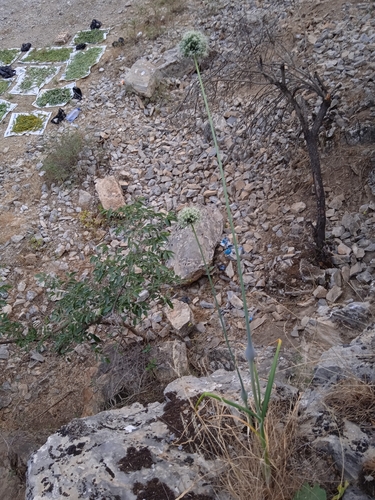
(c) Karimov Boburbek, some rights reserved (CC BY-NC)
What to Eat
Edible parts: Flowers, Leaves, Root, Bulb
The bulb, around 4cm in diameter, can be eaten raw or cooked. Leaves are edible raw or cooked, and the flowers can be used raw as a garnish on salads.
Known Hazards
Where to Find It
It is a temperate plant. It grows naturally in rocky crevices in mountains in Afghanistan.
Asia, Afghanistan, Central Asia, Iran, Middle East, Tajikistan, Uzbekistan,
How to Identify
An onion family plant. A bulb plant. It grows to 1 m high. Bulbs are 4 cm across.
How to Grow
Prefers a sunny position in a light well-drained soil. Probably slightly tender in Britain. The bulbs should be planted fairly deeply. Most members of this genus are intolerant of competition from other growing plants. This species is an ancestor of the cultivated onion, A. cepa, and so could be of value in breeding programmes. Grows well with most plants, especially roses, carrots, beet and chamomile, but it inhibits the growth of legumes. This plant is a bad companion for alfalfa, each species negatively affecting the other. Members of this genus are rarely if ever troubled by browsing deer.
Propagation: Sow seed in spring in a cold frame. Prick seedlings into individual pots once large enough to handle — placing three per pot will build clumps more quickly. Grow under greenhouse conditions for at least the first winter, then plant out in spring once vigorous and sufficiently sized. Division is best done in spring, though plants can be divided at any point during the growing season; pot up divisions in a cold frame or greenhouse until growing well before planting out into permanent positions.
Medicinal Uses
No specific medicinal uses have been recorded for this species, but members of this genus are generally considered healthy dietary additions. They contain sulphur compounds responsible for their onion flavour, and regular consumption is thought to help reduce blood cholesterol levels, tone the digestive system, and support circulatory health.
Other Uses
The plant juice acts as a moth repellent. The whole plant is also said to repel insects and moles.
Wikipedia
Source ↗Allium oschaninii, the French gray shallot, griselle or true shallot, is a perennial plant of the onion genus Allium. It forms underground bulbs much like the (French red) shallots, covered by a layer of pale brown-grey skin (hence the common name). It is native to Northeastern Iran and Central Asia. It is widely planted in parts of southern France for culinary use.
Notes
There are about 300-700 Allium species. Most species of Allium are edible (Flora of China). All alliums are edible but they may not all be worth eating! They have also been put in the family Alliaceae.
Names & Synonyms
Evoj pijoz
References (8)
- Hisoriev, H., et al, 2017, Collection, germplasm introduction and conservation of Allium in Xinjiang and its collection garden construction. China Botanical Congress.
- Khassanov, F. O., 2007, Edible Alliums of Uzbekistan. in First Kazbegi workshop on "Botany, taxonomy and phytochemistry of wild Allium L. species of the Caucasus and Central Asia".
- Keusgen, M. et al., 2006, Wild Allium species (Alliaceae) used in folk medicine of Tajikstan and Uzbekistan. Journal of Ethnobiology and Ethnomedicine. 2:18
- Lim, T. K., 2015, Edible Medicinal and Non Medicinal Plants. Volume 9, Modified Stems, Roots, Bulbs. Springer p 5
- Plants for a Future database, The Field, Penpol, Lostwithiel, Cornwall, PL22 0NG, UK. http://www.pfaf.org Progressivnoe sadovodstvo i ogorodnichestvo 3:332. 1906
- Seidemann J., 2005, World Spice Plants. Economic Usage, Botany, Taxonomy. Springer. p 22
- Wiersema, J. H. & Leon, B., 2013, World Economic Plants. A Standard Reference CRC Press. 2nd Ed. p 35
- World Checklist of Useful Plant Species 2020. Royal Botanic Gardens, Kew