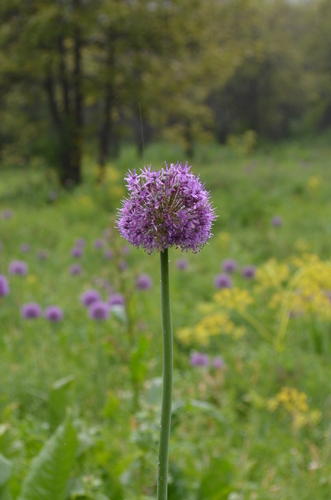
Allium ramosum
L.
Fragrant onion, Chinese leek

(c) V.S. Volkotrub, some rights reserved (CC BY-NC), uploaded by V.S. Volkotrub

(c) aleksey_strahov, some rights reserved (CC BY-NC)

(c) aleksey_strahov, some rights reserved (CC BY-NC)
What to Eat
Edible parts: Flowers, Leaves, Root, Bulb
The small bulbs, around 10mm in diameter, can be eaten raw or cooked. The leaves are also edible raw or cooked, with a flavour somewhere between garlic and chives — excellent, with a pleasant sweetness alongside a strong onion character. The flowers are eaten raw and used as a garnish on salads.
Known Hazards
Where to Find It
It is a temperate climate plant. It grows in sunny hill pastures between 500-2100 m altitude in N China.
Asia, Australia, Central Asia, China, Japan, Kazakhstan, Korea, Mongolia, Russia, Siberia,
How to Identify
An onion family plant. It is a bulb plant. The bulbs occur in clusters. The skin is dull yellow to yellow brown. It has a netlike appearance. The leaves are narrow. They are 1.5-8 mm wide and 3 angled. The scape is 25-60 cm long. It is covered with the leaf sheaths only at the base. The flower head is half round. The flowers are white with red stripes.
Nutrition Score: 29/100
| Part | Moisture | kJ | kcal | Protein | Vit A | Vit C | Iron | Zinc |
|---|---|---|---|---|---|---|---|---|
| Leaves | 88.4 | 142 | 34 | 3 | 35 | — | 2.6 | — |
| Stem | — | — | 2.5 | — | — | — | — | — |
| Bulb | — | — | — | — | — | — | — | — |
| Leaves | — | — | — | — | — | — | — | — |
| Flowers | — | — | — | — | — | — | — | — |
How to Grow
An easily grown plant, it prefers a sunny position in a light well-drained soil. The bulbs should be planted fairly deeply. A very ornamental plant, the flowers are especially attractive. Very closely related to A. tuberosum. Grows well with most plants, especially roses, carrots, beet and chamomile, but it inhibits the growth of legumes. This plant is a bad companion for alfalfa, each species negatively affecting the other. Members of this genus are rarely if ever troubled by browsing deer.
Propagation: Sow seed in spring in a cold frame. Prick out seedlings into individual pots when large enough to handle — placing three plants per pot will produce clumps more quickly. Grow on in the greenhouse for at least the first winter, then plant out into permanent positions in spring once growing vigorously. Division in spring is also very easy; plants can be divided successfully at any point during the growing season and the divisions planted straight out into their permanent positions if needed.
Medicinal Uses
The leaves and bulbs contain sulphur compounds (responsible for their onion flavour), saponins, and bitter substances. They have antibacterial properties and are used in Vietnam to treat haemoptysis, epistaxis, cough, sore throat, asthma, dysentery, and dyspepsia. Eaten regularly, they help reduce blood cholesterol levels, act as a digestive tonic, and support the circulatory system. The seed contains alkaloids and saponins and is used in the treatment of spermatorrhoea, haematuria, incontinence, and lumbago.
Other Uses
The juice of the plant is used as a moth repellent. The whole plant is also said to repel insects and moles.
Wikipedia
Source ↗Allium ramosum, called fragrant-flowered garlic or Chinese chives is a northern Asian species of wild onion native to Kazakhstan, Mongolia, Siberia, the Russian Far East, and northern China (Gansu, Hebei, Heilongjiang, Jilin, Liaoning, Inner Mongolia, Ningxia, Qinghai, Shaanxi, Shandong, Shanxi, Xinjiang). The species is also naturalized in a few places in eastern Europe. In its native range, it grows at elevations of 500–2100 m. Allium ramosum has clusters of narrow bulbs. Scapes are up to 60 cm tall. Leaves are linear, keeled, shorter than the scape. Umbels have many flowers crowded together. Tepals are white or pale red with a red midvein.
Notes
There are about 300-700 Allium species. Most species of Allium are edible (Flora of China). All alliums are edible but they may not all be worth eating! They have also been put in the family Alliaceae.
Names & Synonyms
Bawang kuchai, Chinese chives, Fragrant-flowered garlic, Ganda, Gau choi fa, Gogd, Heger-e in gogud, Kechai, Shan jiu cai, Ye jiu, Zherlig gogd
References (25)
- Arora, R. K., 2014, Diversity in Underutilized Plant Species - An Asia-Pacific Perspective. Bioversity International. p 35
- Burkill, I.H., 1966, A Dictionary of the Economic Products of the Malay Peninsula. Ministry of Agriculture and Cooperatives, Kuala Lumpur, Malaysia. Vol 1 (A-H) p 102 (As Allium odorum)
- Chen Xinqi, Liang Songyun, Xu Jiemei, Tamura M.N., Liliaceae. Flora of China. p 110
- Creasy, R., 2000, The Edible Asian Garden. Periplus p 43
- Facciola, S., 1998, Cornucopia 2: a Source Book of Edible Plants. Kampong Publications, p 5
- Food Composition Tables for use in East Asia FAO http://www.fao.org/infoods/directory No. 641 (As Allium odorum)
- Hedrick, U.P., 1919, (Ed.), Sturtevant's edible plants of the world. p 40 (As Allium odorum)
- https://en.wikipedia.org/wiki/List of wild edible plants in Mongolian cuisine
- Khasbagan, Narisu, & Stuart, K., 1999, Ethnobotanical Overview of Gogd (Allium ramosum L.): A traditional edible wild plant used by Inner Mongolians. Journal of Ethnobiology 19(2):221-225
- Khasbagan, Hu-Yin Huai, and Sheng-Ji pei, 2000, Wild Plants in the Diet of Athorchin Mongol Herdsmen in Inner Mongolia. Economic Botany 54(4): 528-536
- Khasbagan, Yeruhan and Zhao Hui, 2011, Study on Traditional Knowledge of Wild Edible Plants Used by the Mongolians in Xilingol Typical Steppe Area. Plant Diversity and Resources. 33(2): 239-246
- Mant. pl. 1:62. 1767 (As Allium odorum)
- Martin, F.W. & Ruberte, R.M., 1979, Edible Leaves of the Tropics. Antillian College Press, Mayaguez, Puerto Rico. p 98 Also p 201 (As Allium odorum)
- Ochse, J.J. et al, 1931, Vegetables of the Dutch East Indies. Asher reprint. p 446 (As Allium odorum)
- Plants for a Future database, The Field, Penpol, Lostwithiel, Cornwall, PL22 0NG, UK. http://www.scs.leeds.ac.uk/pfaf/
- Sachula, et al, 2020, Wild edible plants collected and consumed by the locals in Daqinggou, Inner Mongolia, China. Journal of Ethnobiology and Ethnomedicine (2020) 16:60
- Seidemann J., 2005, World Spice Plants. Economic Usage, Botany, Taxonomy. Springer. p 23
- Solomon, C., 2001, Encyclopedia of Asian Food. New Holland. p 206
- Sp. pl. 1:296. 1753
- Terra, G.J.A., 1973, Tropical Vegetables. Communication 54e Royal Tropical Institute, Amsterdam, p 20 (As Allium odorum)
- Urgamal, M., et al, 2014, Conspectus of the Vascular Plants of Mongolia. Mongolia Academy of Sciences Institute of Botany and National University of Mongolia Department of Biology. p 48
- World Checklist of Useful Plant Species 2020. Royal Botanic Gardens, Kew
- Wujisguleng, W., & Khasbagen. K., 2010, An integrated assessment of wild vegetable resources in Inner Mongolian Autonomous Region, China. Journal of Ethnobiology and Ethnomedicine 6:34
- Zeven, A. C. & de West, J. M. J., 1982, Dictionary of cultivated plants and their regions of diversity. Wageningen. p 32
- Zhang, Y., et al, Yunatov’s Records of Wild Edible Plant Used by the Mongols in Mongolia During 1940- 1951: Ethnobotanical Arrangements and Discussions. Inner Mongolia Normal University. p 9