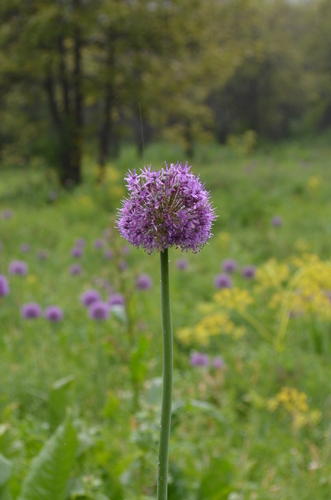
Allium rubellum
M. Bieb
Himalayan onion

(c) Теймуров А.А., some rights reserved (CC BY-NC), uploaded by Теймуров А.А.

(c) Теймуров А.А., some rights reserved (CC BY-NC), uploaded by Теймуров А.А.

(c) Теймуров А.А., some rights reserved (CC BY-NC), uploaded by Теймуров А.А.
What to Eat
Edible parts: Flowers, Leaves, Root, Bulb
The bulbs can be eaten raw or cooked. The leaves are edible raw or cooked and are also dried and preserved for use as a condiment in Europe. The flowers are eaten raw and used as a garnish on salads.
Known Hazards
Where to Find It
It is a subtropical plant. It grows in semi-arid deserts. It is best in well-drained soils. It must grow in the sun.
Asia, Europe, Himalayas, India, Iran, Middle East, Russia, Siberia,
How to Identify
An onion family herb. It grows 60 cm tall. The bulb is egg shaped and 1-2 cm across. The leaves are narrow and flat. The flowers are reddish pink.
Nutrition Score: 9/100
| Part | Moisture | kJ | kcal | Protein | Vit A | Vit C | Iron | Zinc |
|---|---|---|---|---|---|---|---|---|
| Bulb | — | — | — | — | — | — | — | — |
| Leaves | 78 | — | — | 1.6 | — | — | — | — |
| Flowers | — | — | — | — | — | — | — | — |
How to Grow
Prefers a sunny position in a light well-drained soil. Best grown in a cold greenhouse or bulb frame, the plant is quite hardy but requires a period of dormancy in the summer when it should not be watered. The bulbs should be planted fairly deeply. Most members of this genus are intolerant of competition from other growing plants. Grows well with most plants, especially roses, carrots, beet and chamomile, but it inhibits the growth of legumes. This plant is a bad companion for alfalfa, each species negatively affecting the other. Members of this genus are rarely if ever troubled by browsing deer.
Propagation: Sow seed in spring in a cold frame. Prick out seedlings into individual pots when large enough to handle — placing three plants per pot will produce clumps more quickly. Grow on in the greenhouse for at least the first winter, then plant out into permanent positions in spring once growing vigorously. For division in spring, plants can be divided successfully at any point during the growing season; pot up the divisions in a cold frame or greenhouse until growing well, then plant out into their permanent positions.
Medicinal Uses
No specific medicinal uses have been recorded for this species, but members of this genus are generally considered very healthy additions to the diet. They contain sulphur compounds (responsible for their onion flavour) which, when eaten regularly, help reduce blood cholesterol levels, act as a tonic to the digestive system, and support the circulatory system.
Other Uses
The juice of the plant is used as a moth repellent. The whole plant is also said to repel insects and moles.
Wikipedia
Source ↗A bulbous plant reaching 0.6 m (2 ft) in height. Flowers appear in June. Hermaphroditic and bee/insect-pollinated. Grows in light sandy and medium loamy, well-drained soils. Tolerates mildly acidic to basic pH. Requires full sun and adapts to dry or moist soil conditions.
Notes
There are about 300-700 Allium species. Most species of Allium are edible (Flora of China). All alliums are edible but they may not all be worth eating! They have also been put in the family Alliaceae.
Names & Synonyms
Alomana, Barani-piaz, Gadwassal, Jangli piaz, Pharna
References (12)
- Angami, A., et al, 2006, Status and potential of wild edible plants of Arunachal Pradesh. Indian Journal of Traditional Knowledge 5(4) October 2006, pp 541-550 (As reballum)
- Badwar, R. R., & Fernandez, R. R., 2011, Edible Wild Plants of the Himachal Pradesh State by IHBT, Himalayas, Daya Publishing House,. Delhi, India
- Bircher, A. G. & Bircher, W. H., 2000, Encyclopedia of Fruit Trees and Edible Flowering Plants in Egypt and the Subtropics. AUC Press. p 19 (As Allium leptophyllum)
- Facciola, S., 1998, Cornucopia 2: a Source Book of Edible Plants. Kampong Publications, p 6
- Fl. taur.-caucas. 1:264. 1808
- Hedrick, U.P., 1919, (Ed.), Sturtevant's edible plants of the world. p 41
- Mirdeilami, S. Z., et al, 2011, Ethnopharmacological survey of medicinal plants in Maraveh Tappeh region, north of Iran. Iranian Journal of Plant Physiology 2(1): 327‐338
- Motamed, S. M., et al, 2010, Antioxidant activity of some edible plants of the Turkmen Sahra region in northern Iran. Food Chemistry 119: 1637-1642
- Negi, K. S., and Pant, K. C., 1992, Less-Known Wild Species of Allium L. (Amaryllidaceae) from Mountainous Regions of India. Economic Botany, Vol. 46, No. 1, pp. 112-114
- Plants for a Future database, The Field, Penpol, Lostwithiel, Cornwall, PL22 0NG, UK. http://www.scs.leeds.ac.uk/pfaf/
- Singh, H.B., Arora R.K., 1978, Wild edible Plants of India. Indian Council of Agricultural Research, New Delhi. p10
- Wild edible plants of Himachal Pradesh