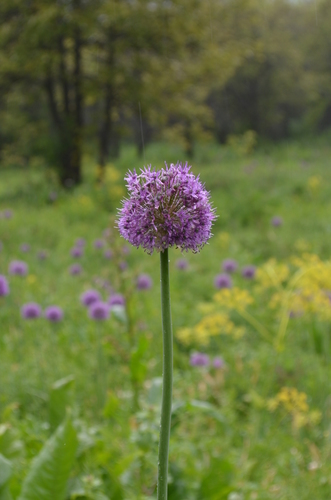
Allium taquetii
Lev. & Van

Wikimedia Commons - sunoochi

Wikimedia Commons - Averater
What to Eat
Edible parts: Flowers, Leaves, Root, Bulb
The flowers, leaves, roots, and bulbs are all edible, following the pattern of most Allium species.
Where to Find It
It is a temperate plant.
Asia, Korea,
How to Identify
A temperate bulbous plant in the onion family (Amaryllidaceae) with edible flowers, leaves, roots, and bulbs.
Wikipedia
Source ↗Allium taquetii is a species of Allium native to the southern Korean peninsula and Jeju Island. In Korean it is called the Halla chive (한라부추) because it grows on the slopes of Mt. Halla, the shield volcano that is Jeju Island. Some sources treat it as a synonym of Allium thunbergii. In Korea it is grown for its floral interest, and its scapes are occasionally eaten as an herb similar to other chives and green onions.
Notes
There are about 300-700 Allium species. Most species of Allium are edible (Flora of China). All alliums are edible but they may not all be worth eating! They have also been put in the family Alliaceae.
References (1)
- Plants for a Future database, The Field, Penpol, Lostwithiel, Cornwall, PL22 0NG, UK. http://www.scs.leeds.ac.uk/pfaf/