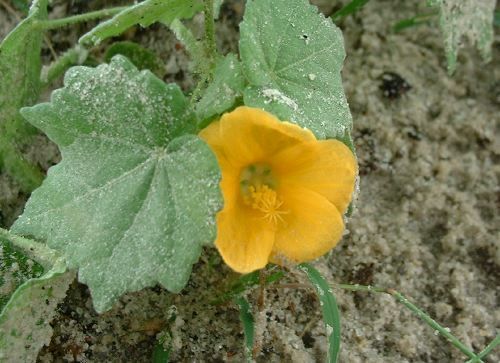
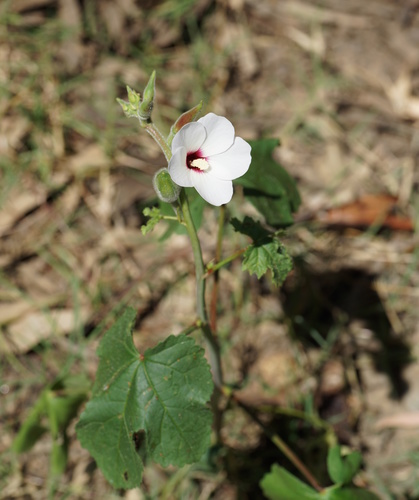
Althaea officinalis
L.
Marsh mallow, White mallow
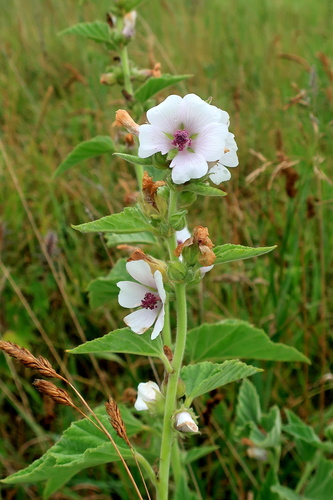
(c) Maxim Sharapov, some rights reserved (CC BY-NC), uploaded by Maxim Sharapov

(c) Sebastian J. Dunkl, some rights reserved (CC BY-NC), uploaded by Sebastian J. Dunkl

(c) Sebastian J. Dunkl, some rights reserved (CC BY-NC), uploaded by Sebastian J. Dunkl
What to Eat
Edible parts: Roots, Leaves, Leaves - tea, Flowers - tea, Vegetable
Leaves can be eaten raw or cooked. As a potherb or soup thickener they work best when mixed with other greens, since cooking a large quantity alone produces an unpalatable mucilaginous texture. Raw leaves are fibrous and slightly hairy but mild in flavour; chopped finely, they are quite acceptable in salads. The root can be eaten raw or cooked — boiled then fried with onions it makes a palatable dish commonly used in times of shortage. It can be prepared as a vegetable, or dried and ground into a powder, then formed into a paste and roasted to produce the sweet confection known as marshmallow. The root contains approximately 37% starch, 11% mucilage, and 11% pectin. The water left after cooking any part of the plant can substitute for egg whites in meringues and similar preparations; the root's cooking water is most effective and should be boiled down to a consistency similar to egg white before use. A tea can be made from the flowers or from the root.
Known Hazards
Where to Find It
It is a temperate plant. It prefers salty marshes and damp soils on the edges of tidal rivers. It is resistant to frost. It cannot survive drought. It suits hardiness zones 3-10. In Yunnan. In Hobart Botanical Gardens.
Afghanistan, Africa, Albania, Algeria, Asia, Australia, Austria, Algeria, Armenia, Azerbaijan, Balkans, Belarus, Belgium, Bosnia, Britain, Bulgaria, Canada, Caucasus, Central Asia, China, Croatia, Czech Republic, Denmark, Ecuador, Europe, France, Georgia, Germany, Greece, Himalayas, Hungary, India, Iran, Iraq, Ireland, Israel, Italy, Kazakhstan, Kyrgyzstan, Lebanon, Luxembourg, Macedonia, Madagascar, Mediterranean, Middle East, Moldova, Netherlands, North Africa, North America, Pakistan, Palestine, Peru, Poland, Portugal, Romania, Russia, Serbia, Western Siberia, Slovakia, Slovenia, South America, Spain, Switzerland, Syria, Tajikistan, Tasmania, Tunisia, Turkey, Türkiye, Turkmenistan, Ukraine, United Kingdom, USA, Uzbekistan, Yugoslavia,
How to Identify
A herb plant which continues to grow year after year. It grows to 1.5 m high and spreads to 1 m across. The root is thick and white and sweet tasting. The stem is thick and woolly and dies down in winter. The leaves are oval and with a short stalk. The leaves can have 3 lobes. The edges of the leaves are irregular and toothed. They are thick and velvety and 8 cm long. The flowers are red, white or purple. The fruit is a hairy nutlet.
How to Grow
Succeeds in almost any soil and situation, though it prefers a rich moist soil in a sunny position. It also tolerates fairly dry soil conditions. Plants are hardy to about -25°c. Marsh mallow is often cultivated in the herb garden, as a culinary and medicinal herb as well as for ornament. Its roots were at one time the source of the sweet 'marsh mallow', but this sweet is now made without using the plant. For polyculture design as well as the above-ground architecture (form - tree, shrub, etc. and size shown above), information on the habit and root pattern is also useful and given here if available. The leaves and flowers can be harvested in summer. The roots are harvested in autumn after the leaves have died down. Marsh Mallow usually flowers from mid-summer to late summer. Marsh Mallow has a moderate growth rate and typically establishes itself within the first year, often reaching maturity in two to three years.
Propagation: Sow seed in spring or autumn in a cold frame; seed sown as soon as it ripens in late summer gives the best results, though germination can be erratic. Stratification can improve both germination rates and timing. Prick seedlings into individual pots when large enough to handle and plant out during summer. Divide plants in spring or autumn — pot up divisions in a lightly shaded cold frame or greenhouse until they are growing strongly before planting out into permanent positions. Root cuttings can be taken in December.
Medicinal Uses
Marsh mallow is a highly versatile medicinal herb whose soothing demulcent properties make it effective against inflammation and irritation of mucous membranes throughout the alimentary canal, urinary tract, and respiratory system. The root addresses excess stomach acid, peptic ulceration, and gastritis, and is applied externally to bruises, sprains, aching muscles, insect bites, skin inflammations, and splinters. The whole plant — especially the root — is antitussive, demulcent, diuretic, strongly emollient, mildly laxative, and odontalgic. A leaf infusion is used to treat cystitis and frequent urination. Leaves are best harvested in August as the plant comes into flower and can be dried for later use. The root can be made into an ointment for boils and abscesses, and is best harvested in autumn, preferably from two-year-old plants, then dried for storage. The German Commission E Monographs approve Althaea officinalis for irritation of the mouth and throat and associated dry cough or bronchitis (root and leaf), and for mild inflammation of the stomach lining (root).
Other Uses
The dried root serves as a toothbrush or can be chewed by teething children, providing a mechanical cleaning action on the gums while helping to ease pain. The root also has cosmetic uses, helping to soften skin. A fibre obtained from the stems and roots is used in paper-making. Dried and powdered root has been used as a binder when making medicinal pills. Boiling the root in water down to a thick syrup produces a glue. An oil extracted from the seed is used in paints and varnishes. The plant can be used as a companion plant to support biodiversity and attract pollinators; its leaves can also serve as a mulch to improve soil quality. The flowers provide nectar and pollen for bees and other beneficial insects. Leaves and flowers can supply food for various wildlife including insects, and the plant offers some shelter for invertebrates, with leaf litter providing habitat for beneficial insects. It is not noted for pest-confusing properties. Suited to food forest planting.
Wikipedia
Source ↗Althaea officinalis, the marsh mallow or marshmallow, is a species of flowering plant indigenous to Europe, Western Asia and North Africa, which is used in herbalism and as an ornamental plant.
Other Information
It was enjoyed by ancient Romans. It is cultivated.
Notes
There are about 12 Althaea species. The roots of this one are used in medicine.
Names & Synonyms
Fiandrilavenombazaha, Guj-khairo, Khutmi, Malvavisco, Navadni slez, Yao kui
References (45)
- Ambasta S.P. (Ed.), 2000, The Useful Plants of India. CSIR India. p 32
- Bircher, A. G. & Bircher, W. H., 2000, Encyclopedia of Fruit Trees and Edible Flowering Plants in Egypt and the Subtropics. AUC Press. p 21
- Blamey, M and Grey-Wilson, C., 2005, Wild flowers of the Mediterranean. A & C Black London. p 133
- Bodkin, F., 1991, Encyclopedia Botanica. Cornstalk publishing, p 72
- Bonet, M. A. & Valles, J., 2002, Use of non-crop food vascular plants in Montseny biosphere reserve (Catalonia, Iberian Peninsula). International Journal of Food Sciences and Nutrition (2002) 53, 225–248
- Bremness, L., 1994, Herbs. Collins Eyewitness Handbooks. Harper Collins. p 145
- Brickell, C. (Ed.), 1999, The Royal Horticultural Society A-Z Encyclopedia of Garden Plants. Convent Garden Books. p 105
- Brown, D., 2002, The Royal Horticultural Society encyclopedia of Herbs and their uses. DK Books. p 117
- Cerne, M., 1992, Wild Plants from Slovenia used as Vegetables. Acta Horticulturae 318
- Crawford, M., 2012, How to grow Perennial Vegetables. Green Books. p 131
- Cundall, P., (ed.), 2004, Gardening Australia: flora: the gardener's bible. ABC Books. p 142
- Dolina, K. & Luczaj, L., 2014, Wild food plants used on the Dubrovnik coast (south-eastern Croatia) Acta Soc Bot Pol 83(3):175–181
- Elias, T.S. & Dykeman P.A., 1990, Edible Wild Plants. A North American Field guide. Sterling, New York p 146
- Ertug, F, Yenen Bitkiler. Resimli Türkiye Florası -I- Flora of Turkey - Ethnobotany supplement
- Esperanca, M. J., 1988. Surviving in the wild. A glance at the wild plants and their uses. Vol. 2. p 74
- Facciola, S., 1998, Cornucopia 2: a Source Book of Edible Plants. Kampong Publications, p 147
- Flora of Pakistan. www.eFloras.org
- Hedrick, U.P., 1919, (Ed.), Sturtevant's edible plants of the world. p 46
- Heywood, V.H., Brummitt, R.K., Culham, A., and Seberg, O. 2007, Flowering Plant Families of the World. Royal Botanical Gardens, Kew. p 201
- Jackes, D. A., Edible Forest Gardens
- Kew Plants of the World Online
- Kiple, K.F. & Ornelas, K.C., (eds), 2000, The Cambridge World History of Food. CUP p 1808
- Lamberton, K (Ed.), 2004, The Australian gardening encyclodepia. Murdoch Books, NSW Australia. p 162
- Lim, T. K., 2015, Edible Medicinal and Non Medicinal Plants. Volume 9, Modified Stems, Roots, Bulbs. Springer p 7
- Mabey, R., 1973, Food for Free. A Guide to the edible wild plants of Britain, Collins. p 67
- Michael, P., 2007, Edible Wild Plants and Herbs. Grub Street. London. p 144
- Plants for a Future database, The Field, Penpol, Lostwithiel, Cornwall, PL22 0NG, UK. http://www.scs.leeds.ac.uk/pfaf/
- Redzic, S. J., 2006, Wild Edible Plants and their Traditional Use in the Human Nutrition in Bosnia-Herzegovina. Ecology of Food and Nutrition, 45:189-232
- Romanowski, N., 2007, Edible Water Gardens. Hyland House. p 80
- Schneider, E., 2001, Vegetables from Amaranth to Zucchini: The essential reference. HarperCollins. p 379
- Sher, H. et al, 2011, Ethnobotanical and Economic Observations of Some Plant Resources from the Northern Parts of Pakistan. Ethnobotany research & Applications 9:027-041 (As Malva officinalis)
- Sher, Z., Hussain, F., & Ibrar, M., 2014, Traditional knowledge on plant resources of Ashezai and Salarzai Valleys, District Buner, Pakistan. African Journal of Plant Science. Vol. 8(1), pp. 42-53, January 2014 (As Malva officinalis)
- Shikov, A. N. et al, 2017, Traditional and Current Food Use of Wild Plants Listed in the Russian Pharmacopoeia. Frontiers in Pharmacology. Vol. 8 Article 841
- Simkova, K. et al, 2014, Ethnobotanical review of wild edible plants used in the Czech Republic. Journal of Applied Botany and Food Quality 88, 49-67
- Singh, H.B., Arora R.K.,1978, Wild edible Plants of India. Indian Council of Agricultural Research, New Delhi. p17
- Sp. pl. 2:686. 1753
- Tang ya, Malvaceae. Flora of China. p
- Tardio, J., et al, 2006, Ethnobotanical review of wild edible plants in Spain. Botanical J. Linnean Soc. 152, 27-71
- Torre, de la, L., et al, 2008, Enciclopedia de las Plantas Útiles del Ecuador. Herbario QCA. Pontificia Universidad Católica del Ecuador. p 400
- Uphof,
- USDA, ARS, National Genetic Resources Program. Germplasm Resources Information Network - (GRIN). [Online Database] National Germplasm Resources Laboratory, Beltsville, Maryland. Available: www.ars-grin.gov/cgi-bin/npgs/html/econ.pl (10 April 2000)
- Wiersema, J. H. & Leon, B., 2013, World Economic Plants. A Standard Reference CRC Press. 2nd Ed. p 42
- Wild edible plants of Himachal Pradesh
- World Checklist of Useful Plant Species 2020. Royal Botanic Gardens, Kew
- Zeven, A. C. & de West, J. M. J., 1982, Dictionary of cultivated plants and their regions of diversity. Wageningen. p 99, 116