Orobanche cooperi
(A. Gray) A. Heller
Desert broomrape, Cooper's broomrape
(c) Rich Hoyer, some rights reserved (CC BY-NC-SA)
(c) Joey Santore, some rights reserved (CC BY-NC)
(c) Joey Santore, some rights reserved (CC BY-NC)
What to Eat
Edible parts: Root, Stem
The roots are peeled and eaten.
Where to Find It
It is a temperate plant. It grows especially in desert regions.
North America, USA,
How to Identify
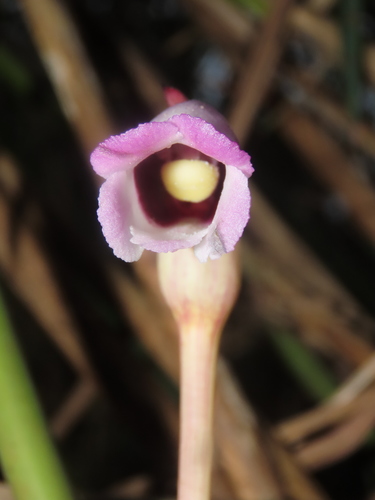
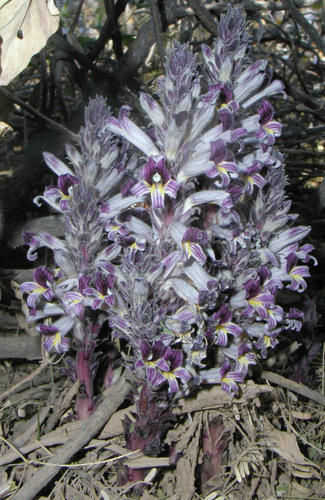
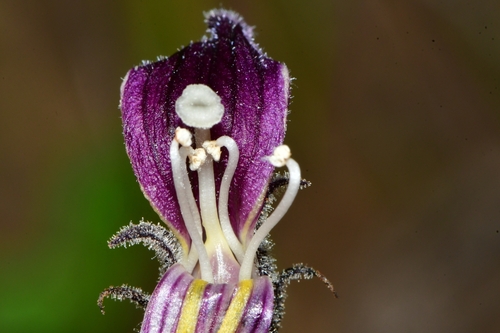
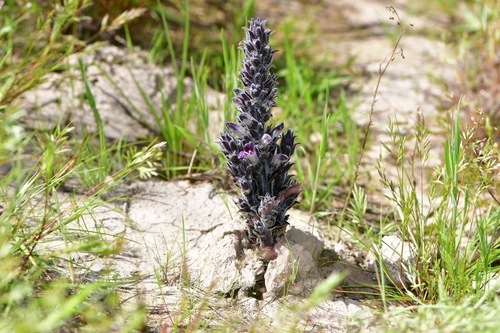
A parasitic herb. It grows attached to the roots of other plants especially the daisy family. It has a thick root and a scaly twisted stem. There can then be a clump of stems 40 cm tall. It lacks leaves and chlorophyll and gets its nutrients from the other plant. It is dark purple and has hairs. There are several flowers in a group. They are tube shaped and purple. They are 3 cm long.
Wikipedia
Source ↗Orobanche cooperi is a species of broomrape known by the common name Cooper's broomrape desert broomrape, spike broomrape, and burroweed strangler. It is native to the desert regions of the southwestern United States and northern Mexico, where it is a parasite growing attached to the roots of other plants, usually members of the Asteraceae, such as Artemisia, Hymenoclea, Ambrosia and Encelia. Although not usually weedy, it has been found infesting agricultural cropland, including tomato fields in inland California. This plant arises from a thick root and a scaly, twisted stem base, and produces a thick, clumpy stem up to 40 centimeters tall. As a parasite taking its nutrients from a host plant, it lacks leaves and chlorophyll. It is dark purple in color and coated with glandular hairs. The inflorescence is an elongated array of several flowers. Each flower is tubular, purple and hairy, and up to about 3 centimeters long.
Notes
There are about 140 Orobanche species.
Names & Synonyms
References (4)
- Beckstrom-Sternberg, Stephen M., and James A. Duke. "The Foodplant Database." http://probe.nalusda.gov:8300/cgi-bin/browse/foodplantdb.(ACEDB version 4.0 - data version July 1994) (As Orobanche ludoviciana)
- Moerman, D. F., 2010, Native American Ethnobotany. Timber Press. p 369 (As Orobanche cooperi)
- Plants for a Future database, The Field, Penpol, Lostwithiel, Cornwall, PL22 0NG, UK. http://www.scs.leeds.ac.uk/pfaf/ (As Orobanche ludoviciana)
- World Checklist of Useful Plant Species 2020. Royal Botanic Gardens, Kew (As Aphyllon cooperi)