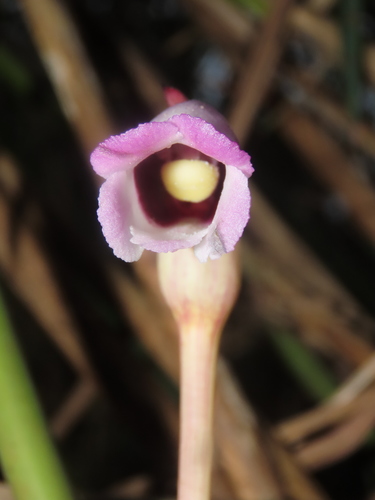
Orobanche pinorum
Geyer
Conifer Broomrape, Pinewoods Broom-rape
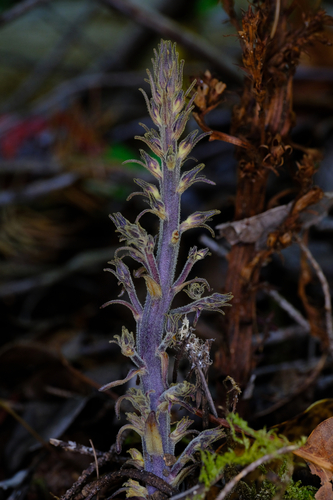
(c) Brian Starzomski, some rights reserved (CC BY-NC)
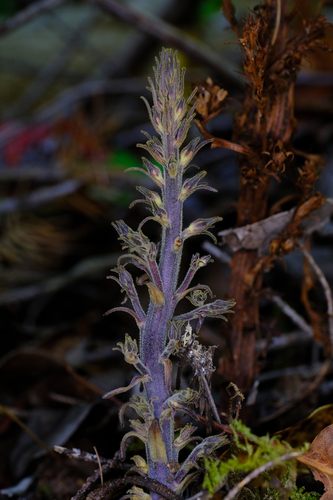
(c) Brian Starzomski, some rights reserved (CC BY-NC)
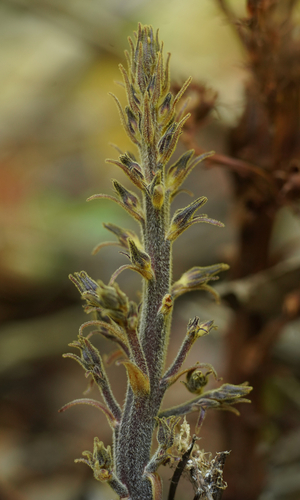
(c) Brian Starzomski, some rights reserved (CC BY-NC)
What to Eat
Edible parts: Leaves, Root
The whole plant is edible, raw or cooked.
Where to Find It
It is a temperate plant. It grows in forests.
North America, USA,
How to Identify
A parasitic plant. It grows attached to the roots of other plants especially Holodiscus species. It has a thickened base and a slender stem 10-30 cm tall. It gets its nutrients from the host plant. It does not have leaves o r chlorophyll and is brown or yellowish in colour. There is a dense clusters of flowers. They are purple to yellow and 2 cm long.
How to Grow
We have very little information on this species and do not know if it will be hardy in Britain. It requires a well-drained soil and should succeed in sun or shade. A fully parasitic plant lacking in chlorophyll, it is entirely dependant upon its host plant for obtaining nutrient. Its natural hosts are coniferous trees. Modern research shows that the plant is not parasitic on coniferous plants but uses Holodiscus discolor as its host (personal communication from M. Ellis )
Propagation: No specific information is available for this species, but sowing seed in a greenhouse in a pot containing a host plant is suggested. Seed is probably best sown as soon as ripe where possible. It may also be feasible to sow seed in situ around a host plant.
Medicinal Uses
The plant is both laxative and sedative.
Other Uses
None known.
Wikipedia
Source ↗Orobanche pinorum is a species of broomrape known by the common name conifer broomrape. It is native to the forests of western North America, where it is a parasite growing attached to the roots of other plants, usually Holodiscus species. This plant has an erect stem with a wide, thickened base and slender top growing 10–30 centimetres (3.9–11.8 in) tall. As a parasite taking its nutrients from a host plant, it lacks leaves and chlorophyll and is brownish or yellowish in color. The inflorescence is a dense, spreading array of purple-tinged yellowish flowers 1–2 centimetres (0.39–0.79 in) long.
Notes
There are about 140 Orobanche species.
References (1)
- Plants for a Future database, The Field, Penpol, Lostwithiel, Cornwall, PL22 0NG, UK. http://www.scs.leeds.ac.uk/pfaf/