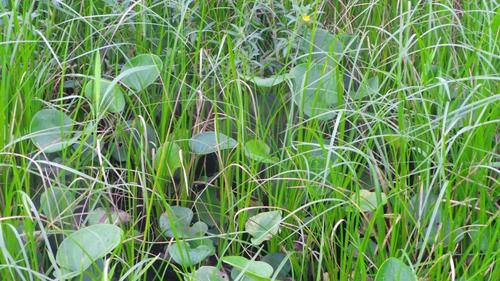
Ottelia ulvifolia
(Planch.) Walp.
Water lettuce

(c) Thomas C. Wagner, some rights reserved (CC BY-NC), uploaded by Thomas C. Wagner

(c) Robert Taylor, some rights reserved (CC BY), uploaded by Robert Taylor

(c) Riana Fourie, some rights reserved (CC BY-NC), uploaded by Riana Fourie
What to Eat
Edible parts: Leaves, Fruit, Seeds, Vegetable
The leaves, fruit, and seeds are edible and used as vegetables.
Where to Find It
A tropical plant. It grows in moving water throughout West Africa.
Africa, Angola, Botswana, Burkina Faso, Cameroon, Central Africa, Central African Republic, CAR, Congo, East Africa, Eswatini, Ethiopia, Gabon, Guinea, Guinée, Guinea-Bissau, Kenya, Liberia, Madagascar, Mozambique, Senegal, Sierra Leone, South Africa, Southern Africa, Sudan, Swaziland, Tanzania, West Africa, Zambia, Zimbabwe,
How to Identify
A herb that grows in water. It keeps growing from year to year. The leaves are under the water. They are 30 cm long by 6 cm wide. The leaves let light through. The flowers are yellow or white and are above the water.
Notes
There are about 40 Ottelia species. They grow in the tropics.
Names & Synonyms
Kumubu, Kunto, M'kopo, Pruia, Sobaba, Yi ba bo, Yi-sasa
References (13)
- Ann. Bot. 3:510. 1853 "ulvaefolia"
- Burkill, H. M., 1985, The useful plants of west tropical Africa, Vol. 2. Kew.
- Dalziel, J. M., 1937, The Useful plants of west tropical Africa. Crown Agents for the Colonies London.
- Fowler, D. G., 2007, Zambian Plants: Their Vernacular Names and Uses. Kew. p 86
- Gallagher, D. E., 2010, Farming beyond the escarpment: Society, Environment, and Mobility in Precolonial Southeastern Burkina Faso. PhD University of Michigan.
- Grubben, G. J. H. and Denton, O. A. (eds), 2004, Plant Resources of Tropical Africa 2. Vegetables. PROTA, Wageningen, Netherlands. p 563
- Jardin, C., 1970, List of Foods Used In Africa, FAO Nutrition Information Document Series No 2. p 92, 151 and p 46 (As Ottelia lancifolia)
- Mutie, F. M., et al, 2023, Important Medicinal and Food Taxa (Orders and Families) in Kenya, Based on Three Quantitative Approaches. Plants 2023, 12, 1145
- Peters, C. R., O'Brien, E. M., and Drummond, R.B., 1992, Edible Wild plants of Sub-saharan Africa. Kew. p 31
- Razanameharizaka, J., et al, 2022, Catalogue Legumes Traditionnels de Madagascar. Université d’Antananarivo, Antananarivo (101), Madagascar. Vol. 1. p 45
- Romanowski, N., 2007, Edible Water Gardens. Hyland House. p 112
- Swaziland's Flora Database http://www.sntc.org.sz/flora
- World Checklist of Useful Plant Species 2020. Royal Botanic Gardens, Kew