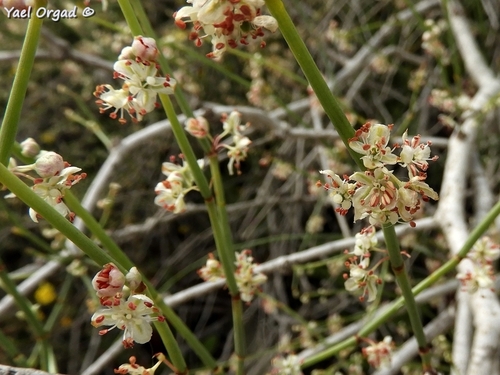
Oxygonum sinuatum
(Hochst. & Steud. ex Meisn.) Dammer
Kindiri, Bamba
(c) Dewald du Plessis, some rights reserved (CC BY-NC), uploaded by Dewald du Plessis

(c) Wynand Uys, some rights reserved (CC BY), uploaded by Wynand Uys
(c) tjeerd, some rights reserved (CC BY-NC), uploaded by tjeerd
What to Eat
Edible parts: Leaves, Fruit, Vegetable
The leaves are the primary edible portion, cooked to a slimy consistency and made into sauces or side dishes, or eaten raw for their acid taste. Leaves can be dried and powdered for storage. The fruit is also edible.
Where to Find It
A tropical plant. It often grows on sandy soils. In Kenya it grows from sea level to 2,400 m altitude. In Uganda it is in areas with an annual rainfall of 1,000-1,600 mm.
Africa, Angola, Botswana, Central Africa, Congo, East Africa, Ethiopia, Kenya, Malawi, Mozambique, South Africa, Southern Africa, Sudan, Tanzania, Uganda, Zambia, Zimbabwe,
How to Identify
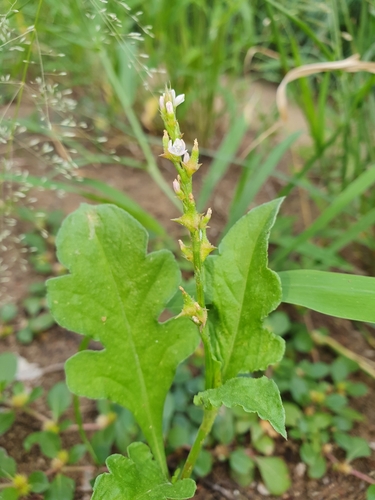
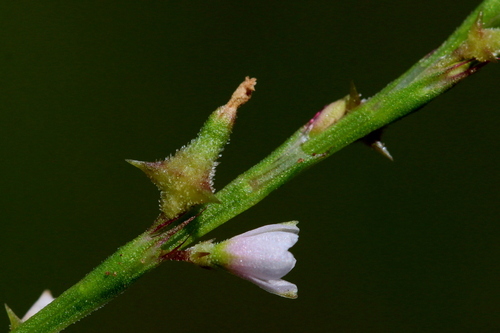
A herb. It grows up to 60 cm high. It is a sprawling plant and the lower parts of the stems lie along the ground. The leaves taper at each end. The leaf stalk is expanded to form a tube around the stem. This often has soft bristles at the top. This tube is 0.5 cm long. The leaves can be simple or divided into rounded lobes. The flowers are on a long leafless stem. This can be 30 cm long. The fruit has a sharp point at the top and 3 sharp prickles near the middle.
Nutrition
| Part | Moisture | kJ | kcal | Protein | Vit A | Vit C | Iron | Zinc |
|---|---|---|---|---|---|---|---|---|
| Leaves | 89.3 | — | — | — | — | 11 | 3.6 | — |
How to Grow
Plants can be grown by seeds.
Medicinal Uses
No medicinal uses documented in provided data.
Production
Leaves are collected during the rainy season. They can be plucked from the plant or the stem bearing leaves cut.
Other Information
In some places it is a famine and and in other places a favourite dish. Locally it is a useful vegetable.
Names & Synonyms
Adwalarach, Agwata-remo, Aketemir, Bulukutu, Chementril, Chew-mirahut, Chimbiri, Ciselu, Cuguru, Kabeta, Kachiwanga, Kacumita bagenge, Kafupa, Kalasaweni, Mbigili, Mororoqissa, Nchonge, Ngonko, Nyatiend-gweno, Okure, Okuro, Saselesya, Song'e
References (33)
- Addis, G., et al, 2005, Ethnobotanical Study of Edible Wild Plants in Some Selected Districts of Ethiopia. Human Ecology, Vol. 33, No. 1, pp. 83-118
- Addis, G., Asfaw, Z & Woldu, Z., 2013, Ethnobotany of Wild and Semi-wild Edible Plants of Konso Ethnic Community, South Ethiopia. Ethnobotany Research and Applications. 11:121-141
- Addis, G., et al, 2013, The Role of Wild and Semi-wild Edible Plants in Household Food Sovereignty in Hamer and Konso Communities, South Ethiopia. Ethnobotany Research & Applications. 11:251-271
- Agea, J. G., et al 2011, Wild and Semi-wild Food Plants of Bunyoro-Kitara Kingdom of Uganda: etc. Environmental Research Journal 5(2) 74-86
- Anywar, G., et al, 2014, Wild Plants Used as Nutraceuticals from Nebbi District, Uganda. European Journal of medicinal Plants. 4(6):641-660
- Anywar, G., et al, 2017, Proximate Nutrient Composition of some wild edible medicinal plants from Uganda. AJFAND 17(3)
- Fowler, D. G., 2007, Zambian Plants: Their Vernacular Names and Uses. Kew. p 53
- Godfrey, J. et al, 2013, Harvesting, preparationand preservation of commonly consumed wild and semi-wild food plants in Bunyoro-Kitara Kingdom, Uganda. Int. J. Med. Arom. Plants. Vol.3 No.2 pp 262-282
- Goode, P., 1989, Edible Plants of Uganda. FAO p 36
- Grubben, G. J. H. and Denton, O. A. (eds), 2004, Plant Resources of Tropical Africa 2. Vegetables. PROTA, Wageningen, Netherlands. p 407
- Ichikawa, M., 1980, The Utilization of Wild Food Plants by the Suiei Dorobo in Northern Kenya. J. Anthrop. Soc. Nippon. 88(1): 25-48
- Jardin, C., 1970, List of Foods Used In Africa, FAO Nutrition Information Document Series No 2.p 92
- Johns, T., and Kokwaro, J.O., 1991, Food Plants of the Luo of Siayo District, Kenya. Economic Botany 45(1), pp 103-113
- Kokwaro, J. O. and Johns. T., Luo Biological Dictionary. p 27
- Lulekal, E., et al, 2011, Wild edible plants in Ethiopia: a review on their potential to combat food insecurity. Afrika Focus - Vol. 24, No 2. pp 71-121
- Masters, T., 2021, Traditional food plants of the upper Aswa River catchment of northern Uganda—a cultural crossroads. Journal of Ethnobiology and Ethnomedicine (2021) 17:24
- Maundu, P. et al, 1999, Traditional Food Plants of Kenya. National Museum of Kenya. 288p
- Msuya, T. S., et al, 2010, Availability, Preference and Consumption of Indigenous Foods in the Eastern Arc Mountains, Tanzania, Ecology of Food and Nutrition, 49:3, 208-227
- Mutie, F. G., 2020, Conservation of Wild Food Plants and Their Potential for Combatting Food Insecurity in Kenya as Exemplified by the Drylands of Kitui County. Plants 2020, 9, 1017
- Mutie, F. M., et al, 2023, Important Medicinal and Food Taxa (Orders and Families) in Kenya, Based on Three Quantitative Approaches. Plants 2023, 12, 1145
- Ngugi, G., 1999, Case study from Kenya in Indigenous Wild Vegetables. Workshop in Kenya. USAID p 51
- Ocho, D. L., et al, 2012, Assessing the levels of food shortage using the traffic light metaphor by analyzing the gathering and consumption of wild food plants, crop parts and crop residues in Konso, Ethiopia. Journal of Ethnobiology and Ethnomedicine 8:30
- Ojelel, S., et al, 2019, Wild edible plants used by communities in and around selected forest reserves of Teso-Karamoja region, Uganda. Journal of Ethnobiology and Ethnomedicine (2019) 15:3
- Peters, C. R., O'Brien, E. M., and Drummond, R.B., 1992, Edible Wild plants of Sub-saharan Africa. Kew. p 162
- Pickering, H., & Roe, E., 2009, Wild Flowers of the Victoria Falls Area. Helen Pickering, London. p 98
- Ruffo, C. K., Birnie, A. & Tengnas, B., 2002, Edible Wild Plants of Tanzania. RELMA p 506
- Ruiters-Welcome, A. K., 2019, Food plants of southern Africa. Ph.D. thesis. Univ. of Johannesburg p 91
- Shumsky, S., et al, 2014, Institutional factors affecting wild edible plant (WEP) harvest and consumption in semi-arid Kenya. Land Use Policy 38(2014) 48-69
- Termote, C., et al, 2014, Assessing the potential of wild foods to reduce the cost of a nutritionally adequate diet: An example from eastern Baringo District, Kenya. Food and Nutrition Bulletin, vol. 35, no. 4
- Vernon, R., 1983, Field Guide to Important Arable Weeds of Zambia. Dept of Agriculture, Chilanga, Zambia. p 22
- Welcome, A. K. & Van Wyk, B.-E., 2019, An inventory and analysis of the food plants of southern Africa. South African Journal of Botany 122 (2019) 136–179
- Williamson, J., 2005, Useful Plants of Malawi. 3rd. Edition. Mdadzi Book Trust. p 184
- World Checklist of Useful Plant Species 2020. Royal Botanic Gardens, Kew