Oxyria digyna
(L.) Hill
Mountain sorrel
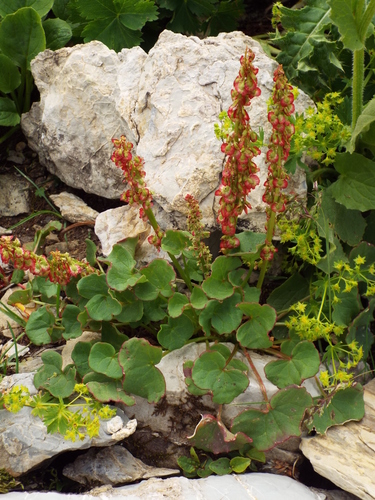
(c) ahmedm, some rights reserved (CC BY-NC), uploaded by ahmedm
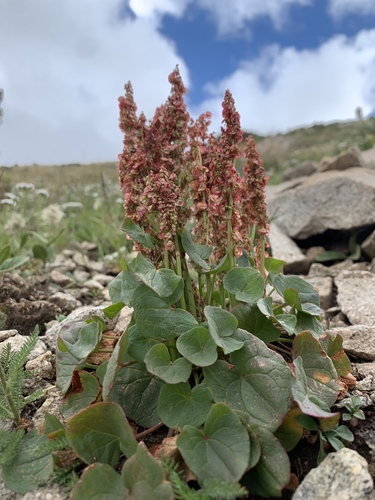
(c) Zach Coury, some rights reserved (CC BY-NC), uploaded by Zach Coury

(c) ahmedm, some rights reserved (CC BY-NC), uploaded by ahmedm
What to Eat
Edible parts: Leaves, Seeds
The leaves can be eaten raw or cooked. They have a pleasingly acidic taste that makes an excellent potherb and a very nice addition to salads. The leaves can also be fermented into a sauerkraut for winter use. Use in moderation.
Where to Find It
It is a temperate plant. It grows to 64°-80° north in North America. It grows in Arctic and alpine regions in the Rocky Mountains. In the Himalayas it grows between 2,400-5,000 m altitude. It often grows on the gravel bars of creeks and river valleys. It suits hardiness zones 2-8.
Afghanistan, Alaska, Arctic, Asia, Balkans, Bhutan, Bosnia, Britain, Canada, Central Asia, China, Denmark, Europe, Faroe Islands, Greenland, Himalayas, Iceland, India, Ireland, Japan, Kazakhstan, Korea, Kyrgyzstan, Mongolia, Nepal, North America, Northeastern India, Norway, NW India, Pakistan, Russia, Scandinavia, Siberia, Sikkim, Slovenia, Sweden, Switzerland, Tajikistan, Tibet, Turkey, Türkiye, USA,
How to Identify
A small herb. It keeps growing from year to year. It has a short rootstock 1 cm thick. It forms clumps. The leaf stems are long. The leaves are kidney-shaped and green and succulent. The leaves are mostly at the base and 2.5-5 cm across. The leaves are often tinted red. The stems have few leaves. The stems are 10-30 cm long and the flowers are green or reddish. They are 2 mm across. The fruit becomes red with papery wings. They are 6 mm across.
How to Grow
Plants can be grown from seeds.
Propagation: Sow seed in spring in a cold frame, barely covering it — germination takes about 2 weeks. Seed sown as soon as it is ripe will germinate within a few days. Prick seedlings into individual pots as soon as they are large enough and plant out into permanent positions in early summer. Division can also be done in spring. Larger divisions can go directly into permanent positions, while smaller divisions are better potted up and grown on in light shade in a cold frame until well established, then planted out in late spring or early summer.
Medicinal Uses
The leaves are rich in vitamin C and have been used to treat scurvy. The plant is regarded as antiscorbutic and astringent. The roots, stems, and leaves are cooked and eaten in the treatment of dysentery.
Other Uses
No other uses are known.
Wikipedia
Source ↗Oxyria digyna (mountain sorrel, wood sorrel, Alpine sorrel or Alpine mountain-sorrel) is a species of flowering plant in the buckwheat family (Polygonaceae). It is native to arctic regions and mountainous parts of the Northern Hemisphere.
Other Information
The leaves are especially eaten by children.
Notes
It is rich in vitamins A, B and C.
Names & Synonyms
Alpski kislec, Amlu, Boke, Chhoti chukri, Chohahak, Chukru, Chu-Lchum, Chuma-tsi, Chyakulti, Fjellsyre, Huli, Kalashi, Khandui lenbu, Kongolick, Kugylnik, Kungluk, Kungoluk, Kyukyuma, Lamanchu, Lugsho, Nyalowa nyali, Quunarliaraat, Rudjevica, Suchali, Suchli, Youyaha
References (57)
- Ager, T. A. & Ager, L. P., 1980, Ethnobotany of the eskimos of Nelson Island, Alaska. Arctic Anthropology Vol 17. No. 1 pp 26-48
- Ainana, L. & Zagrebin, I., 2014, Edible Plants Used by the Siberian Yupik Eskimos of Southeastern Chukotka Peninsula, Russia, (English translation). p 32
- Ambasta, S.P. (Ed.), 2000, The Useful Plants of India. CSIR India. p 418
- Amin, M., et al, 2023, Edible wild plant species used by different linguistic groups of Kohistan Upper Khyber Pakhtunkhwa (KP), Pakistan. Journal of Ethnobiology and Ethnomedicine 19:6 p 11
- Ballabh, B., et al, 2007, Raw edible plants of cold desert Ladakh. Indian Journal of Traditional Knowledge. 6(1) pp 182-184
- Beckstrom-Sternberg, Stephen M., and James A. Duke. "The Foodplant Database." http://probe.nalusda.gov:8300/cgi-bin/browse/foodplantdb.(ACEDB version 4.0 - data version July 1994)
- Bhattarai, S and Chaudary, R. P., 2009, Wild Edible Plants Used by the People of Manang District, Central Nepal. Ecology of Food and Nutrition, 48:1-20
- Boesi, A., 2014, Traditional knowledge of wild food plants in a few Tibetan communities. Journal of Ethnobiology and Ethnomedicine 10:75
- Cormack, R. G. H., 1967, Wild Flowers of Alberta. Commercial Printers Edmonton, Canada. p 78
- Crawford, M., 2012, How to grow Perennial Vegetables. Green Books. p 135
- Dobriyal, M. J. R. & Dobriyal, R., 2014, Non Wood Forest Produce an Option for Ethnic Food and Nutritional Security in India. Int. J. of Usuf. Mngt. 15(1):17-37
- Dutt, B., et al, 2011, Ethnobotanical Survey of Plants used by Gaddi Tribe of Bharmour Area in Himachal Pradesh. ENVIS Bulletin: Himalayan Ecology 19, 2011
- Elias, T.S. & Dykeman P.A., 1990, Edible Wild Plants. A North American Field guide. Sterling, New York p 153
- Esperanca, M. J., 1988. Surviving in the wild. A glance at the wild plants and their uses. Vol. 2. p 98
- Facciola, S., 1998, Cornucopia 2: a Source Book of Edible Plants. Kampong Publications, p 185
- Flora of China @ efloras.org Volume 5
- Flora of Pakistan. www.eFloras.org
- Ghimire, S. K., et al, 2008, Non-Timber Forest Products of Nepal Himalaya. WWF Nepal p 115
- Girard, N. J., 2020, Sustainable Foraging of Wild Edible Plants in Norway. A Biocultural Approach. M. Sc. thesis Norwegian University. p 134
- Hedrick, U.P., 1919, (Ed.), Sturtevant's edible plants of the world. p 458
- Heller, C. A., 1962, Wild Edible and Poisonous Plants of Alaska. Univ. of Alaska Extension Service. p 19
- Heywood, V.H., Brummitt, R.K., Culham, A., and Seberg, O., 2007, Flowering Plant Families of the World. Royal Botanical Gardens, Kew. p 264
- http://www.botanic-gardens-ljubljana.com/en/plants
- Hu, Shiu-ying, 2005, Food Plants of China. The Chinese University Press. p 371
- Irving, M., 2009, The Forager Handbook, A Guide to the Edible Plants of Britain. Ebury Press p 171
- Jackes, D. A., Edible Forest Gardens
- Jernigan, K. (Ed.), 2012, A Guide to the Ethnobotany of the Yukon-Kuskokwim Region. Draft.
- Jernigan, K. A., et al, 2017, Naukan ethnobotany in post-Soviet times: lost edibles and new medicinals. Journal of Ethnobiology and Ethnomedicine (2017) 13:61
- Kermath, B. M., et al, 2014, Food Plants in the Americas: A survey of the domesticated, cultivated and wild plants used for Human food in North, Central and South America and the Caribbean. On line draft. p 600
- Khan, M. & Hussain, S., 2014, Diversity of wild edible plants and flowering phenology of district Poonch (J & K) in the northwest Himalaya. Indian Journal of Sci, Res. 9(1): 032-038
- Kiple, K.F. & Ornelas, K.C., (eds), 2000, The Cambridge World History of Food. CUP p 1817
- Kuhnlein, H. V. et al, 2009, Indigenous Peoples' food systems. FAO Rome
- MacKinnon, A., et al, 2009, Edible & Medicinal Plants of Canada. Lone Pine. p 324
- Masoodi, H. U. R. & Sundriyal, R. C., 2020, Richness of non-timber forest products in Himalayan communities—diversity, distribution, use pattern and conservation status. Journal of Ethnobiology and Ethnomedicine 16:56
- Moerman, D. F., 2010, Native American Ethnobotany. Timber Press. p 374
- Mullory, C. & Aitken, S., 2012, Common Plants of Nunavut. Inhabit Media p 84
- Murugan, Pal M., et al, 2010, Phytofoods of Nubra valley, Ladakh - The cold desert. Indian Journal of Traditional Knowledge. Vol. 9(2): 303-308
- Orhan, I., et al, 2009, Free radical scavenging properties and phenolic characterization. Food Chemistry 114: 276-281
- Plants for a Future database, The Field, Penpol, Lostwithiel, Cornwall, PL22 0NG, UK. http://www.scs.leeds.ac.uk/pfaf/
- Polunin, O., & Stainton, A., 2006, Flowers of the Himalaya, Oxford India Paperbacks. p 349
- Porsild, A.E., 1953, Edible Plants of the Arctic, Arctic 6:15-34, page 24
- Porsild, A.E., 1974, Rocky Mountain Wild Flowers. Natural History Series No. 2 National Museums of Canada. p 146
- Rana, D., et al, 2019, Ethnobotanical knowledge among the semi-pastoral Gujjar tribe in the high altitude (Adhwari’s) of Churah subdivision, district Chamba, Western Himalaya. Journal of Ethnobiology and Ethnomedicine (2019) 15:10
- Rana, J.C. et al, 2011, Genetic resources of wild edible plants and their uses among tribal communities of cold arid regions of India. Genetic Resources and crop Evolution.
- Rana, P. K., et al, 2014, Uses of Local Plant Biodiversity among the Tribal Communities of Pangi Valley of District Chamba in Cold Desert Himalaya, India. The Scientific World Journal. Volume 2014, Article ID 753289, 15 pages
- Rawat, G.S., & Pangtey, Y.P.S., 1987, A Contribution to the Ethnobotany of Alpine Regions of Kumaon. J. Econ. Tax. Bot. Vol. 11 No. 1 pp 139-147
- Redzic, S. J., 2006, Wild Edible Plants and their Traditional Use in the Human Nutrition in Bosnia-Herzegovina. Ecology of Food and Nutrition, 45:189-232
- Ryabushkina, N., et al, 2008, Brief Review of Kazakhstan Flora and Use of its Wild Species. The Asian and Australasian Journal of Plant Science and Biotechnology
- Sharma, L. et al, 2018, Diversity, distribution pattern, endemism and indigenous uses of wild edible plants in Cold Desert Biosphere Reserve of Indian Trans Himalaya. Indian Journal of Traditional Knowledge. Vol 17(1) January 2018 pp 122-131
- Singh, H.B., Arora R.K.,1978, Wild edible Plants of India. Indian Council of Agricultural Research, New Delhi. p 32
- Sundriyal, M., et al, 2004, Dietary Use of Wild Plant Resources in the Sikkim Himalaya, India. Economic Botany 58(4) pp 626-638
- Svanberg, I., et al, 2012, Edible wild plant use in the Faroe Islands and Iceland. Acta Societatis Botanicorum Poloniae 81(4): 233-238
- Thakur, D., et al, 2017, Why they eat, what they eat: patterns of wild edible plants consumption in a tribal area of Western Himalaya. Journal of Ethnobiology and Ethnomedicine (2017) 13:70
- Tsering, J., et al, 2017, Ethnobotanical appraisal on wild edible plants used by the Monpa community of Arunchal Pradesh. Indian Journal of Traditional Knowledge. Vol 16(4), October 2017, pp 626-637
- Turner, N., et al, 2011, "Up on the Mountain": Ethnobotanical Important of Montane Sites in Pacific Coastal North America. Journal of Ethnobiology 31(1): 4-43
- Turner, N. J. et al, 2011, Edible and Tended Wild Plants, Traditional Ecological Knowledge and Agroecology. Critical Reviews in Plant Sciences, 30:198-225
- Weckerle, C. S., et al, 2006, Plant Knowledge of the Shuhi in the Hengduan Mountains, Southwest China. Economic Botany 60(1):2-23