Pangium edule
Reinw. ex Blume
Sis, Pangi, Kluwak tree
(c) Naufal Urfi Dhiya'ulhaq, some rights reserved (CC BY-NC), uploaded by Naufal Urfi Dhiya'ulhaq
(c) omegatron, some rights reserved (CC BY-NC), uploaded by omegatron
(c) Naufal Urfi Dhiya'ulhaq, some rights reserved (CC BY-NC), uploaded by Naufal Urfi Dhiya'ulhaq
What to Eat
Edible parts: Seeds, Nut, Leaves (old), Spice, Fruit
The fresh fruit and seeds contain hydrogen cyanide, and are thus deadly poisonous if consumed without prior preparation. The seeds are first boiled and then buried in ash, banana leaves and earth for forty days, during which time they turn from a creamy white colour to dark brown or black. The method relies on the fact that the hydrogen cyanide released by the boiling and fermentation is water-soluble and easily washed out. The kernels may be ground up to form a thick black gravy called rawon. Popular dishes include nasi rawon, beef stew in keluwek paste, popular in East and Central Java, and sambal rawon, rawon stew made with beef or chicken, also made in East Java. In West Java and Jakarta, gabus pucung, snakehead fish in pucung paste soup, is a popular traditional dish in Betawi cuisine. The Toraja dish pammarrasan (black spice with fish or meat, also sometimes with vegetables) uses the black keluak powder. In Singapore and Malaysia, the seeds are best known as an essential ingredient in ayam (chicken) or babi (pork) buah keluak, a mainstay of Peranakan cuisine. The Dusun tribe of Borneo use this pounded kernel as main ingredient for making local signature dish called bosou, a sour fermented fish. People of the Minahasa tribe in North Sulawesi use the young leaves as a vegetable, slicing them small, then cooking them with herbs and pork fat or meat inside bamboo. Many sellers in the Tomohon traditional market sell the leaves.
Known Hazards
Where to Find It
A tropical plant. It is native to SE Asia. It is a plant of the hot humid tropics. They are widely distributed in primary forests and clearings at low and medium altitudes from southern Luzon to Palawan and southern Mindanao in the Philippines. It mostly grows below 300 m altitude but can be up to 1000 m. It is in the lowland and mid altitude rainforests often near creeks. It prefers slightly acidic soils. It can be in mangrove swamps.
Andamans, Asia, Bougainville, East Timor, FSM, Guam, Indochina, Indonesia, Kosrae, Malaysia, Micronesia, Pacific, Palau, Papua New Guinea, PNG, Philippines, Pohnpei, SE Asia, Singapore, Solomon Islands, Thailand, Timor-Leste, Vanuatu, Yap,
How to Identify
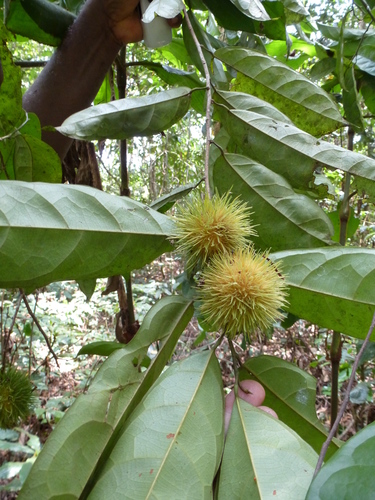
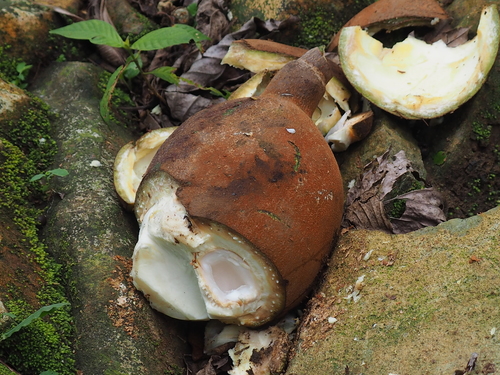
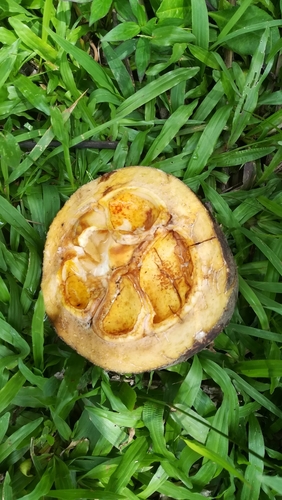
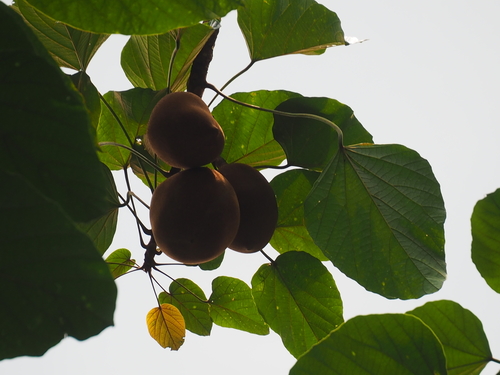
A large tree reaching a height of 25-40 m and about 50-100 cm across the trunk. The crown of the tree can spread to 50 m across. It has buttresses. The branches normally droop over. The leaves are very large and smooth. They can vary between 10 to 60 cm long by 8 to 40 cm across. They can be entire or lobed, pointed at the tip and rounded or heart shaped at the base. Leaves in young trees have 3 lobes. Often leaves are in a spiral arrangement near the ends of branches. Flowers are separate sexes and often on different trees. The flowers are yellowish white and have a faint smell. They are about 4 cm wide. The fruit are large, up to 15 cm long, brown and contain several seeds embedded in yellowish edible pulp. The seeds are about 5 cm long. The fruit has a strong smell.
Nutrition Score: 58/100
| Part | Moisture | kJ | kcal | Protein | Vit A | Vit C | Iron | Zinc |
|---|---|---|---|---|---|---|---|---|
| Leaves | 71.2 | 443 | 106 | 6.2 | — | — | 7.3 | 25 |
| Fruit | 57.7 | 113 | 227 | 7.3 | — | — | 21 | 14 |
How to Grow
Plants grow wild and are also cultivated from seeds. Seeds can float for a long time in water.
Propagation: Seed - in view of the hard seed coat, scarification followed by immersion in water for 24 hours prior to sowing is preferred. A seed bed consisting of sand facilitates transplanting. Germination takes about 1 month, seedlings are transplanted to individual pots when 2 - 3 leaves have developed. Potting medium consists of equal amounts of compost and sand. After 4 months the seedlings can be transplanted to the garden. In a seedling trial of Pangium edule in Malaysia 9 out of 14 non-scarified seeds germinated after 20 - 32 days.
Medicinal Uses
The glucosides contained in the plant, although toxic, also have several medical applications. In particular they have antiseptic properties and the crushed fresh seeds can be used to sterilize wounds. They are also applied externally as a poultice to boils. The leaves are antiseptic. They are crushed and used externally to steralize wounds, treat skin parasites etc. They are heated on a fire then placed around the head and covered with a cloth as a remedy for head lice. The juice of the fruit is applied topically to sores and cuts. The crushed bark from a mature tree is cooked in a soup and then given to lactating mothers. Their breast milk is then believed to help the young child to become stronger and more resistant to illness. The inner bark is heated over a hot stone and the vapour produced is used as a steam bath to bring relief to swollen and painful joints.
Other Uses
The oil from the seed is used as an illuminant and for making soap. The shells are used as rattles on dancing masks. The heartwood is a light yellow; it is not clearly demarcated from the yellowish to orangish sapwood. There is a disagreeable odour. The wood is hard but not very durable. A good timber source for local use in traditional house construction etc.
Production
Trees start to fruit when about 10-15 years old. Trees live for a long time. Fruiting is seasonal and the fruit season tends to be May to August.
Other Information
Seeds are sold in markets. The tree is moderately common in coastal areas of Papua New Guinea, but the nut is not always eaten. It is popular near Madang. It is cultivated.
Notes
There is only one Pangium species. Also put in the Flacourtiaceae and Salicaceae family.
Names & Synonyms
Ariammel, Bauh keluak, Black nut, Bua keluak, Dahdah, Duhrien, Funge, Hapesong, Kapayang, Kayu tuba buwah, Kepayang, Kluwek, Pachung, Paiuwa, Pakem, Payang, Pohon kluwak Puchong, Puchung, Raun vange, Riamel Simaung, Ru dohdoh, Siburu, Siwamang, Suwung, Tuhriaen, Vange, Wak
References (49)
- Awasthi, A.K., 1991, Ethnobotanical studies of the Negrito Islanders of Andaman Islands, India - The Great Andamanese. Economic Botany 45(2) pp274-280
- Barwick, M., 2004, Tropical and Subtropical Trees. A Worldwide Encyclopedic Guide. Thames and Hudson p 308
- Batet, K., Koil, U., and Hertel, H., 1998, Traditional Plant Use by the Didipa Clan, Baitabag, Papua New Guinea. GDS. p 41
- Blench, R., 2004, Fruits and Arboriculture in the Indo-Pacific Region. Indo-Pacific Prehistory Association Bulletin 24. (Taipei Papers Volume 2) p 39
- Borrell, O.W., 1989, An Annotated Checklist of the Flora of Kairiru Island, New Guinea. Marcellin College, Victoria Australia. p 80, 100+10, 190
- Bourke, M., 1995, Edible Indigenous Nuts in Papua New Guinea. In South Pacific Indigenous Nuts. ACIAR Proceedings No 69, Canberra. p 46
- Bremness, L., 1994, Herbs. Collins Eyewitness Handbooks. Harper Collins. p 71
- Brown, W.H., 1920, Wild Food Plants of the Philippines. Bureau of Forestry Bulletin No. 21 Manila. p 122
- Burkill, I.H., 1966, A Dictionary of the Economic Products of the Malay Peninsula. Ministry of Agriculture and Cooperatives, Kuala Lumpur, Malaysia. Vol 2 (I-Z) p 1680
- Cabalion, P. and Morat, P., 1983, Introduction le vegetation, la flore et aux noms vernaculaires de l'ile de Pentcoste (Vanuatu), In: Journal d'agriculture traditionnelle et de botanique appliquee JATBA Vol. 30, 3-4
- Chai, P. P. K. (Ed), et al, 2000, A checklist of Flora, Fauna, Food and Medicinal Plants. Lanjak Entimau Wildlife Sanctuary, Sarawak. Forestry Malaysia & ITTO. p 164
- Evans, B. R, 1999, Edible nut Trees in Solomon Islands. A variety collection of Canarium, Terminalia and Barringtonia. ACIAR Technical Report No. 44 96pp
- Facciola, S., 1998, Cornucopia 2: a Source Book of Edible Plants. Kampong Publications, p 117
- Flavelle, A. J., 1991, A Traditional Agroforestry Landscape on Fergusson Island, Papua New Guinea. M. Sc. Univ. of British Columia. p 160
- French, B.R., 1986, Food Plants of Papua New Guinea, A Compendium. Asia Pacific Science Foundation p 193
- French, B.R., 2010, Food Plants of Solomon Islands. A Compendium. Food Plants International Inc. p 181
- Havel, J.J., 1975, Forest Botany, Volume 3 Part 2 Botanical taxonomy. Papua New Guinea Department of Forests, p 211
- Hedrick, U.P., 1919, (Ed.), Sturtevant's edible plants of the world. p 461
- Henning, B. M., 2014, The Diversity of Conservation: Exploring Narratives, Relationships and Ecosystem Services in Melanesian Market-based Biodiversity Conservation. Ph D dissertation, Uni of Minnesota. p 209
- Henty, E.E., 1980, Harmful Plants in Papua New Guinea. Botany Bulletin No 12. Division Botany, Lae, Papua New Guinea. p 64, 65
- Hide, R. L., (Ed.) 1984, Research Report of the Simbu Land Use Project. Vol.V1 South Simbu: Studies in Demography, Nutrition, and Subsistence. p 434
- Hoe, V. B. & Siong, K. H., 1999, The nutritional value of indigenous fruit and vegetables in Sarawak. Asia Pacific J. Clin. Nutr. 8(1):24-31
- http://palaeoworks.anu.edu.au/Nuno_PhD/04.pdf re Timor
- Lebot, V. & Sam, C., Green desert or ‘all you can eat’? How diverse and edible was the flora of Vanuatu before human introductions?. Terra australis 52 p 410
- Lepofsky, D., 1992, Arboriculture in the Mussau Islands, Bismarck Archipelago. Economic Botany, Vol 46, No. 2, pp. 192-211
- Menninger, E.A., 1977, Edible Nuts of the World. Horticultural Books. Florida p 120
- Monsalud, M.R., Tongacan, A.L., Lopez, F.R., & Lagrimas, M.Q., 1966, Edible Wild Plants in Philippine Forests. Philippine Journal of Science. p 471
- Morley, B. & Everard, B., 1970, Wild Flowers of the World. Ebury press. Plate 118
- Nombo, P. & Leach, J. 2010, Reite Plants: An Ethnobotanical Study in Tok Pisin and English. ANU press. p 104
- Ochse, J.J. et al, 1931, Vegetables of the Dutch East Indies. Asher reprint. p 293
- Owen, S., 1993, Indonesian Food and Cookery, INDIRA reprints. p 69
- Pawera, L., et al, 2020, Wild Food Plants and Trends in Their Use: From Knowledge and Perceptions to Drivers of Change in West Sumatra, Indonesia, Foods. 2020, 9, 1240
- Peekel, P.G., 1984, (Translation E. E. Henty), Flora of the Bismarck Archipelago for Naturalists, Division of Botany, Lae, PNG. p 385, 382
- PROSEA No. 2
- Siong, K. H., 2003, Indigenous Fruits of Sarawak. ITTO & Sarawak Forest Department. p 72
- Sleumer, H., 1954, Flacourtiaceae in Flora Malesiana, Ser 1 Vol 5(1) p 36
- Solomon, C., 2001, Encyclopedia of Asian Food. New Holland. p 44
- Sukarya, D. G., (Ed.) 2013, 3,500 Plant Species of the Botanic Gardens of Indonesia. LIPI p 430
- Sukenti, K., et al, 2016, Ethnobotanical study on local cuisine of the Sasak tribe in Lombok Island, Indonesia. Journal of Ethnic Foods. 3 (2016) 189-200 p 198
- Sunanto H., 1993, Budidaya Pucung. Usaha Produksi Kluwak Dan Minyak Kepayang, Penerbit Kanisius.
- Syll. Pl. Nov. 2:13. 1826 (ex Blume, Catalogus 112. 1823, nom. nudum)
- Terra, G.J.A., 1973, Tropical Vegetables. Communication 54e Royal Tropical Institute, Amsterdam, p 64
- USDA, ARS, National Genetic Resources Program. Germplasm Resources Information Network - (GRIN). [Online Database] National Germplasm Resources Laboratory, Beltsville, Maryland. Available: www.ars-grin.gov/cgi-bin/npgs/html/econ.pl (10 April 2000)
- Walter, A & Sam, C., 1995, Indigenous Nut Trees in Vanuatu: Ethnobotany and Variability. In South Pacific Indigenous Nuts. ACIAR Proceedings No 69. Canberra. p 57
- Walter, A. & Sam C., 2002, Fruits of Oceania. ACIAR Monograph No. 85. Canberra. p 219
- Wiersema, J. H. & Leon, B., 2013, World Economic Plants. A Standard Reference CRC Press. 2nd Ed. p 491
- World Checklist of Useful Plant Species 2020. Royal Botanic Gardens, Kew
- www.manoa.hawaii.edu/botany/plants of micronesia
- Zeven, A. C. & de West, J. M. J., 1982, Dictionary of cultivated plants and their regions of diversity. Wageningen. p 53