Parinari capensis
Harv.
Sand apple, Dwarf mabolo

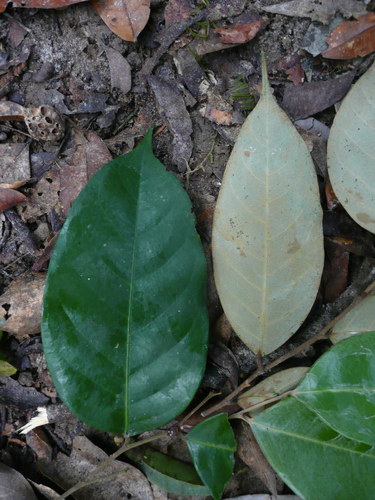
(c) Kate Braun, some rights reserved (CC BY-NC), uploaded by Kate Braun
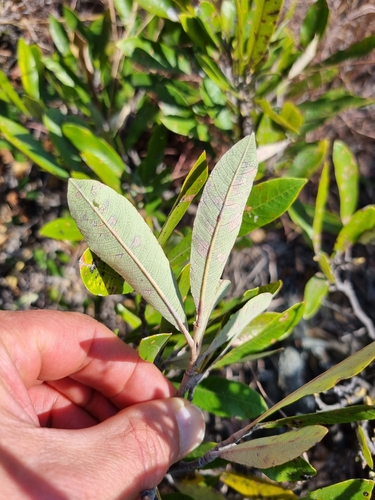
(c) Reuben Heydenrych, some rights reserved (CC BY-NC), uploaded by Reuben Heydenrych

(c) Richard Gill, some rights reserved (CC BY-NC), uploaded by Richard Gill
What to Eat
Edible parts: Seeds, Fruit, Drink
The sweet outer layer of the fruit is eaten fresh or buried in sand to soften, and can be dried into a soft cake. The juice is consumed fresh or boiled to a firm consistency. Crushed kernels are eaten as a relish with meat, and the fruit is used to make beer.
Where to Find It
A tropical plant. It grows amongst rocks and in sand and clay soils. It can be in seasonally flooded grassland. It grows between 900-1,200 m above sea level. In Zimbabwe it grows between 1,200-1,600 m above sea level. It can grow in arid places. It grows in poor savannah soils.
Africa, Angola, Botswana, Central Africa, Congo DR, East Africa, Eswatini, Malawi, Mozambique, Namibia, South Africa, Southern Africa, Swaziland, Tanzania, Zambia, Zimbabwe,
How to Identify
A shrub. It has underground stems. These are woody and up to 1 cm thick. This forms a branching network. Aerial stems arise from these. These can be 20 cm high. There are a few erect leaves. The leaf blade is sword shaped and 8 cm long by 1.5 cm wide. The lower surface has a white felt. The flowers are in loose clusters. They are cream coloured. The fruit is oval and fleshy. They are 1.8 cm long and have one seed. The fruit has a strong smell.
Nutrition Score: 70/100
| Part | Moisture | kJ | kcal | Protein | Vit A | Vit C | Iron | Zinc |
|---|---|---|---|---|---|---|---|---|
| Nuts | 1.9 | 2919 | 698 | 26.3 | — | — | 4.7 | 3.7 |
How to Grow
Plants are grown from seeds. The ripe fruit are buried and the flesh allowed to rot,. Then the seed is put in boiling water that is then allowed to cool and soak for 12 hours. Root suckers can also be used.
Wikipedia
Source ↗Parinari capensis, the sand apple, is a species of flowering plant in the family Chrysobalanaceae. It is found in Botswana, DRC, Mozambique, Namibia, South Africa, Tanzania and Zimbabwe. It is 20 centimetres (7.9 in) tall. The leaves are elliptic with a white underside. It has small white flowers and a hairy sand-coloured calyx.
Notes
There are about 50 Parinari species. They grow in the tropics.
Names & Synonyms
Axani, Ekokofi, Hachapasi, Ikia, Imvimbandhlebe, Isagogwane, Isitshapasi, Itchwakudi, Kapundubusushi, Mbola-oa-fase, Mmola, Mmolofasane, Molahatsia, Mubulu, Muchakatapasi, Muchkatapasi, Muhachapasi, Muhacha kwa pasi, Ncha, Nonsani, Nsansi, Nsudi nfuni, Ntadapalivu, Omukokofi, Sagogwane, Salaki, Salakia, Salakakizu, Shashi, Tamelassoli, Tshivhulafhasi, Tshivhulana, Umbula, Umkhuna, Umvalandhlebe
References (28)
- Cheikhyoussef, A & Embashu, W., 2013, Ethnobotanical knowledge on Indigenous fruits in Ohangwena and Oshito regions in Northern Namibia. Journal of Ethnobiology and Ethnomedicine 9:34
- Facciola, S., 1998, Cornucopia 2: a Source Book of Edible Plants. Kampong Publications, p 78
- FAO, 1988, Traditional Food Plants, FAO Food and Nutrition Paper 42. FAO Rome p 381
- Fowler, D. G., 2007, Zambian Plants: Their Vernacular Names and Uses. Kew. p 18
- Fox, F. W. & Young, M. E. N., 1982, Food from the Veld. Delta Books. p 153
- Jardin, C., 1970, List of Foods Used In Africa, FAO Nutrition Information Document Series No 2.p 152 p 153 (As Parinari latifolia), p 35 (As Parinari pumila)
- Latham, P & Mbuta, A., 2017, Useful Plants of Central Province, Democratic Republic of Congo. Volume 2. Salvation Army p 85
- Lautenschläger, T., et al, 2018, First large-scale ethnobotanical survey in the province of Uíge, northern Angola. Journal of Ethnobiology and Ethnomedicine (2018) 14:51
- Long, C., 2005, Swaziland's Flora - siSwati names and Uses http://www.sntc.org.sz/flora/ (As subsp. incohata)
- Maguire, 1978,
- Magwede, K., van Wyk, B.-E., & van Wyk, A. E., 2019, An inventory of Vhavenḓa useful plants. South African Journal of Botany 122 (2019) 57–89
- Malaisse, F., 1997, Se nourrir en floret claire africaine. Approche ecologique et nutritionnelle. CTA., p 65
- Marshall, 1976,
- Mashile, S. P., et al, 2019, Indigenous fruit plants species of the Mapulana of Ehlanzeni district in Mpumalanga province, South Africa. South African Journal of Botany 122 (2019) 180–183
- Mogg, 1975,
- Ogle & Grivetti, 1985,
- Peters, C. R., O'Brien, E. M., and Drummond, R.B., 1992, Edible Wild plants of Sub-saharan Africa. Kew. p 83
- Prance, G. T. & Sothers, C., 2003, Species Plantarum - Flora of the World. Chrysobalanaceae. p 205
- Royal Botanic Gardens, Kew (1999). Survey of Economic Plants for Arid and Semi-Arid Lands (SEPASAL) database. Published on the Internet; http://www.rbgkew.org.uk/ceb/sepasal/internet [Accessed 10th April 2011]
- Ruiters-Welcome, A. K., 2019, Food plants of southern Africa. Ph.D. thesis. Univ. of Johannesburg p 44
- Swaziland's Flora Database http://www.sntc.org.sz/flora
- Tredgold, M.H., 1986, Food Plants of Zimbabwe. Mambo Press. p 115
- van Wyk, Be., & Gericke, N., 2007, People's plants. A Guide to Useful Plants of Southern Africa. Briza. p 52
- van Wyk, B-E., 2011, The potential of South African plants in the development of new food and beverage products. South African Journal of Botany 77 (2011) 857–868
- Wehmeyer, A. S, 1986, Edible Wild Plants of Southern Africa. Data on the Nutrient Contents of over 300 species
- Welcome, A. K. & Van Wyk, B.-E., 2019, An inventory and analysis of the food plants of southern Africa. South African Journal of Botany 122 (2019) 136–179
- World Checklist of Useful Plant Species 2020. Royal Botanic Gardens, Kew
- www.zimbabweflora.co.zw 2011