Paris polyphylla
Smith
Herb Paris

(c) BunnyTailGra22 | 兔尾草, some rights reserved (CC BY-NC), uploaded by BunnyTailGra22 | 兔尾草
(c) Basu Dev Neupane, some rights reserved (CC BY-NC), uploaded by Basu Dev Neupane
(c) Gordon Chen, some rights reserved (CC BY-NC)
What to Eat
Edible parts: Seeds, Caution, Leaves, Flowers
The seed has a sweet but somewhat mawkish flavour.
Known Hazards
Where to Find It
A tropical and subtropical plant. It grows in broadleaved woodlands up to 3,000 metres in the Himalayas. It grows in moist humus rich soil. It can grow in sunlight of partial shade. In China it grows in forests between 100-3500 m altitude in many provinces. It suits hardiness zones 6-9. In Sichuan and Yunnan.
Asia, Australia, Bhutan, China, Himalayas, India, Indochina, Laos, Myanmar, Nepal, Northeastern India, Pakistan, SE Asia, Sikkim, Taiwan, Thailand, Tibet, Vietnam,
How to Identify
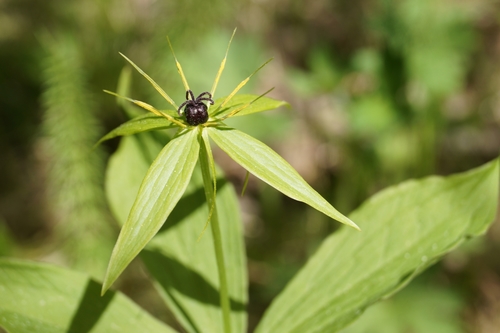
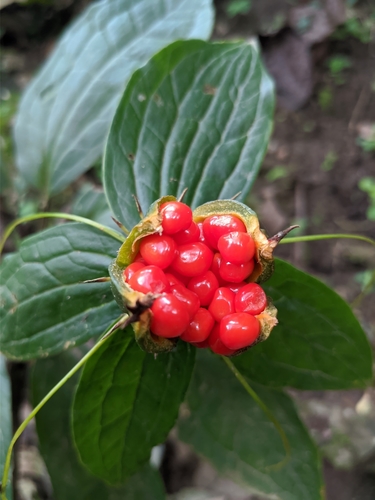
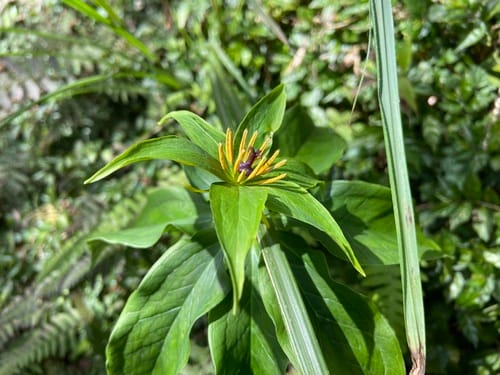
A perennial plant which grows up to 1 m tall. It spreads to 30 cm across. It has rhizomes or underground stems which are 1-2.5 cm thick. There are 5-10 leaves. The leaf stalk is 1-6 cm long. The leaf blade is usually oblong to sword shaped and 6-15 cm long by 0.5-5 cm wide. The base is rounded or wedge shaped. The flower stalk is 5-14 cm long. (There can be more leaves and longer leaf blades and flower stalks.) The flowers are yellowish-green. The fruit is a capsule which is round. The seeds are in a red soft aril or seed layer. Several varieties of this plant have been described.
How to Grow
Easily grown in a moist humus-rich soil in woodland conditions, succeeding in full or partial shade. Prefers a light sandy loam. This species is hardy to about -15°c according to one report, though another says that plants only succeed outdoors in southern and western Britain. Overcollection of this plant from the wild for medicinal purposes is a cause of conservation concern. A very variable species, with a large number of subspecies recognised. Plants are very slow to flower from seed. The individual flowers are very long-lived, lasting for up to 3 months.
Propagation: Sow seed as soon as it is ripe in late summer in light shade in a greenhouse. Stored seed should be sown in a greenhouse as soon as it is received. Germination is very slow: a primary root forms about 7 months after sowing and pulls the seed deeper into the soil, with leaves appearing roughly 4 months after that. Sow thinly in fairly deep pots so seedlings can remain undisturbed for their first two years. Once germinated, feed regularly with a weak liquid fertiliser to prevent nutrient deficiency. At the end of their second year of dormancy, divide seedlings into individual pots and grow on for at least another year in a shady part of the greenhouse before planting out. Can also be propagated by division.
Medicinal Uses
The roots are analgesic, antiphlogistic, antipyretic, antispasmodic, antitussive, depurative, febrifuge, narcotic, and anthelmintic. A decoction of the roots is used to treat poisonous snake bites, boils, ulcers, diphtheria, and epidemic Japanese B encephalitis. A paste of the roots is applied as a poultice for cuts and wounds, and the root juice has been used as an anthelmintic. The roots have demonstrated antibacterial activity against Bacillus dysenteriae, B. typhi, B. paratyphi, E. coli, Staphylococcus aureus, haemolytic streptococci, Meningococci, and others. The whole plant is febrifuge.
Other Uses
None known.
Wikipedia
Source ↗Paris polyphylla is a species of flowering plant native to China, the Indian subcontinent, and Indochina. It produces spider-like flowers that throw out long, thread-like, yellowish green petals throughout most of the warm summer months and into the autumn. In the fall, the flowers are followed by small, scarlet berries. It is a perennial, which slowly spreads, is fully hardy in Britain, and survives in leafy, moist soil in either complete or partial shade. This plant usually grows up to 90 cm (3 ft) high and spreads out about 30 cm (1 ft) wide. Its leaves grow in a single whorl below a flower growing in two whorls. According to Fayaz, there can be as many as twenty-two leaves in the whorl, a number exceeded only by some Equisetum species. This same source states that the tepals can number up to fourteen. It is used as an ornamental plant for woodland gardens or for planting under deciduous trees.
Production
Plants are slow to flower from seed. Flowers last 3 months.
Notes
The plant is poisonous. It has medicinal uses. There are about 24 Paris species. Also put in the family Trilliaceae.
Names & Synonyms
Ding-ding, Nyomrang takeng, Qi ye yi zhi hua, Satuwa, Tsao Hsiu
References (16)
- Ambasta, S.P. (Ed.), 2000, The Useful Plants of India. CSIR India. p 430
- Aryal, K. P., et al, 2018, Diversity and use of wild and non-cultivated edible plants in the Western Himalaya. Journal of Ethnobiology and Ethnomedicine (2018) 14:10
- Bremness, L., 1994, Herbs. Collins Eyewitness Handbooks. Harper Collins. p 200
- Brickell, C. (Ed.), 1999, The Royal Horticultural Society A-Z Encyclopedia of Garden Plants. Convent Garden Books. p 751
- Chen Xinqi, Liang Songyun, Xu Jiemei, Tamura M.N., Liliaceae. Flora of China. p 18
- Cundall, P., (ed.), 2004, Gardening Australia: flora: the gardener's bible. ABC Books. p 986
- Ding, X., 2021, Collection calendar: the diversity and local knowledge of wild edible plants used by Chenthang Sherpa people to treat seasonal food shortages in Tibet, China. Journal of Ethnobiology and Ethnomedicine 17:40
- Flora of Pakistan. www.eFloras.org
- Guo, C., et al, 2022, An Ethnobotany Survey of Wild Plants Used by the Tibetan People of the Yadong River Valley, Tibet, China. Journal of Ethnobiology and Ethnomedicine p 24
- Hedrick, U.P., 1919, (Ed.), Sturtevant's edible plants of the world. p 464
- Khakurel, D., et al, 2021, Foods from the wild: Local knowledge, use pattern and distribution in Western Nepal. PLOS ONE.
- Menninger, E.A., 1977, Edible Nuts of the World. Horticultural Books. Florida p 120
- Plants for a Future database, The Field, Penpol, Lostwithiel, Cornwall, PL22 0NG, UK. http://www.scs.leeds.ac.uk/pfaf/
- A. Rees, Cycl. 26: Paris no. 2. 1813
- Ryan, S., 2008, Dicksonia. Rare Plants Manual. Hyland House. p 108
- Taram, M., et al, 2018, Wild Food Plant Resources of Komkar Adi Tribe of Upper Siang District in Arunachal Pradesh, India. Bulletin of Arunachal Forest Research, Vol. 33(2), 27-35
More from Melanthiaceae