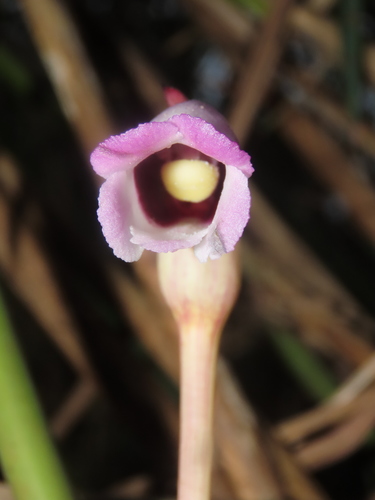
Pedicularis lanata
Willd. ex Cham. & Schltdl.
Woolly lousewort
no rights reserved, uploaded by hitchco

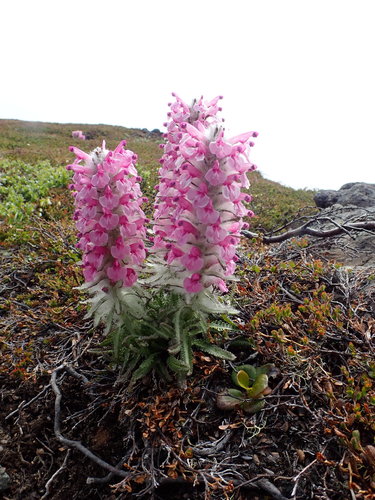
(c) GRID Arendal, some rights reserved (CC BY-NC-SA)

(c) Boris Bolshakov, some rights reserved (CC BY-NC), uploaded by Boris Bolshakov
What to Eat
Edible parts: Flowers, Leaves, Root
The root is eaten raw, boiled, or roasted (though bitter). The young flower tops are fermented and eaten as a dessert with oil and sugar. The flower stems are boiled and eaten as a potherb.
Where to Find It
It is a cold temperate plant. It grows in the tundra on the high mountains in Alaska. It grows in dry rocky places.
Alaska, Arctic, North America, Russia, Siberia, USA,
How to Identify
A herb that keeps growing from year to year. It has a thick yellow taproot. The stem has grey white woolly hairs. It grows 15 cm high. The leaves are mostly at the base. They are dark green and 6 cm long. The flowers are pink to red. They are on a woolly spike at the top of the plant. The seed capsules are brown.
Wikipedia
Source ↗Pedicularis lanata is a species of flowering plant in the family Orobanchaceae. It is native to Canada and Alaska. Its common names include woolly lousewort and bumble-bee flower.
Notes
Also put in the family Scrophulariaceae.
Names & Synonyms
Bumblebee plant, Kakykak, Kooklingwuk, Lousewort, Nahzakmeetak, Ugjungnaq, Ulevleruyiit, Woolly fernwed
References (10)
- Ager, T. A. & Ager, L. P., 1980, Ethnobotany of the eskimos of Nelson Island, Alaska. Arctic Anthropology Vol 17. No. 1 pp 26-48 (As Pedicularis kanei)
- Ainana, L. & Zagrebin, I., 2014, Edible Plants Used by the Siberian Yupik Eskimos of Southeastern Chukotka Peninsula, Russia, (English translation). p 64
- Heller, C. A., 1962, Wild Edible and Poisonous Plants of Alaska. Univ. of Alaska Extension Service. p 59
- Jernigan, K. (Ed.), 2012, A Guide to the Ethnobotany of the Yukon-Kuskokwim Region. Draft. (As Pedicularis kanei)
- Jones, A., 2010, Plants that we eat. University of Alaska Press. p 69
- Lim, T. K., 2015, Edible Medicinal and Non Medicinal Plants. Volume 9, Modified Stems, Roots, Bulbs. Springer p 63
- Moerman, D. F., 2010, Native American Ethnobotany. Timber Press. p 380
- Mullory, C. & Aitken, S., 2012, Common Plants of Nunavut. Inhabit Media p 174
- Plants for a Future database, The Field, Penpol, Lostwithiel, Cornwall, PL22 0NG, UK. http://www.scs.leeds.ac.uk/pfaf/ (Pedicularis kanei)
- Porsild, A.E., 1953, Edible Plants of the Arctic, Arctic 6:15-34, page 23