Persicaria attenuata
(R. Br.) Sojak
Watersmart weed, Hairy knotweed

(c) pcopping, some rights reserved (CC BY-NC), uploaded by pcopping

(c) Greg Tasney, some rights reserved (CC BY-SA), uploaded by Greg Tasney

(c) Alan McArthur, some rights reserved (CC BY-NC), uploaded by Alan McArthur
What to Eat
Edible parts: Leaves, Vegetable
Leaves - raw or cooked. Used as a fresh salad or as a cooked vegetable. In South-East Asia the leaves are eaten with food as a tonic and to purify the blood. We have no specific information for this species, but the seed of most, if not all, members of the genus is edible both raw and cooked, and is potentially a good source of amino acids. Unfortunately the seed is also usually rather small and fiddly to utilize.
Where to Find It
A tropical plant. It grows on the edges of swamps and waterways. It grows from sea level to 1,000 m above sea level.
Africa, Asia, Australia, Benin, East Africa, East Timor, Eswatini, Indochina, Indonesia, Laos, Pacific, Papua New Guinea, PNG, SE Asia, Sierra Leone, South Africa, Southern Africa, Swaziland, Tanzania, Timor-Leste, West Africa, Zimbabwe,
How to Identify
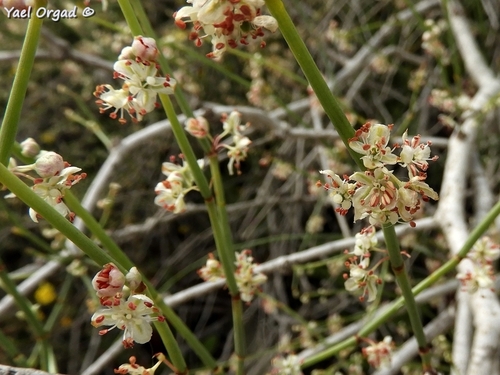
A herb which keeps growing from year to year. It can grow in water or dry land. The stems are spreading. They can have long hairs. The sheaths are reddish-brown and 3 cm long. The leaves are 8-20 cm long by 1.5-5 cm wide. They are narrowly oval. The leaves are hairy. The flower spikes are 11 cm long by 1 cm wide. The flowers are about 0.4 cm long and white. The fruit are small nuts. They are dark brown to black.
How to Grow
Plants can be grown from seed or cuttings.
Medicinal Uses
Persicaria attenuata is widely used medicinally. The rhizome contains 2.5% of an acrid resin which is a depressant and can arrest the heart. The leaves are used in treatments for syphilis, rheumatism and swellings. They are eaten with food as a tonic and to purify the blood. The plant is burnt to obtain a vegetable salt which is rich in potassium and is applied to sores on the back and chest of scrofulous hunchbacked children.
Other Uses
The plant is considered an indicator of land suitable for rice cultivation.
Other Information
A locally used vegetable.
Notes
There are about 75-150 Persicaria species. There are about 20 in tropical America.
Names & Synonyms
Jankong, Jukut carang
References (19)
- Calvert, G. & Liessman, L., 2014, Wetland Plants of the Townsville - Burdekin Flood Plain. LBLCA Ayr, Queensland, p 83
- Cowie, I, 2006, A Survey of Flora and vegetation of the proposed Jaco-Tutuala-Lore National Park. Timor-Lests (East Timor) www.territorystories.nt/gov.au p 52
- Elliot, W.R., & Jones, D.L., 1997, Encyclopedia of Australian Plants suitable for cultivation. Vol 7. Lothian. p 204
- Grubben, G. J. H. and Denton, O. A. (eds), 2004, Plant Resources of Tropical Africa 2. Vegetables. PROTA, Wageningen, Netherlands. p 412
- Henty, E.E., & Pritchard, G.S., 1973, Weeds of New Guinea and their control. Botany Bulletin No 7, Division of Botany, Lae, PNG. p 138
- Henty, E.E., in Womersley, J.S., (ed), 1978, Handbooks of the Flora of Papua New Guinea. Melbourne University Press,Victoria. Vol 1, p 232
- Henty, E.E., 1980, Harmful Plants in Papua New Guinea. Botany Bulletin No 12. Division Botany, Lae, Papua New Guinea. p 116, 117
- Jardin, C., 1970, List of Foods Used In Africa, FAO Nutrition Information Document Series No 2.p 95
- Martin, F.W. & Ruberte, R.M., 1979, Edible Leaves of the Tropics. Antillian College Press, Mayaguez, Puerto Rico. p 213
- Leach, G.J., & Osborne, P.L., 1985, Freshwater Plants of Papua New Guinea. UPNG Press, p 213
- Paczkowska, G . & Chapman, A.R., 2000, The Western Australian Flora. A Descriptive Calatogue. Western Australian Herbarium. p 460
- Pham-Hoang Ho, 1999, An Illustrated Flora of Vietnam. Nha Xuat Ban Tre. p 751
- Plants for a Future database, The Field, Penpol, Lostwithiel, Cornwall, PL22 0NG, UK. http://www.scs.leeds.ac.uk/pfaf/
- Romanowski, N., 2007, Edible Water Gardens. Hyland House. p 77
- Stephens, K.M., & Dowling, R.M., 2002, Wetland Plants of Queensland. A field guide. CSIRO p 74
- Swaziland's Flora Database http://www.sntc.org.sz/flora (As var. africana)
- Terra, G.J.A., 1973, Tropical Vegetables. Communication 54e Royal Tropical Institute, Amsterdam, p 68
- Wheeler, J.R.(ed.), 1992, Flora of the Kimberley Region. CALM, Western Australian Herbarium, p 146
- World Checklist of Useful Plant Species 2020. Royal Botanic Gardens, Kew