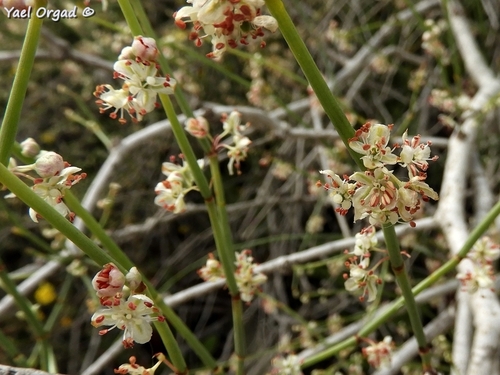
Persicaria decipiens
(R. Br.) K. L. Wilson
Slender Knotweed, Snake root

(c) Terra Occ, some rights reserved (CC BY), uploaded by Terra Occ
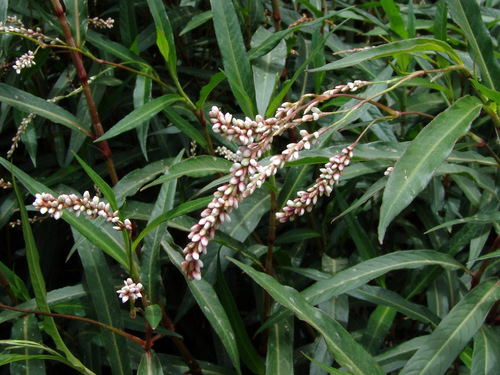
(c) Ron Frumkin, some rights reserved (CC BY-NC), uploaded by Ron Frumkin
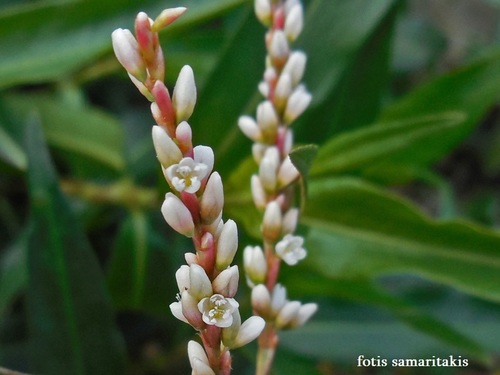
(c) fotis-samaritakis, some rights reserved (CC BY-NC), uploaded by fotis-samaritakis
What to Eat
Edible parts: Leaves, Vegetable
The leaves are cooked as a vegetable, though they are described as slimy and coarse. It is used as a famine food in local communities.
Known Hazards
Where to Find It
A tropical plant. It grows in damp situations. It grows in marshy places and on the edge of streams. In West Africa it grows in the savannah in swampy sites. It is often in high rainfall sites. In Africa it grows from sea level to 2,400 m above sea level. Tasmania Herbarium.
Africa, Asia, Australia, Botswana, Burkina Faso, Cameroon, Central Africa, Congo, East Africa, Eswatini, Ethiopia, Gambia, Lesotho, Madagascar, Malawi, Mediterranean, Mozambique, Namibia, Nigeria, Norfolk Island, SE Asia, Senegal, Sierra Leone, South Africa, Southern Africa, Swaziland, Tanzania, Tasmania, Uganda, West Africa, Zambia, Zimbabwe,
How to Identify
A small herb. It can keep growing from year to year or re-grow from seed each year. It can grow in water or on land. It grows 20-50 cm high and spreads 30-100 cm wide. The stems are spreading and creeping. They form roots at the lower nodes. The sheaths are 2 cm long and brown. The leaves are 5-12 cm long by 0.5-1.5 cm wide. They are sword shaped. They are green but can have reddish tinges. There is usually a purple blotch near the middle. The flower spikes are 6 cm long by 0.4 cm wide. The flowers are 3.5 cm long and pink or white. The fruit is a small nut. It is brown.
Nutrition Score: 31/100
| Part | Moisture | kJ | kcal | Protein | Vit A | Vit C | Iron | Zinc |
|---|---|---|---|---|---|---|---|---|
| Leaves | 80 | 268 | 64 | 3.6 | — | — | — | — |
How to Grow
Plants can be grown from seed, cuttings or division of the rooted stems.
Propagation: Seed - germination is usually free and easy. When seedlings are large enough to handle, prick them out into individual pots and plant them out when large enough
Medicinal Uses
Known as snake root in traditional use.
Wikipedia
Source ↗Persicaria decipiens, commonly known as slender knotweed, is a species of flowering plant native to Australia and Asia. Persicaria decipiens is a trailing plant whose stems grow horizontally at first but become more vertical with time, reaching 30 cm (1 ft) high. Its narrow elliptic to lanceolate (spear-shaped) leaves are 5–12 cm (2–4.5 in) long and 0.5–1.3 cm (0.20–0.51 in) across. The slender pink flower spikes appear from November to June, with a peak in February. Cylindrical in shape, they are not stiff and tend to bend over. The plant tends to die back in winter and regenerate after water. Persicaria decipiens was among the plants collected by Joseph Banks and Daniel Solander on 5 May 1770 at Botany Bay during the first voyage of Captain James Cook. Prolific Scottish botanist Robert Brown described the species as Polygonum decipiens in his 1810 work Prodromus Florae Novae Hollandiae et Insulae Van Diemen. It was given its current name by Karen Wilson in 1988 as the broadly defined genus Polygonum was split into smaller genera. Common names include slender knotweed, willow weed and snake root. P. decipiens is found in water and wet soil. It is found across Africa and the Mediterranean, through southwestern Asia, Malesia and all states of Australia, as well as Norfolk Island, New Zealand and New Caledonia. It has become naturalised in Madagascar. Likely pollinators of its flowers are insects, including honeybees, native bees, flies, wasps and small butterflies. Persicaria decipiens is not cultivated but is eaten locally in times of famine in Africa.
Other Information
It is locally used and is a famine food.
Notes
There are about 75 Persicaria species.
Names & Synonyms
Bomboli, Cikanda-nzovu, Cikungu, Khovani, Nnyo-ya-oudi, Vumbani
References (20)
- Busson, 1965,
- Flora Zambesiaca. http://apps.kew.org/efloras
- Fowler, D. G., 2007, Zambian Plants: Their Vernacular Names and Uses. Kew. p 53 (As Persicaria salicifolia)
- Fox, F. W. & Young, M. E. N., 1982, Food from the Veld. Delta Books. p 305 (As Polygonum salicifolium)
- Glover et al, 1966b,
- Grubben, G. J. H. and Denton, O. A. (eds), 2004, Plant Resources of Tropical Africa 2. Vegetables. PROTA, Wageningen, Netherlands. p 413
- Hibbert, M., 2002, The Aussie Plant Finder 2002, Florilegium. p 229
- Long, C., 2005, Swaziland's Flora - siSwati names and Uses http://www.sntc.org.sz/flora/
- Paczkowska, G . & Chapman, A.R., 2000, The Western Australian Flora. A Descriptive Calatogue. Western Australian Herbarium. p 460
- Peters, C. R., O'Brien, E. M., and Drummond, R.B., 1992, Edible Wild plants of Sub-saharan Africa. Kew. p 162
- Ruiters-Welcome, A. K., 2019, Food plants of southern Africa. Ph.D. thesis. Univ. of Johannesburg p 91
- Swaziland's Flora Database http://www.sntc.org.sz/flora
- Tasmanian Herbarium Vascular Plants list p 45
- Telopea 3:178. 1988
- Terra, G.J.A., 1973, Tropical Vegetables. Communication 54e Royal Tropical Institute, Amsterdam, p 68 (As Polygonum serrulatum)
- Thiselton-Dywer, W.T., (Ed.), 1913, Flora of Tropical Africa. Vol VI-section 1. Reeve, p 108 (As Polygonum serrulatum)
- Welcome, A. K. & Van Wyk, B.-E., 2019, An inventory and analysis of the food plants of southern Africa. South African Journal of Botany 122 (2019) 136–179
- Wheeler, J.R.(ed.), 1992, Flora of the Kimberley Region. CALM, Western Australian Herbarium, p 148
- Williamson, 1972,
- World Checklist of Useful Plant Species 2020. Royal Botanic Gardens, Kew