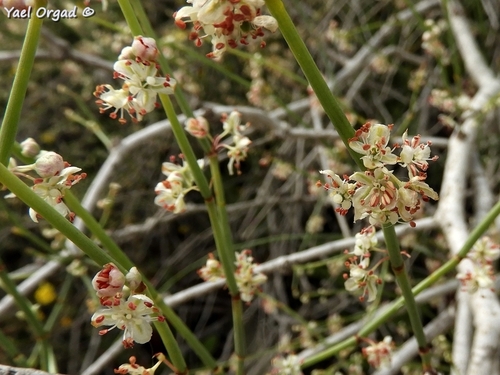
Persicaria orientalis
(L.) Spach
Prince’s Feathers, Prince’s Plume
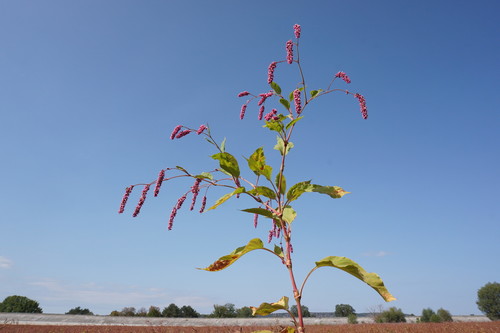
(c) Сергей, some rights reserved (CC BY-NC), uploaded by Сергей
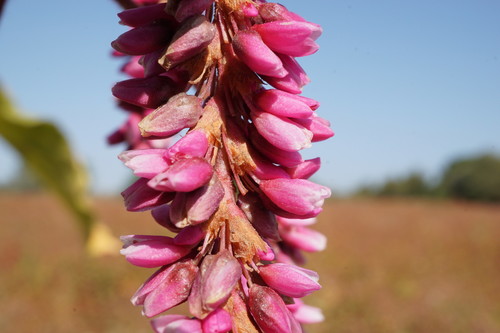
(c) Сергей, some rights reserved (CC BY-NC), uploaded by Сергей
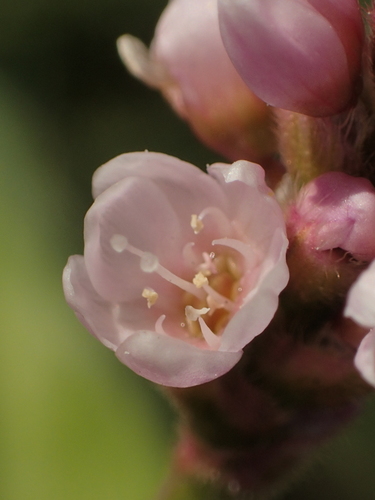
no rights reserved, uploaded by 葉子
What to Eat
Edible parts: Leaves
The leaves are cooked as a pot herb and are eaten as a famine food in China, where they are also sold in markets.
Known Hazards
Where to Find It
It is a warm temperate plant. It grows at the edges of swamps. It grows in wetlands. It can survive a dry season. It grows at low altitudes. It suits hardiness zones 8-10. In Yunnan.
Africa, Asia, Australia, Central Asia, China, East Africa, India, Indochina, Indonesia, Japan, Korea, Madagascar, Malaysia, Manchuria, Myanmar, North America, Northeastern India, Pacific, Pakistan, Papua New Guinea, PNG, SE Asia, Tajikistan, Thailand, USA, Vietnam,
How to Identify
A herb which can grow each year from seed or keeps growing from year to year. It can grow in water or on land. It grows 1-2 m high and spreads 1-2 m wide. Young growth is very hairy. The stems are robust and finely hairy. The stem is 1-1.5 cm thick but slender in the upper part. It is often covered with grey hairs. The leaves are 6-25 cm long by 3.5-12 cm wide. They are oval and taper to the tip and have stalks. They are green and hairy on both surfaces. The flower spikes have 3-6 flowers and are 2-8 cm long and drooping. They occur in clusters at the ends of branches at the top of the plant. The flowers are 0.4 cm long and pink. The fruit is a small brown nut.
How to Grow
Plants can be grown from seed or cuttings.
Wikipedia
Source ↗Persicaria orientalis is a species of flowering plant in the family Polygonaceae, known as kiss-me-over-the-garden-gate and princess-feather. It was first described, as Polygonum orientale, by Carl Linnaeus in 1753. It was transferred to the genus Persicaria by Édouard Spach in 1841. Its native distribution is unclear. As of April 2023, Kew's Plants of The World Online lists its native distribution as ranging from the Russian far east to Indochina, Malesia and Australia. It is widely cultivated and naturalized.
Other Information
The leaves are eaten as a famine food in China. The leaves are sold in markets.
Notes
There are about 75 Persicaria species. It can irritate the skin.
Names & Synonyms
Bara pani mirich, Bon kunhiar, Bon kuhiyar, Hong liao, Hongthao, Jalynoh, Kiss-me-over-the-garden gate, Nghe ba, Nghe dong, Oriental pepper, Oriental persicary, Princess-Feather, Red knotweed, Shuihonghuazi, Taktir oing, Yellang
References (34)
- Ambasta, S.P. (Ed.), 2000, The Useful Plants of India. CSIR India. p 481 (As Polygonum orientale)
- Brickell, C. (Ed.), 1999, The Royal Horticultural Society A-Z Encyclopedia of Garden Plants. Convent Garden Books. p 775
- Burkill, I.H., 1966, A Dictionary of the Economic Products of the Malay Peninsula. Ministry of Agriculture and Cooperatives, Kuala Lumpur, Malaysia. Vol 2 (I-Z) p 1821 (As Polygonum orientale)
- Cundall, P., (ed.), 2004, Gardening Australia: flora: the gardener's bible. ABC Books. p 1013
- Duke, J.A., 1992, Handbook of Edible Weeds. CRC Press. p 154 (As Polygonum orientale)
- Elliot, W.R., & Jones, D.L., 1997, Encyclopedia of Australian Plants suitable for cultivation. Vol 7. Lothian. p 204
- Flora of Pakistan. www.eFloras.org
- Henty, E.E., & Pritchard, G.S., 1973, Weeds of New Guinea and their control. Botany Bulletin No 7, Division of Botany, Lae, PNG. p 140 (As Polygonum orientale)
- Henty, E.E., in Womersley, J.S., (ed), 1978, Handbooks of the Flora of Papua New Guinea. Melbourne University Press,Victoria. Vol 1, p 240 (As Polygonum orientale)
- Henty, E.E., 1980, Harmful Plants in Papua New Guinea. Botany Bulletin No 12. Division Botany, Lae, Papua New Guinea. p 116, 118 (As Polygonum orientale)
- Hist. nat. veg. 10:537. 1841
- Kachenchart, B., et al, 2008, Phenology of Edible Plants at Sakaerat Forest. In Proceedings of the FORTROP II: Tropical Forestry Change in a Changing World. Bangkok, Thailand.
- Lazarides, M. & Hince, B., 1993, Handbook of Economic Plants of Australia, CSIRO. p 195 (As Polygonum orientale)
- Leach, G.J., & Osborne, P.L., 1985, Freshwater Plants of Papua New Guinea. UPNG Press, p 216 (As Polygonum orientale)
- Martin, F.W. & Ruberte, R.M., 1979, Edible Leaves of the Tropics. Antillian College Press, Mayaguez, Puerto Rico. p 214 (As Polygonum orientale)
- Paczkowska, G . & Chapman, A.R., 2000, The Western Australian Flora. A Descriptive Calatogue. Western Australian Herbarium. p 460
- Pagag, K. & Borthakur, S.K., 2012, Wild edible wetland plants from Lakhimpur district of Assam, India. Pleione 6(2): 322 - 327
- Patiri, B. & Borah, A., 2007, Wild Edible Plants of Assam. Geethaki Publishers. p 116 (As Polygonum orientale)
- Pegu, R., et al, 2013, Ethnobotanical study of Wild Edible Plants in Poba Reserved Forest, Assam, India. Research Journal of Agriculture and Forestry Sciences 1(3):1-10 (As Polygonum orientale)
- Pham-Hoang Ho, 1999, An Illustrated Flora of Vietnam. Nha Xuat Ban Tre. p 748 (As Polygonum orientale)
- Plants for a Future database, The Field, Penpol, Lostwithiel, Cornwall, PL22 0NG, UK. http://www.scs.leeds.ac.uk/pfaf/ (As Polygonum orientale)
- Rao, R.R. & Neogi, B., 1980, Observation on the Ethnobotany of the Khasi and Garo tribes in Meghalaya (India). J. Econ. Tax. Bot. Vol. 1 pp 157-162 (As Polygonum orientale)
- Romanowski, N., 2007, Edible Water Gardens. Hyland House. p 77
- Sainty, G.R. & Jacobs, S.W.L., 1981, Waterplants of New South Wales. Water Resources Commission. NSW p 351 (As Polygonum orientale)
- Sarma, H., et al, 2010, Updated Estimates of Wild Edible and Threatened Plants of Assam: A Meta-analysis. International Journal of Botany 6(4): 414-423 (As Polygonum orientale)
- Singh, H.B., Arora R.K.,1978, Wild edible Plants of India. Indian Council of Agricultural Research, New Delhi. p 33 (As Polygonum orientale)
- Singh, P.K., Singh, N.I., and Singh, L.J., 1988, Ethnobotanical Studies on Wild Edible Plants in the Markets of Manipur - 2. J. Econ. Tax. Bot. Vol. 12 No. 1 pp 113-119 (As Polygonum orientale)
- Sp. pl. 1:362. 1753 (As Polygonum orientale)
- Stephens, K.M., & Dowling, R.M., 2002, Wetland Plants of Queensland. A field guide. CSIRO p 75
- Terra, G.J.A., 1973, Tropical Vegetables. Communication 54e Royal Tropical Institute, Amsterdam, p 68
- Valder, P., 1999, The Garden Plants of China. Florilegium. p 378
- World Checklist of Useful Plant Species 2020. Royal Botanic Gardens, Kew
- Xu, You-Kai, et al, 2004, Wild Vegetable Resources and Market Survey in Xishuangbanna, Southwest China. Economic Botany. 58(4): 647-667. (As Polygonum orientale)
- Zhang, Y., et al, 2014, Diversity of wetland plants used traditionally in China: a literature review. Journal of Ethnobiology and Ethnomedicine. 10:72 (As Polygonum orientale)