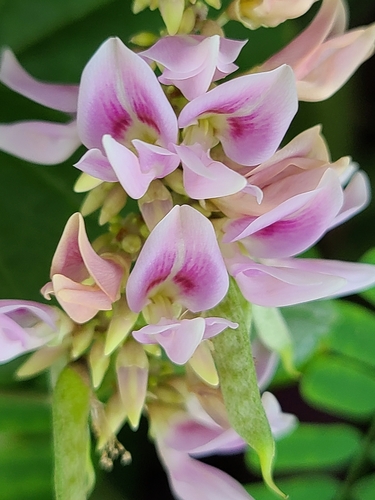
Phaseolus coccineus
L.
Scarlet runner bean
(c) elimaya, some rights reserved (CC BY-NC), uploaded by elimaya

(c) Neptalí Ramírez Marcial, some rights reserved (CC BY), uploaded by Neptalí Ramírez Marcial

(c) Conall, some rights reserved (CC BY)
What to Eat
Edible parts: Seeds, Pods, Leaves, Roots, Vegetable, Flowers
Immature seedpods can be eaten raw or cooked — they have a pleasant, mild flavour and are widely used as a vegetable around the world, whether added to salads, cooked on their own, or included in soups and stews. Immature seeds are used as shelled beans. The protein-rich mature seeds can be dried and stored; they must be thoroughly cooked before eating to destroy a toxic principle, and are best soaked for 12 hours prior to use, then boiled or added to soups. The seed can also be ground into a powder and mixed with cereal flour to make protein-enriched bread. Flowers are edible raw and have a bean-like taste. Young leaves can be cooked and used as a potherb. The root is starchy and can be cooked, though one source notes it may be poisonous.
Known Hazards
Where to Find It
A tropical plant. It grows naturally in the mountain regions from Mexico to Panama. It is grown in the highlands in the tropics. On the tropical coast seedlings die and pods are not formed. It is damaged by frost. It suits hardiness zones 8-10. In Sichuan and Yunnan.
Africa, Argentina, Asia, Australia, Bangladesh, Britain, Canada, Caribbean, Central Africa, Central America, Central Asia, Chile, China, Colombia, Congo, Cook Islands, Costa Rica, East Africa, East Timor, Ecuador, El Salvador, Ethiopia, Europe, Fiji, Guatemala, Honduras, India, Indochina, Indonesia, Japan, Kenya, Korea, Madagascar, Mauritius, Mexico, Netherlands, New Zealand, Nigeria, North America, Pacific, Pakistan, Panama, Papua New Guinea, PNG, Philippines, Russia, Rwanda, SE Asia, Serbia, Slovenia, South Africa, Southern Africa, South America, Switzerland, Tajikistan, Tanzania, Tasmania, Timor-Leste, Turkey, Türkiye, Uganda, USA, Vietnam, West Africa,
How to Identify
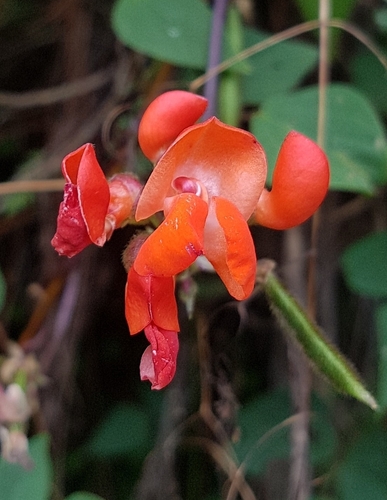
A climbing bean. It is a robust plant and keeps growing from year to year by re-growing from the fattened root. The stems are often hairy. It grows 1.8-2.4 m high. It can spread 1.8-2.4 m wide. It twines around a trellis. The leaves are compound and have three leaflets. The flowers are bright red. They are in clusters 2.5 cm long. The pods are long (30 cm) and with a wavy edge. The seeds are large and can be several different colours. It sometimes has a root tuber.
Nutrition Score: 67/100
| Part | Moisture | kJ | kcal | Protein | Vit A | Vit C | Iron | Zinc |
|---|---|---|---|---|---|---|---|---|
| Seeds | 12 | 1419 | 339 | 20.3 | — | 7 | 9 | — |
How to Grow
Requires a warm sheltered sunny position in a rich well-drained soil with plenty of moisture in the growing season. Dislikes heavy, wet or acid soils. Prefers a pH in the range 6 to 7. The runner bean is commonly cultivated in many parts of the world for its edible seeds and immature seedpods, there are many named varieties. Most varieties are climbing plants but some dwarf forms have been developed. Plants are perennials but are often grown as annuals, especially in the temperate zone. Plants flower under long day conditions, which is ideal for temperate regions. When grown for their edible pods, the immature pods should be harvested regularly in order to promote extra flower production and therefore higher yields. The perennial roots will survive mild winters outdoors in many parts of the country, especially if given a protective mulch in late autumn, they will then give an earlier but lighter crop the following year. They can also be dug up in late autumn and stored like dahlias in a cool but frost free place over winter and replanted in the following spring. The plants might need some protection from slugs since these creatures adore the young shoots in the spring. Runner beans grow well with carrots, cauliflowers, cucumbers, cabbage, leek and celeriac. They are inhibited by alliums and fennel growing nearby. This species has a symbiotic relationship with certain soil bacteria, these bacteria form nodules on the roots and fix atmospheric nitrogen. Some of this nitrogen is utilized by the growing plant but some can also be used by other plants growing nearby. Carbon Farming - Cultivation: regional crop. Management: standard. Phaseolus coccineus ssp.polyanthus (Cache Bean) is also worth considering as a carbon farming plant. It is similar to Phaseolus coccineus but more suited to tropical highlands and semi-arid conditions.
Propagation: Pre-soak the seed for 12 hours in warm water, then sow in mid-spring in a greenhouse. Germination should occur within 10 days. Prick seedlings out into individual pots when large enough to handle, and plant out after the last expected frosts. Seed can also be sown in situ in late spring, though it may not ripen in a cool summer.
Medicinal Uses
None known
Other Uses
The plant fixes nitrogen. It also attracts hummingbirds.
Wikipedia
Source ↗Phaseolus coccineus, known as runner bean, scarlet runner bean, or multiflora bean, is a plant in the legume family, Fabaceae. Another common name is butter bean, which can also refer to the lima bean, a different species. It is grown both as a food plant and an ornamental plant.
Production
It grows quickly.
Other Information
It is a commercially cultivated vegetable. Only occasionally grown in Papua New Guinea. The fleshy roots are an important food in Mexico. It is sold in local markets.
Names & Synonyms
Ayacote, Botil, Chamborote, Chilipuca, Climat, Cub, Cubaces, Dau son, Dutch caseknipe bean, Ejote, Fagioli rampicante di Spagna, Frejol de castilla, Frejol de monte, Frijol chamborote, Hana mame, Haricot d'Espagne, Kacang besar, Koto moruk, Laški fižol, Patol, Poroto chileno, Seven year bean, Shim
References (47)
- Bianchini, F., Corbetta, F., and Pistoia, M., 1975, Fruits of the Earth. Cassell. p 34
- Brink, M., 2006. Phaseolus coccineus L. [Internet] Record from Protabase. Brink, M. & Belay, G. (Editors). PROTA (Plant Resources of Tropical Africa), Wageningen, Netherlands. < http://database.prota.org/search.htm>. Accessed 21 October 200919 October 2009.
- Burkill, I.H., 1966, A Dictionary of the Economic Products of the Malay Peninsula. Ministry of Agriculture and Cooperatives, Kuala Lumpur, Malaysia. Vol 2 (I-Z) p 1739 (As Phaseolus multiflorus)
- Burnie, G.(Ed.), 2003, Annuals and Bulbs. The Gardener's Handbooks. Fog City Press. p 208
- Cheifetz, A., (ed), 1999, 500 popular vegetables, herbs, fruits and nuts for Australian Gardeners. Random House p 87
- Cruz, I. M., et al, 2015, Edible fruits and seeds in the State of Mexico. Revista Mexicana de Ciencias Agricolas. Vol. 6. Num. 2 pp 331-346
- Cundall, P., (ed.), 2004, Gardening Australia: flora: the gardener's bible. ABC Books. p 1022
- Evans, A.M., 1979, Beans, in Simmonds N.W.,(ed), Crop Plant Evolution. Longmans. London. p 168
- Facciola, S., 1998, Cornucopia 2: a Source Book of Edible Plants. Kampong Publications, p 109
- FAO, 1993, Valor Nutritivo Y Usis en Alimantacion humana de Algunis Cultivos Autoctonos Subexplotados de Mesoamerica. FAO, Santiago, Chile. p 103
- Farfan, B., et al, 2007, Mazahua Ethnobotany and Subsistence in the Monarch Butterfly Biosphere Reserve, Mexico. Economic Botany 61(2) 2007, pp 173-191
- French, B.R., 1986, Food Plants of Papua New Guinea, A Compendium. Asia Pacific Science Foundation p 48
- Hedrick, U.P., 1919, (Ed.), Sturtevant's edible plants of the world. p 480 (As Phaseolus multiflorus)
- Hermandez Bermejo, J.E., and Leon, J. (Eds.), 1994, Neglected Crops. 1492 from a different perspective. FAO Plant Production and Protection Series No 26. FAO, Rome. p18, 48
- http://www.botanic-gardens-ljubljana.com/en/plants
- Hu, Shiu-ying, 2005, Food Plants of China. The Chinese University Press. p 479
- ILDIS Legumes of the World http:www:ildis.org/Legume/Web
- Jardin, C., 1970, List of Foods Used In Africa, FAO Nutrition Information Document Series No 2.p 28
- Kapelle, M., et al, 2000, Useful plants within a Campesino Community in a Costa Rican Montane Cloud Forest. Mountain Research and Development, 20(2): 162-171
- Kays, S. J., and Dias, J. C. S., 1995, Common Names of Commercially Cultivated Vegetables of the World in 15 languages. Economic Botany, Vol. 49, No. 2, pp. 115-152
- Kiple, K.F. & Ornelas, K.C., (eds), 2000, The Cambridge World History of Food. CUP p 1729
- Lazarides, M. & Hince, B., 1993, Handbook of Economic Plants of Australia, CSIRO. p 187
- Lim, T. K., 2015, Edible Medicinal and Non Medicinal Plants. Volume 9, Modified Stems, Roots, Bulbs. Springer p 65
- Macmillan, H.F. (Revised Barlow, H.S., et al) 1991, Tropical Planting and Gardening. Sixth edition. Malayan Nature Society. Kuala Lumpur. p 328, 360
- Manzanero-Medina, G. I., et al, 2020, Ethnobotany of food plants (quelites) sold in two traditional markets of Oaxaca, Mexico. South African Journal of Botany. 130 (2020) 215-223
- Mapes, C. & Basurto, F., 2016, Biodiversity and Edible Plants of Mexico. Chapter 5 in R. Lira, et al. (eds.), Ethnobotany of Mexico, Ethnobiology, Springer. p 109
- Martin, F.W. & Ruberte, R.M., 1979, Edible Leaves of the Tropics. Antillian College Press, Mayaguez, Puerto Rico. p 45, 200
- Moerman, D. F., 2010, Native American Ethnobotany. Timber Press. p 390
- Molares, S. & Ladio, A., 2012, The Usefulness of Edible and Medicinal Fabaceae in Argentine and Chilean Patagonia: Environmental Availability and Other Sources of Supply. Evidence-Based Complementary and Alternative Medicine. Volume 2012, Article ID 901918, 12 pages, Hindawi Publishing Corporation.
- Pascual-Mendoza, S. et al, 2021, Traditional knowledge of edible plants in an indigenous community in the Sierra Norte of Oaxaca, Mexico. Plant Biosystems - An International Journal Dealing with all Aspects of Plant Biology
- Pena, F. B., et al, 1998, Los quelites de la Sierra Norte de Puebla, Mexico: Inventory Y Formas de Preparacion. Bol. Soc. Bot. Mexico 62:49-62
- Pham-Hoang Ho, 1999, An Illustrated Flora of Vietnam. Nha Xuat Ban Tre. p 963
- Piedra-Malagón, E. M., et al, 2022, Edible native plants of the Gulf of Mexico Province. Biodiversity Data Journal 10: e80565 p 21
- Plants for a Future database, The Field, Penpol, Lostwithiel, Cornwall, PL22 0NG, UK. http://www.scs.leeds.ac.uk/pfaf/
- PROSEA
- Purseglove, J.W., 1968, Tropical Crops Dicotyledons, Longmans. p 294
- Shaheen, N., et al, 2013, Food Composition Table for Bangladesh. University of Daka. p 21
- Terra, G.J.A., 1973, Tropical Vegetables. Communication 54e Royal Tropical Institute, Amsterdam, p 65
- Tindall, H.D., 1983, Vegetables in the Tropics, Macmillan p 276
- Torre, de la, L., et al, 2008, Enciclopedia de las Plantas Útiles del Ecuador. Herbario QCA. Pontificia Universidad Católica del Ecuador. p 356
- Tronickova, E. & Krejcova, Z., 1987, Ortaggi, Instituto Geografico de Agostini, Cecoslovacchia. p 126
- Ulian, T., et al, 2020, Unlocking plant resources to support food security and promote sustainable agriculture. Plants, People, Planet. 2020;2:421–445.
- USDA, ARS, National Genetic Resources Program. Germplasm Resources Information Network - (GRIN). [Online Database] National Germplasm Resources Laboratory, Beltsville, Maryland. Available: www.ars-grin.gov/cgi-bin/npgs/html/econ.pl (10 April 2000)
- van Wyk, B., 2005, Food Plants of the World. An illustrated guide. Timber press. p 288
- Verdcourt, B., 1979, Manual of New Guinea Legumes. Botany Bulletin No 11, Division of Botany, Lae, Papua New Guinea. p 512
- Wiersema, J. H. & Leon, B., 2013, World Economic Plants. A Standard Reference CRC Press. 2nd Ed. p 514
- http://cookislands.bishopmuseum.org