Phoenix canariensis
Horta ex Chabaud
Canary Island Date Palm
(c) alexcm, some rights reserved (CC BY-NC), uploaded by alexcm
(c) joseluisblazquez, some rights reserved (CC BY-NC)

(c) Jesús Cabrera, some rights reserved (CC BY)
What to Eat
Edible parts: Fruit, Sap
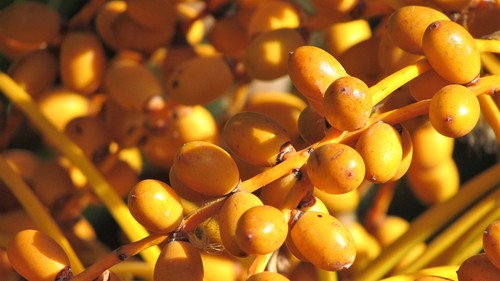
The fruit weighs around 1.7g and has an edible outer pericarp. Each fruit is orange, about 2cm long and 1cm in diameter, with a large seed. The pulp is edible when fully ripe (solid black) but is usually too thin to be worth eating; the fruit are considered a famine food. The inflorescence buds are tapped for their sweet sap, which is eaten as syrup or palm honey. This plant is recognised as a staple crop for sugar production.
Known Hazards
Where to Find It
It is a warm temperate plant. It will tolerate hot dry conditions in inland Australia. It is very frost hardy and thrives on poor soils. It needs good drainage. In the Canary Island it grows to 700 m altitude. In Melbourne Botanical Gardens. In Hobart Botanical gardens. It suits plant hardiness zones 8-11. Arboretum Tasmania.
Africa, Algeria, Andes, Argentina, Asia, Australia, Bermuda, Bolivia, Canada, Canary Islands*, Central America, Colombia, East Africa, Ecuador, Europe, Greece, Guatemala, India, Indonesia, Italy, Mediterranean, Norfolk Is., North America, Pakistan, SE Asia, Slovenia, South America, Spain, Tasmania, Tunisia,
How to Identify
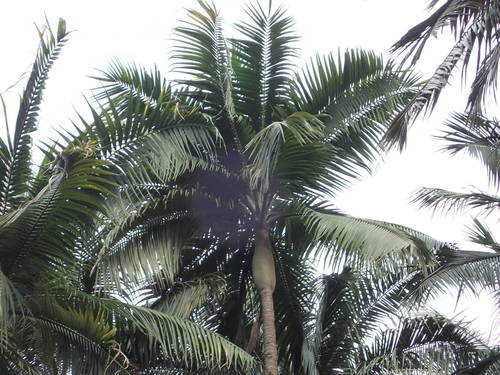
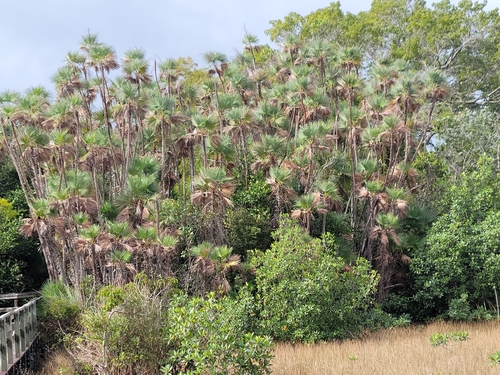
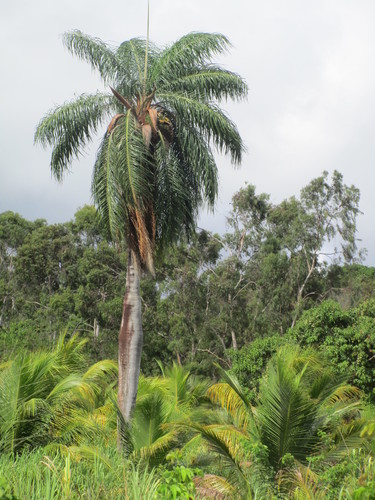
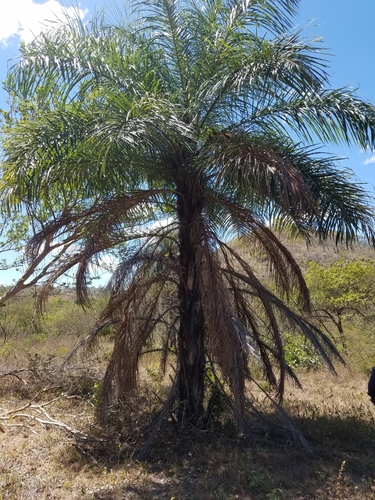
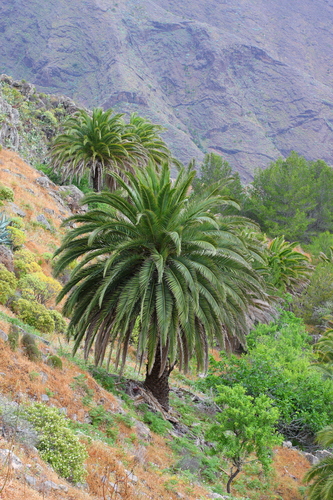
A large palm. It has a single, stout woody trunk. It grows to 20 m tall. The trunk can be 70 cm across. There is a diamond pattern of leaf scars down the trunk. The crown can have 100 leaves. The fronds are long and dull green. Leaves can be 6 m long. They are divided into leaflets along the stalk. The fronds are spiny at the base. The leaflets are directed upwards and forward. The flowering stalks are produced among the leaf bases. The flowers are creamy yellow. Male and female trees are needed for fruit. The fruit occur in large clusters. They are a golden colour. They grow among the leaves. The fruit are 2 cm long and 1 cm across.
How to Grow
Found at elevations from sea level to 1,200m in a range of habitats, from humid areas just below cloud forest to semi-arid areas where its presence usually indicates groundwater. Cultivated in wet-winter or Mediterranean climates, but also in wet-summer or humid subtropical climates like eastern Australia and the southeastern United States. Examples in high-latitude oceanic climates, such as Ireland, the UK, and the Channel Islands. It can be cultivated where temperatures rarely fall below -10°C (14 or 10 °F). Light: Full Sun. USDA Hardiness Zone 8a: to -12.2°C (10 °F) to 11: above 4.5 °C (40 °F). Drought-tolerant; suitable for xeriscaping. It is very frost hardy and thrives on poor soils. It needs good drainage. Soil pH requirements: 6.1 (mildly acidic) to 7.8 (mildly alkaline). Carbon Farming Solutions - Cultivation: regional crop. Management: standard (Describes the non-destructive management systems that are used in cultivation). Normal height range 10–20m (33–66 ft) tall; some specimens have reached 40m (130 ft).
Propagation: Plants are grown from seed, which germinates readily and typically sprouts within one to two months. In tropical locations, suckers can also be used for propagation.
Medicinal Uses
No medicinal uses are known for this plant.
Other Uses
This is a highly ornamental tree that has received the Royal Horticultural Society's Award of Garden Merit. The leaflets are used in much the same way as those of Phoenix dactylifera for a range of woven products, including crosses made for Palm Sunday celebrations.
Wikipedia
Source ↗Phoenix canariensis, the Canary Island date palm, is a species of flowering plant in the palm family Arecaceae, native to the Canary Islands off the coast of Northwestern Africa. It is a relative of Phoenix dactylifera, the true date palm. It is the natural symbol of the Canary Islands, together with the canary Serinus canaria.
Production
Fruit weigh 1.7 g.
Notes
There are 17 Phoenix species. The seeds contain a fat.
Names & Synonyms
Kanarska dateljnova palma, Palem korma kannari
References (31)
- Ambasta, S.P. (Ed.), 2000, The Useful Plants of India. CSIR India. p 447
- Amoros, A., et al, 2014, Physico-chemical and functional characteristics of date fruits from different Phoenix species (Arecaceae). Fruits, Vol. 69, p. 315-323
- Balick, M.J. and Beck, H.T., (Ed.), 1990, Useful palms of the World. A Synoptic Bibliography. Colombia p 662,
- Blamey, M and Grey-Wilson, C., 2005, Wild flowers of the Mediterranean. A & C Black London. p 501
- Blomberry, A. & Rodd, T., 1982, Palms. An informative practical guide. Angus & Robertson. p 139
- Bodkin, F., 1991, Encyclopedia Botanica. Cornstalk publishing, p 787
- Cronin, L., 1989, The Concise Australian Flora. Reed. p 229
- Cronin, L., 2000, Australian Palms, Ferns, Cycads and Pandans. Cronin Publications. p 64
- Cundall, P., (ed.), 2004, Gardening Australia: flora: the gardener's bible. ABC Books. p 1030
- Dharani, N., 2002, Field Guide to common Trees & Shrubs of East Africa. Struik. p 292
- Facciola, S., 1998, Cornucopia 2: a Source Book of Edible Plants. Kampong Publications, p 30
- Gibbons, M., 1993, Palms. Compact study Guide and Identifier. Sandstone. p 60
- Gibbons, M., 2003, A pocket guide to Palms. Chartwell Books. p 156
- Haynes, J., & McLaughlin, J., 2000, Edible palms and Their Uses. University of Florida Fact sheet MCDE-00-50-1 p 11
- http://www.botanic-gardens-ljubljana.com/en/plants
- Jones, D.L., 1994, Palms throughout the World. Smithtonian Institution, Washington. p 286
- Jones, D.L., 2000, Palms of Australia 3rd edition. Reed/New Holland. p 193
- Kermath, B. M., et al, 2014, Food Plants in the Americas: A survey of the domesticated, cultivated and wild plants used for Human food in North, Central and South America and the Caribbean. On line draft. p 641
- Kew Plants of the World Online
- Krishen P., 2006, Trees of Delhi, A Field Guide. DK Books. p 315
- Kunkel,
- La Provence Agric. 19:293-297, figs. 66-68. 1882
- Lazarides, M. & Hince, B., 1993, Handbook of Economic Plants of Australia, CSIRO. p 187
- Lord, E.E., & Willis, J.H., 1999, Shrubs and Trees for Australian gardens. Lothian. p 97
- Marcia, M. J., et al, 2011, Palm Uses in Northwestern South America: A Quantitative Review. Bot. Rev. (2011) 77:462-570
- Oudejans, J.H.M., 1979, Date palm, in Simmonds, N.W., (ed), Crop Plant Evolution. Longmans. London. p 230
- Riffle, R.L. & Craft, P., 2003, An Encyclopedia of Cultivated Palms. Timber Press. p 400
- Roa, J. A. G. & Boada, D. S. G., 2018, Fundación para el Fortalecimiento de la Fruticultura y Plantas Alimenticias no Convencionales en Colombia.
- Schuler, S., (Ed.), 1977, Simon & Schuster's Guide to Trees. Simon & Schuster. No. 61
- Sukarya, D. G., (Ed.) 2013, 3,500 Plant Species of the Botanic Gardens of Indonesia. LIPI p 800
- Tanaka,