Phoenix dactylifera
L.
Date palm

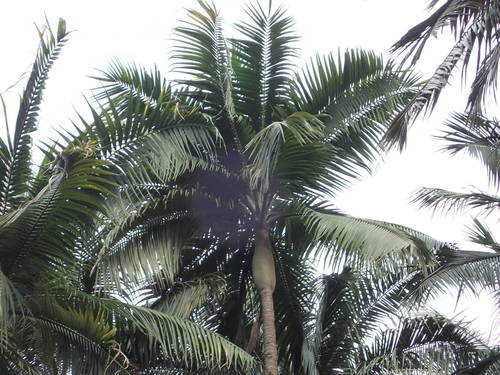
(c) Ashley Basil, some rights reserved (CC BY)

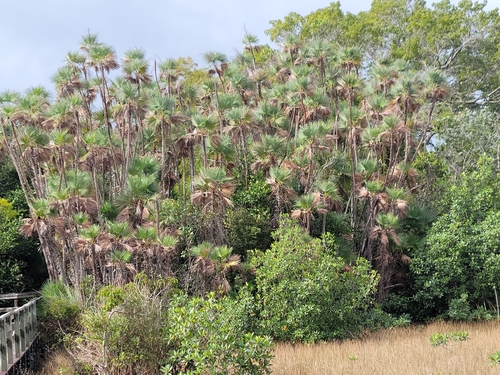
(c) dami garcia, some rights reserved (CC BY-NC-SA)
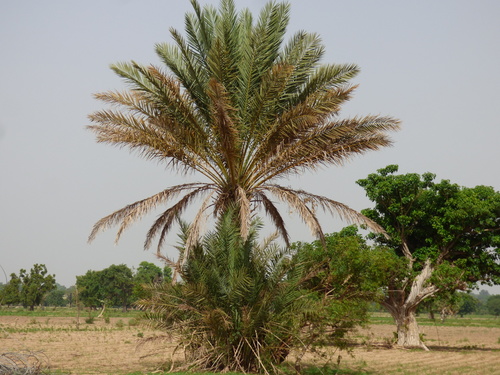
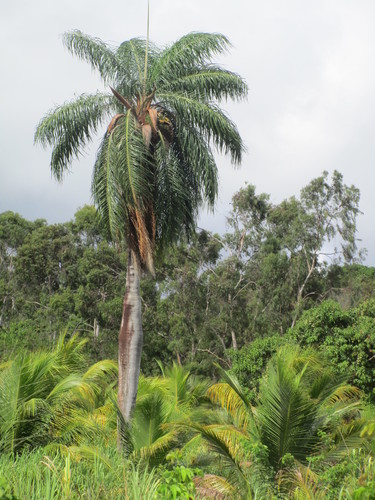
(c) Abubakar S. Ringim, some rights reserved (CC BY-NC), uploaded by Abubakar S. Ringim
What to Eat
Edible parts: Fruit, Cabbage, Sap, Palm heart, Flowers, Nuts-oil
The fruit can be eaten raw or cooked and is often dried before use. Fresh or dried, it adds sweetness to foods such as cakes, fruit pies, and confectionery. Each fruit is around 5cm long and 2.5cm in diameter, produced in clusters that can hold as many as 1,500 fruits. The male inflorescence is eaten as a delicacy, and the pollen is also consumed. Where fruiting is poor, the sap is tapped and becomes the tree's main product; it can be drunk fresh, fermented into toddy, or distilled into the spirit known as arrack.
Known Hazards
Where to Find It
They suit dry subtropical climates. It needs hot, dry arid climates while fruit mature. It can tolerate salty or brackish water. It can also grow in alkaline soils but with reduced yields. In cold temperate regions the palm grows but rarely flowers. It does best in areas with long dry summers and sufficient heat for fruit to ripen. It should not have rain during flowering and fruit set. For best production it needs 3,400 heat units above 10°C for fruit to fully mature. It can grow in arid places. It suits plant hardiness zones 9-12. In Yunnan.
Africa, Algeria, Angola, Antigua and Barbuda, Arabia, Argentina, Asia, Australia, Bahrain, Bangladesh, Brazil, Burkina Faso, Cambodia, Cameroon, Cape Verde, Central Africa, Central America, Chad, China, Colombia, Cuba, Cyprus, East Africa, East Timor, Egypt, Egypt - Sinai, Eritrea, Ethiopia, Europe, Fiji, Gambia, Greece, Guam, Guatemala, Haiti, Hawaii, Himalayas, India, Indochina, Iran, Iraq, Israel, Jordan, Kenya, Lebanon, Libya, Madagascar, Malawi, Malaysia, Mali, Marquesas, Marshall Islands, Mauritania, Mediterranean, Mexico, Middle East, Morocco, Myanmar, Namibia, Nepal, Niger, Nigeria, North Africa, North America, Oman, Pacific, Pakistan, Palestine, Papua New Guinea, PNG, Pakistan, Philippines, Qatar, Rotuma, Sahel, Sao Tome and Principe, Saudi Arabia, SE Asia, Senegal, Seychelles, Sinai, Somalia, South Africa, Southern Africa, South America, South Sudan, Spain, Sudan, Syria, Taiwan, Tanzania, Thailand, Timor-Leste, Tunisia, Turkey, Türkiye, United Arab Emirates, UAE, USA, Vietnam, West Africa, West Indies, Yemen,
How to Identify
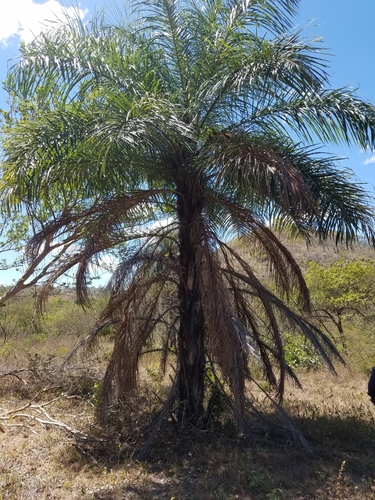
A tall unbranched evergreen palm. It grows to 30 m high. The trunk can be 30-40 cm across. The trunk is covered with fibres and has the bases of old leaves along it. It produces suckers on the trunk and at the base. The fronds are grey-green. The leaves are 6-7 m long. The leaflets are 20-40 cm long. They are spaced in two irregular rows along each side of the stalk. Male and female flowers are produced on separate trees. The flowers spadices are yellow-brown. There are 1,000-1,500 fruit is a cluster. The fruit is small, brown and very sweet. It has one grooved seed. The fruit is 2.5-5 cm long. When ripe the fruit is dull yellow and the flesh soft. The skins of the fruit darken when dried. Strands of fruit have 25-35 dates. The fruit are edible.
Nutrition Score: 43/100
| Part | Moisture | kJ | kcal | Protein | Vit A | Vit C | Iron | Zinc |
|---|---|---|---|---|---|---|---|---|
| Fruit - dry | 22.5 | 1151 | 275 | 2 | 5 | 0 | 1.2 | 0.3 |
| Fruit | 58.5 | 598 | 143 | 0.9 | 50 | 6 | 1.3 | — |
How to Grow
It grows best in areas where annual daytime temperatures are within the range 26 - 45°c, but can tolerate 10 - 52°c. When dormant, the plant can survive temperatures down to about -15?c, but the leaves and young growth can be severely damaged at -4°c. It prefers a mean annual rainfall in the range 200 - 300mm, but tolerates 100 - 400mm. The tree transpires large quantities of moisture and the amount of available rainfall is often little, or entirely absent in the production areas. The water requirement of the palm must be provided for by ground water (the roots of the tree can reach 2 - 6 metres deep) or by irrigation. Plants are tolerant of a range of soil types, so long as they are well-drained. Plants grow well in full sun, even when small. Tolerant of salty soils, though fruit quality might be adversely affected. Prefers a pH in the range 6.5 - 8, tolerating 6 - 8.5. Seedlings begin to develop a stem when about 4 - 5 years old and will usually start flowering soon afterwards. Plants propagated from suckers can commence fruiting within 2 - 4 years and normally reach full production at 5 - 8 years, although productivity may increase up to 9 - 15 years. Pollination is critical for good fruiting; therefore, pollen is usually artificially introduced to the female flowers by cutting a male inflorescence and placing it strategically within a female inflorescence - this may be thinned a little to accommodate it. It is important that male trees are planted with females in ratios of about 1:50 in order to provide sufficient pollen. An average well-managed palm can produce about 60 - 70 kilos of fresh dates per year. Commercially, yields of dates are often restricted to about 50 kilos per tree in order to ensure high quality, though yields of 100 kilos have been recorded. Yields decline after 40 - 50 years, but the tree will continue to produce until about the age of 75 years. When fruit yields are poor, the tree is often tapped for its sap. The yield varies with management and site conditions, but it is in the range of 4 - 8 litres per day. There are many named forms. A dioecious species, at least one male plant for every 6 females is necessary to ensure fertilization. Flowering Time: Early spring, Early winter, Late spring, Late winter, Mid spring, Mid winter (Late Winter/Early Spring Blooms repeatedly). Bloom Color: White (Pale Yellow). Spacing: 20-30 ft. (6-9 m). The Date Palm grows slowly, typically taking 4-8 years to start producing fruit. Dates are harvested in late Summer to early Autumn. The Date Palm flowers in Spring. Date Palms are typically not self-fertile and require cross-pollination from male trees.
Propagation: Pre-soak seed for 24 hours in warm water before sowing in containers. Germination typically takes two to three months. Seed viability can be maintained for 8–15 years at room temperature. Suckers can also be divided; pot them up immediately into large containers and plant into permanent positions once established.
Medicinal Uses
Date fruits are demulcent, expectorant, and laxative, and are used in treating respiratory diseases and fevers. The tree yields a gum that is used to treat diarrhoea.
Other Uses
Being salt-tolerant, the date palm has been used for decades to revegetate salt-affected lands in the Mediterranean region. It can serve as a shade tree and windbreak, and once mature its high, wide crown has little effect on the yield of crops grown beneath it. The leaves make an excellent thatch for roofs and walls and are widely used in weaving. Fibre from the leaves, leaf bases, and bark is used to make ropes, baskets, hats, and mats. Fibre from the leaf petiole, combined with other materials, is used for insulating boards. Dried leaves with their stiff, woody rachis are used for fencing. The wood from the outer portion of the stem is strong, termite-resistant, and valued for construction. Stems are also used as fuel. The plant is fire-retardant and can be grown as an indoor plant. Date palm flowers are rich in nectar and pollen, attracting pollinators including bees. The fruits provide food for birds and small mammals, dense fronds offer shelter and potential nesting or roosting sites for birds, and leaf litter supports beneficial insects. The rough bark, fronds, and leaf litter also provide overwintering and sheltering sites for invertebrates.
Wikipedia
Source ↗Phoenix dactylifera is a slow-growing evergreen tree reaching 25 m tall and 7 m wide. Hardy to UK zone 9 and not self-fertile, it attracts significant wildlife. The tree demands full sun and grows in light sandy, medium loamy, and heavy clay soils with good drainage. It prefers neutral and basic pH soils, including very alkaline and saline conditions, and tolerates both drought and moist soil but cannot grow in shade.
Production
Trees take about 6 years before good production. There can be 45-70 kg of fruit per tree. Trees continue to bear for 50 years.
Other Information
A major food. It is cultivated.
Notes
There are 17 Phoenix species.
Names & Synonyms
Ablouh, Akarap, Arabi khejur, Belah, Dabino, Dadel, Datil, Datilera, Dattelpalme, Dattero, Dattier, Dibinodje, Hai zao, Imae, Ita, Ittappazham, Karchuram, Khajur, Kharjura, Kharjuramu, Khorjjuri, Mtende, Nakhil al-tamer, Nakhla, Nakl-el-balah, Natsume yashi, Palma datilera, Perichchankay, Sunbalun, Sunpalun, Tamar, Tamareira, Tamr, Tenitta, Timir, Ye zao
References (104)
- Alexander, D.M., Scholefield, P.B., Frodsham, A., 1982, Some tree fruits for tropical Australia. CSIRO, Australia. p 19
- Ambasta, S.P. (Ed.), 2000, The Useful Plants of India. CSIR India. p 447
- Amoros, A., et al, 2014, Physico-chemical and functional characteristics of date fruits from different Phoenix species (Arecaceae). Fruits, Vol. 69, p. 315-323
- Arora, R. K., 2014, Diversity in Underutilized Plant Species - An Asia-Pacific Perspective. Bioversity International. p 81
- Bailey, C. and Danin, A., 1981, Bedouin Plant Utilization in Sinai and the Negev. Economic Botany 35(2): 145-162
- Balick, M.J. and Beck, H.T., (Ed.), 1990, Useful palms of the World. A Synoptic Bibliography. Colombia p 121
- Bekele-Tesemma A., Birnie, A., & Tengnas, B., 1993, Useful Trees and Shrubs for Ethiopia. Regional Soil Conservation Unit. Technical Handbook No 5. p 348
- Bernal, R., et al, (Eds), 2016, Catalogo de Plantas y Liquenes de Colombia, Volumen 2, Magnoliaceae a Zygophyllaceae. Universidad Nacional de Colombia. p 2502
- Bernholt, H. et al, 2009, Plant species richness and diversity in urban and peri-urban gardens of Niamey, Niger. Agroforestry Systems 77:159-179
- Bianchini, F., Corbetta, F., and Pistoia, M., 1975, Fruits of the Earth. Cassell. p 196
- Bidak, L. M., et al, 2015, Goods and services provided by native plants in desert ecosystems: Examples from the northwestern coastal desert of Egypt. Global Ecology and Conservation 3 (2015) 433–447
- Blamey, M and Grey-Wilson, C., 2005, Wild flowers of the Mediterranean. A & C Black London. p 501
- Blomberry, A. & Rodd, T., 1982, Palms. An informative practical guide. Angus & Robertson. p 139
- Bodkin, F., 1991, Encyclopedia Botanica. Cornstalk publishing, p 787
- Bremness, L., 1994, Herbs. Collins Eyewitness Handbooks. Harper Collins. p 72
- Brickell, C. (Ed.), 1999, The Royal Horticultural Society A-Z Encyclopedia of Garden Plants. Convent Garden Books. p 787
- Burkill, H. M., 1985, The useful plants of west tropical Africa, Vol. 4. Kew.
- Burkill, I.H., 1966, A Dictionary of the Economic Products of the Malay Peninsula. Ministry of Agriculture and Cooperatives, Kuala Lumpur, Malaysia. Vol 2 (I-Z) p 1742
- Cheifetz, A., (ed), 1999, 500 popular vegetables, herbs, fruits and nuts for Australian Gardeners. Random House p 217
- Cobley, L.S. (rev. Steele, W.M.) 2nd Ed., 1976, An Introduction to the Botany of Tropical Crops. Longmans. p 168
- Cronin, L., 1989, The Concise Australian Flora. Reed. p 230
- Cronin, L., 2000, Australian Palms, Ferns, Cycads and Pandans. Cronin Publications. p 66
- Cundall, P., (ed.), 2004, Gardening Australia: flora: the gardener's bible. ABC Books. p 1030
- Dransfield, J. & Beentje, H., 1995, The Palms of Madagascar. Royal Botanical Gardens, Kew and The International Palm Society. p 49
- Duarte, M. C., et al, 2022, Diversity of Useful Plants in Cabo Verde Islands: A Biogeographic and Conservation Perspective. Plants 2022, 11, 1313 p 8
- Facciola, S., 1998, Cornucopia 2: a Source Book of Edible Plants. Kampong Publications, p 30
- Flora of Pakistan. www.eFloras.org
- Flowerdew, B., 2000, Complete Fruit Book. Kyle Cathie Ltd., London. p 148
- Fox, F. W. & Young, M. E. N., 1982, Food from the Veld. Delta Books. p 101
- Gallagher, D. E., 2010, Farming beyond the escarpment: Society, Environment, and Mobility in Precolonial Southeastern Burkina Faso. PhD University of Michigan.
- Garba, A., Useful Plants in the Chad region of North-East Nigeria. p 116
- Ghanimi, R., et al, 2022, Ethnobotanical study on wild edible plants traditionally used by Messiwa people, Morocco. Journal of Ethnobiology and Ethnomedicine. 18:16
- Gibbons, M., 1993, Palms. Compact study Guide and Identifier. Sandstone. p 61
- Gibbons, M., 2003, A pocket guide to Palms. Chartwell Books. p 158
- Gilbert, T., et al, 2017, Diversity and local transformation of indigenous edible fruits in sahelian domain of Cameroon. Journal of Animal & Plant Sciences Vol. 26 (2): 5289-5300
- Grivetti, L. E., 1980, Agricultural development: present and potential role of edible wild plants. Part 2: Sub-Saharan Africa, Report to the Department of State Agency for International Development. p 30
- Haynes, J., & McLaughlin, J., 2000, Edible palms and Their Uses. University of Florida Fact sheet MCDE-00-50-1 p 11
- Hedrick, U.P., 1919, (Ed.), Sturtevant's edible plants of the world. p 488
- Heywood, V.H., Brummitt, R.K., Culham, A., and Seberg, O., 2007, Flowering Plant Families of the World. Royal Botanical Gardens, Kew. p 348
- http://palaeoworks.anu.edu.au/Nuno_PhD/04.pdf re Timor
- http://www.botanic-gardens-ljubljana.com/en/plants
- Hussey, B.M.J., Keighery, G.J., Cousens, R.D., Dodd, J., Lloyd, S.G., 1997, Western Weeds. A guide to the weeds of Western Australia. Plant Protection Society of Western Australia. p 20
- Hu, Shiu-ying, 2005, Food Plants of China. The Chinese University Press. p 303
- Huxley, A. (Ed.), 1977, The Encyclopedia of the Plant Kingdom. Chartweil Books. p 169
- Ibrahim, H. A., et al, 2012, Ethnobotanical Survey of the Wild Edible Food Plants Consumption among Local Communities in Kano State, North-Western, Nigeria, International Journal of Science and Technology. Vol. 2. No. 10 p 716
- INFOODS:FAO/INFOODS Databases
- Janick, J. & Paul, R. E. (Eds.), 2008, The Encyclopedia of Fruit & Nuts. CABI p 138
- Jardin, C., 1970, List of Foods Used In Africa, FAO Nutrition Information Document Series No 2.p 22, 94, 154
- John, L., & Stevenson, V., 1979, The Complete Book of Fruit. Angus & Robertson p 122
- Johnson, D.V., 1998, Tropical palms. Non-wood Forest products 10. FAO Rome. p 133
- Jones, D.L., 1994, Palms throughout the World. Smithtonian Institution, Washington. p 54, 286
- Jones, D.L., 2000, Palms of Australia 3rd edition. Reed/New Holland. p 193
- Kamal, M., et al, 2009, Ethnobotanically Important Plants of District Bannu, Pakistan. Pak. J. Pl. Sci., 15 (2): 87-93
- Karim, F. M. & Dakheel, A, J., 2006, Salt-tolerant plants of the United Arab Emirates. 2006. International Center for Biosaline Agriculture, Dubai, UAE.
- Kenneally, K.E., Edinger, D. C., and Willing T., 1996, Broome and Beyond, Plants and People of the Dampier Peninsula, Kimberley, Western Australia. Department of Conservation and Land Management. p 201
- Khan, D. & Shaukat, S.S., 2006, The Fruits of Pakistan: Diversity, Distribution, Trends of Production and Use. Int. J. Biol. Biotech., 3(3):463-499
- Kiple, K.F. & Ornelas, K.C., (eds), 2000, The Cambridge World History of Food. CUP p 1768
- Lazarides, M. & Hince, B., 1993, Handbook of Economic Plants of Australia, CSIRO. p 187
- Llamas, K.A., 2003, Tropical Flowering Plants. Timber Press. p 111
- Lorenzi, H., Bacher, L., Lacerda, M. & Sartori, S., 2006, Brazilian Fruits & Cultivated Exotics. Sao Paulo, Instituto Plantarum de Estuados da Flora Ltda. p 366
- Macmillan, H.F. (Revised Barlow, H.S., et al) 1991, Tropical Planting and Gardening. Sixth edition. Malayan Nature Society. Kuala Lumpur. p 289
- Mahony, D., 1991, Trees of Somalia. A Field Guide for Development Workers. Oxfam Research Paper 3. p 9
- Martin, F.W. & Ruberte, R.M., 1979, Edible Leaves of the Tropics. Antillian College Press, Mayaguez, Puerto Rico. p 210
- Martin, F. W., et al, 1987, Perennial Edible Fruits of the Tropics. USDA Handbook 642 p 49
- Maundu, P. et al, 1999, Traditional Food Plants of Kenya. National Museum of Kenya. 288p
- Maydell, H. von, 1990 Trees and shrubs of the Sahel: their characteristics and uses. Margraf. p 345
- Miller, A. G., Morris, M. & Stuart-Smith, S., 1988, Plants of Dhofar. The Southern Region of Oman, Traditional, Economic and Medicinal Uses. Sultanate of Oman. p 226
- Morton, J. F., 1987, Fruits of Warm Climates. Wipf & Stock Publishers p 5
- Norton, J., et al, 2009, An Illustrated Checklist of the Flora of Qatar. UNESCO Office in Doha.
- Oudejans, J.H.M., 1979, Date palm, in Simmonds, N.W., (ed), Crop Plant Evolution. Longmans. London. p 229 and p 229 (As Phoenix atlantica var. maroccana)
- Paczkowska, G. & Chapman, A.R., 2000, The Western Australian Flora. A Descriptive Calatogue. Western Australian Herbarium. p 36
- Pasha, M. K. & Uddin, S. B., 2019, Minor Edible Fruits of Bangladesh. Bangladesh J. Plant Taxon. 26(2): 299–313
- Peters, C. R., O'Brien, E. M., and Drummond, R.B., 1992, Edible Wild plants of Sub-saharan Africa. Kew. p 38
- Phon, P., 2000, Plants used in Cambodia. © Pauline Dy Phon, Phnom Penh, Cambodia. p 495
- Purseglove, J.W., 1972, Tropical Crops. Monocotyledons. Longmans p 429
- Riffle, R.L. & Craft, P., 2003, An Encyclopedia of Cultivated Palms. Timber Press. p 401
- Rivera, D. et al, 2006, Gathered Mediterranean Food Plants - Ethnobotanical Investigations and Historical Development, in Heinrich M, Müller WE, Galli C (eds): Local Mediterranean Food Plants and Nutraceuticals. Forum Nutr. Basel, Karger, 2006, vol 59, pp 18–74
- Roa, J. A. G. & Boada, D. S. G., 2018, Fundación para el Fortalecimiento de la Fruticultura y Plantas Alimenticias no Convencionales en Colombia.
- Royal Botanic Gardens, Kew (1999). Survey of Economic Plants for Arid and Semi-Arid Lands (SEPASAL) database. Published on the Internet; http://www.rbgkew.org.uk/ceb/sepasal/internet [Accessed 5th May 2011]
- Ruiters-Welcome, A. K., 2019, Food plants of southern Africa. Ph.D. thesis. Univ. of Johannesburg p 29
- Sahni, K.C., 2000, The Book of Indian Trees. Bombay Natural History Society. Oxford. p 180
- Schuler, S., (Ed.), 1977, Simon & Schuster's Guide to Trees. Simon & Schuster. No. 62
- Segura, S. et al, 2018, The edible fruit species in Mexico. Genet Resour Crop Evol (2018) 65:1767–1793
- Sharma, B.B., 2005, Growing fruits and vegetables. Publications Division. Ministry of Information and broadcasting. India. p 54
- Small, E., 2009, Top 100 Food Plants. The world's most important culinary crops. NRC Research Press. p 250
- Smith, A.C., 1979, Flora Vitiensis Nova, Lawaii, Kuai, Hawaii, Volume 1 p 400
- Sp. pl. 2:1188. 1753
- Stone, B. C., 1970, The Flora of Guam. A Manual for the Identification of the Vascular Plants of the Island. Micronesica. Journal of the University of Guam. p 120
- Swaminathan, M.S., and Kochnar, S.L., 2007, An Atlas of major Flowering Trees in India. Macmillan. p 276
- Tankard, G., 1990, Tropical fruit. An Australian Guide to Growing and using exotic fruit. Viking p 107
- Terra, G.J.A., 1973, Tropical Vegetables. Communication 54e Royal Tropical Institute, Amsterdam, p 67
- Timyan, J., 1996, Bwa Yo: Important Trees of Haiti. SE Consortium for International Development. Washington. p 218
- TodaFruta.com.br
- USDA, ARS, National Genetic Resources Program. Germplasm Resources Information Network - (GRIN). [Online Database] National Germplasm Resources Laboratory, Beltsville, Maryland. Available: www.ars-grin.gov/cgi-bin/npgs/html/econ.pl (10 April 2000)
- Van Damme, P., et al, 1922, Plant uses by the Topnaar of the Kuiseb Valley Namib Desert. Afrika Focus 8(3-4), 1922, 223-252
- Vander Velde, N, 2003, The Vascular Plants of Majuro Atoll, Republic of the Marshall Islands. Atoll research Bulletin. No. 503. Smithsonian Institute. p 32
- van Wyk, B., 2005, Food Plants of the World. An illustrated guide. Timber press. p 291
- van Wyk, Be., & Gericke, N., 2007, People's plants. A Guide to Useful Plants of Southern Africa. Briza. p 52
- Vickery, M.L. and Vickery, B., 1979, Plant Products of Tropical Africa, Macmillan. p 99
- Welcome, A. K. & Van Wyk, B.-E., 2019, An inventory and analysis of the food plants of southern Africa. South African Journal of Botany 122 (2019) 136–179
- Wiersema, J. H. & Leon, B., 2013, World Economic Plants. A Standard Reference CRC Press. 2nd Ed. p 518
- Williamson, J., 2005, Useful Plants of Malawi. 3rd. Edition. Mdadzi Book Trust. p 199
- World Checklist of Useful Plant Species 2020. Royal Botanic Gardens, Kew
- www.worldagroforestrycentre.org/treedb/