Phoenix paludosa
Roxb.
Mangrove Date Palm, Swamp date palm

User:AndonicO (via Wikimedia Commons)

MSH Sourav (via Wikimedia Commons)

Soumyajit Nandy (via Wikimedia Commons)

(c) MSH Sourav, some rights reserved (CC BY-NC), uploaded by MSH Sourav
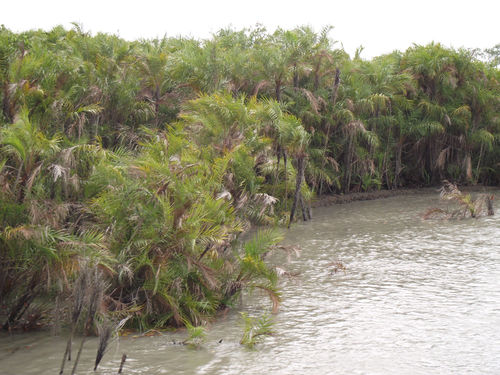
(c) M. A. Naturalist, some rights reserved (CC BY-NC), uploaded by M. A. Naturalist
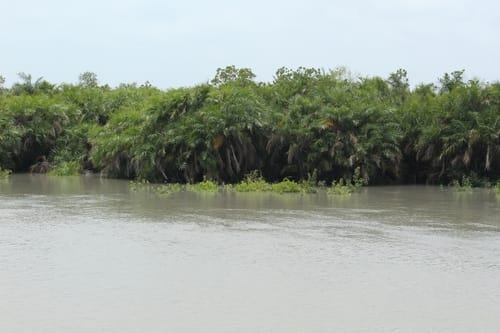
(c) Dr. Purab Chowdhury, some rights reserved (CC BY-NC)
What to Eat
Edible parts: Fruit, Palm heart, Cabbage
The fruits are eaten in curries. The boiled fruits are eatenThe blue-black, ovoid-ellipsoid fruit is 10 - 12,, long and 7 - 10mm wide, containing a single, large woody seed. The fruits have been used as a coffee substitute. The pith of the stem is edible. The terminal bud is eaten. The palm heart (the inner core and growing bud of the plant) is harvested. It provides a crispy food, rich in nutrients, that can be eaten raw or cooked. Harvesting the heart will lead to the death of the stem it was harvested from, though in multi-stemmed plants such as this the rest of the plant will continue to grow and often produce new stems.
Known Hazards
Where to Find It
A tropical plant. It grows at the back of the mangrove and along banks. It grows in swampy areas that are occasionally flooded with salt water. It grows in wetlands. It suits tropical and subtropical locations. It is cold sensitive. It cannot tolerate drought. In Townsville palmetum.
Andamans, Asia, Australia, Bangladesh, Cambodia, India, Indochina, Indonesia, Malaysia, Myanmar, SE Asia, Singapore, Thailand, Vietnam,
How to Identify
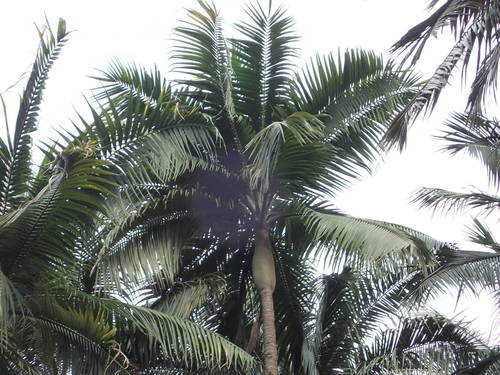
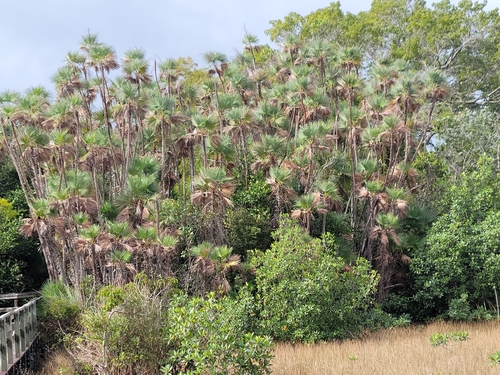
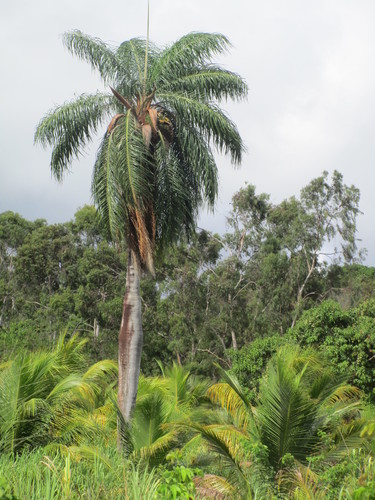
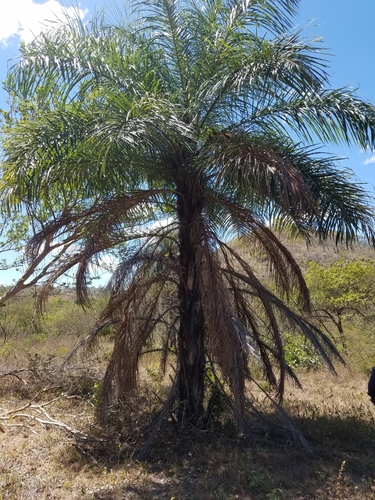
A palm tree 2-6 m high. It is a suckering plant. The trunks are covered with a mass of narrow leaf bases. The leaves are spreading and the leaflets are limp. They are green above and grey underneath. The leaves are 2-2.6 m long. They arch over. Leaf sheaths are covered with coarse fibres. The leaf stalks have long yellowish thorns. The leaflets are soft and erect. They grow in clusters arranged at different angles. This gives the leaves a feathery appearance. The fruit are about 1 cm long. They can be orange or black when ripe.
How to Grow
The plant can be grown from the warm temperate to tropical zones. It can withstand some frost. Grows best in a sunny position. Grows best in a moist soil. Phoenix species are quite liable to hybridize where the various species meet as a result of cultivation. A dioecious species, both male and female forms need to be grown if fruit and seed are required.
Propagation: Seed - pre-soak for 24 hours prior to sowing. The seed germinates best at a temperature of 21 - 27°c. Division of offsets.
Other Uses
The fibrous leaves are used to make mats, ropes, umbrellas, and fences as well as for thatching roofs. The stems are used to make walking sticks (believed traditionally to repel snakes), as rafters and for flooring. The stems are used as posts.
Wikipedia
Source ↗Phoenix paludosa (paludosa, Latin, swampy), also called the mangrove date palm, is a species of flowering plant in the palm family, indigenous to coastal regions of India, Bangladesh, Myanmar, Thailand, Cambodia, Sumatra, Vietnam and peninsular Malaysia. They are also known as sea dates. The trees grow in clusters, to 5 m (16 ft) high, usually forming dense thickets. The leaves are 2 to 3 m (6.6 to 9.8 ft) long and recurved. Similar to Nypa leaves, but smaller and placed towards the plant's top.
Notes
There are 17 Phoenix species.
Names & Synonyms
Bengal date palm, Chak toch, Dangsar, Hantal, Hatal, Hental, Hintal, Rophey, Thinbaung
References (19)
- Amoros, A., et al, 2014, Physico-chemical and functional characteristics of date fruits from different Phoenix species (Arecaceae). Fruits, Vol. 69, p. 315-323
- Arora, K., Indigenous Forest Management in the Andaman and Nicobar Islands, India.
- Awasthi, A.K., 1991, Ethnobotanical studies of the Negrito Islanders of Andaman Islands, India - The Great Andamanese. Economic Botany 45(2) pp274-280
- BARC, 2016, State of Biodiversity for Food and Agriculture in Bangladesh. Bangladesh Agricultural Research Council.
- Burkill, I.H., 1966, A Dictionary of the Economic Products of the Malay Peninsula. Ministry of Agriculture and Cooperatives, Kuala Lumpur, Malaysia. Vol 2 (I-Z) p 1743
- Facciola, S., 1998, Cornucopia 2: a Source Book of Edible Plants. Kampong Publications, p 30
- Fl. ind. ed. 1832, 3:789, t. 1193. 1832
- Haynes, J., & McLaughlin, J., 2000, Edible palms and Their Uses. University of Florida Fact sheet MCDE-00-50-1 p 11
- Hosen, M. Z., et al, 2020, Comparison or Physicochemical and Antioxidant Properties of Edible Fruits in the Sundarbans' Mangrove Forest, Bangladesh. Bangladesh J. Bot. 49 (3): 671-678
- Johnson, D.V., 1998, Tropical palms. Non-wood Forest products 10. FAO Rome. p 42, 48
- Jones, D.L., 1994, Palms throughout the World. Smithtonian Institution, Washington. p 287
- Jones, D.L., 2000, Palms of Australia 3rd edition. Reed/New Holland. p 195
- Mishra, N., et al, 2016, Indigenous knowledge in utilization of wetland plants in Bhadrak district, Odisha, India. Indian Journal of Natural Products and Resources. Vol. 7(1) pp. 82-89
- Pasha, M. K. & Uddin, S. B., 2019, Minor Edible Fruits of Bangladesh. Bangladesh J. Plant Taxon. 26(2): 299–313
- Phon, P., 2000, Plants used in Cambodia. © Pauline Dy Phon, Phnom Penh, Cambodia. p 495
- Riffle, R.L. & Craft, P., 2003, An Encyclopedia of Cultivated Palms. Timber Press. p 403
- Singh, H.B., Arora R.K.,1978, Wild edible Plants of India. Indian Council of Agricultural Research, New Delhi. p 68
- Tanaka,
- World Checklist of Useful Plant Species 2020. Royal Botanic Gardens, Kew