Phoenix rupicola
T. Anderson
East Indian Wine Palm, Cliff date palm

User:AndonicO (via Wikimedia Commons)

DominusVobiscum (via Wikimedia Commons)

James Bailey

(c) Tobias Spanner, some rights reserved (CC BY-NC), uploaded by Tobias Spanner

(c) indrabhutan, some rights reserved (CC BY-NC)
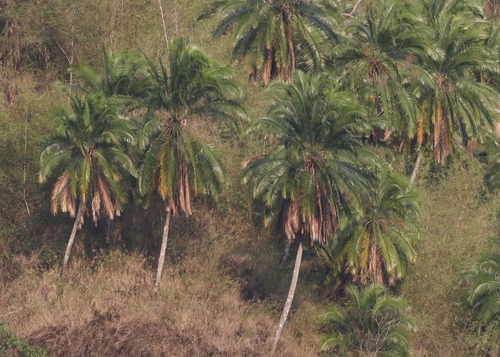
(c) James Bailey, some rights reserved (CC BY-NC), uploaded by James Bailey
What to Eat
Edible parts: Starch
The pith of the stem is sometimes eaten raw. Fruit - raw. A sweet but mealy flesh. The obovoid fruit is around 15mm long and 9mm wide.
Where to Find It
A tropical plant. It grows naturally among rocks on cliffs and gorges. They suit tropical and subtropical regions. It can grow in sunny or shady locations. It suits hardiness zones 10-12.
Asia, Australia, Bangladesh, Bhutan, Himalayas, India, Indochina, Indonesia, Myanmar, Northeastern India, SE Asia, Sikkim,
How to Identify
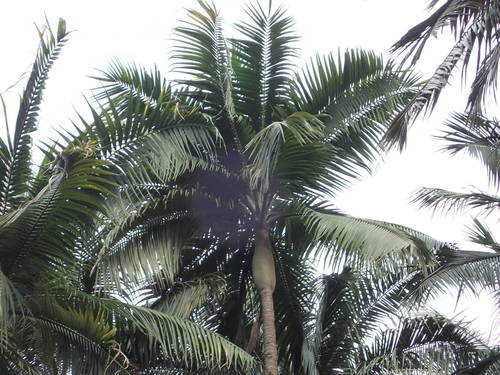
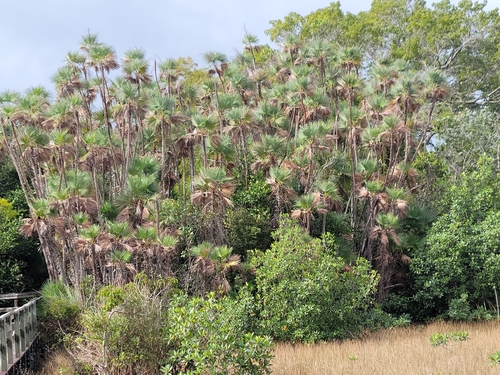
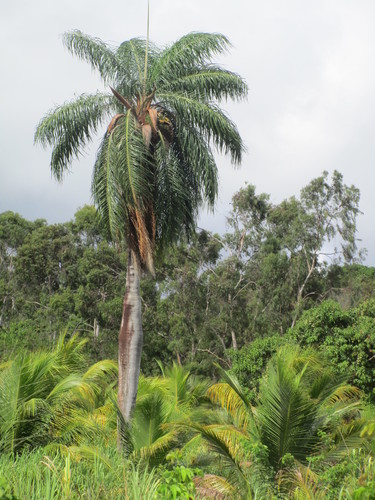
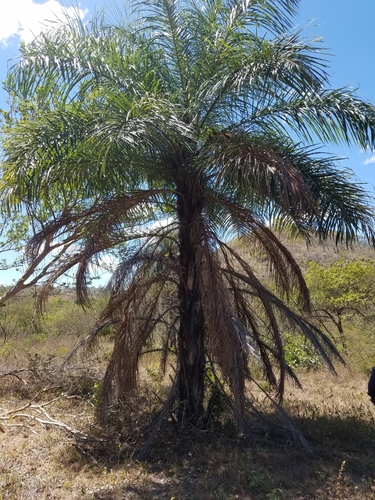
A medium sized palm. The trunk can be 8-10 m tall. The trunk is slender and 15-20 cm across. The trunk is often free of old leaf bases. The fronds arch over and form a graceful crown. The leaves are feather shaped, finely divided and glossy green. They are 3 m long. They are often twisted and hang down. There are many stiff leaflets which are thin textured. They are bright green and crowded along the midrib. They arise mostly in one plane. This gives the leaves a flat appearance. The flowering stalk arises among the leaf bases. It is short and much branched. It hangs down. The flowers are cream. Male and female flowers occur on separate plants. The fruit are oblong and 20 mm long. The fruit are purple-red when ripe.
How to Grow
Plants are grown from seed. Seeds are small and germinate easily. They take 2-3 months to germinate.
Wikipedia
Source ↗Phoenix rupicola (rupicola - Latin, inhabitant of rocks) or cliff date palm is a species of flowering plant in the palm family, native to the mountainous forests of India and Bhutan from 300 to 1,200 m (980 to 3,940 ft), usually occurring on cliffs, hillsides and similar terrain. It is threatened by habitat loss in its native range. On the other hand, the species is reportedly naturalised in the Andaman Islands, the Leeward Islands, Cuba and Puerto Rico and a specimen has recently been reported in Saint Lucia.
Other Information
It is cultivated.
Notes
There are 17 Phoenix species.
Names & Synonyms
Kola khejur, Palem korma, Scrap
References (20)
- Ambasta, S.P. (Ed.), 2000, The Useful Plants of India. CSIR India. p 448
- Blomberry, A. & Rodd, T., 1982, Palms. An informative practical guide. Angus & Robertson. p 141
- Burkill, I.H., 1966, A Dictionary of the Economic Products of the Malay Peninsula. Ministry of Agriculture and Cooperatives, Kuala Lumpur, Malaysia. Vol 2 (I-Z) p 1742
- Cundall, P., (ed.), 2004, Gardening Australia: flora: the gardener's bible. ABC Books. p 1030
- Gibbons, M., 1993, Palms. Compact study Guide and Identifier. Sandstone. p 62
- Gibbons, M., 2003, A pocket guide to Palms. Chartwell Books. p 161
- Johnson, D.V., 1998, Tropical palms. Non-wood Forest products 10. FAO Rome. p 40
- Jones, D.L., 1994, Palms throughout the World. Smithtonian Institution, Washington. p 290
- Jones, D.L., 2000, Palms of Australia 3rd edition. Reed/New Holland. p 197
- J. Linn. Soc., Bot. 11:13. 1871 ("1869")
- Krishen P., 2006, Trees of Delhi, A Field Guide. DK Books. p 314
- Pasha, M. K. & Uddin, S. B., 2019, Minor Edible Fruits of Bangladesh. Bangladesh J. Plant Taxon. 26(2): 299–313
- PROSEA handbook Volume 9 Plants yielding non-seed carbohydrates. p 178
- Riffle, R.L. & Craft, P., 2003, An Encyclopedia of Cultivated Palms. Timber Press. p 405
- Savita, et al, 2006, Studies on wild edible plants of ethnic people in east Sikkim. Asian J. of Bio Sci. (2006) Vol. 1 No. 2 : 117-125
- Singh, P., et al, 2019 Plants of Indian Himalayan region. Part 1 Botanical Surbey of India. p 34
- Sukarya, D. G., (Ed.) 2013, 3,500 Plant Species of the Botanic Gardens of Indonesia. LIPI p 801
- Sundriyal, M., et al, 1998, Wild edibles and other useful plants from the Sikkim Himalaya, India. Oecologia Montana 7:43-54
- Sundriyal, M., et al, 2004, Dietary Use of Wild Plant Resources in the Sikkim Himalaya, India. Economic Botany 58(4) pp 626-638
- World Checklist of Useful Plant Species 2020. Royal Botanic Gardens, Kew