Phytelephas aequatorialis
Spruce
Vegetable ivory, Corozo

(c) rlunken, some rights reserved (CC BY-NC)
(c) prengelv, some rights reserved (CC BY-NC), uploaded by prengelv
What to Eat
Edible parts: Fruit, Palm heart, Seeds, Nut
The seed is used in several ways depending on its stage of maturity. When young, the liquid endosperm is drunk as a refreshing beverage; as it firms to a jelly-like consistency it is eaten as a food. The orange, fleshy fruit is eaten as a delicacy. Leaves can be eaten cooked. The apical bud — commonly called a palm heart — is eaten as a vegetable, though harvesting it kills the tree since the plant cannot produce side shoots.
Where to Find It
It is a tropical plant. It grows in lowland rainforest. In the Andes it grows up to 1660 m altitude. It suits humid regions. In Townsville Queens BG and palmetum.
Australia, Brazil, Central America, Colombia, Ecuador*, Panama, Peru, South America,
How to Identify
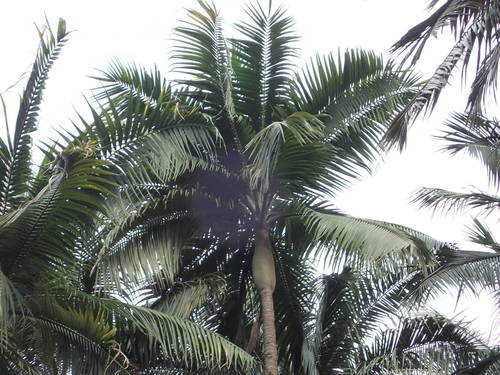
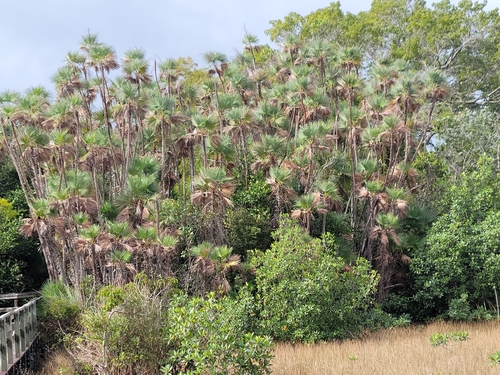
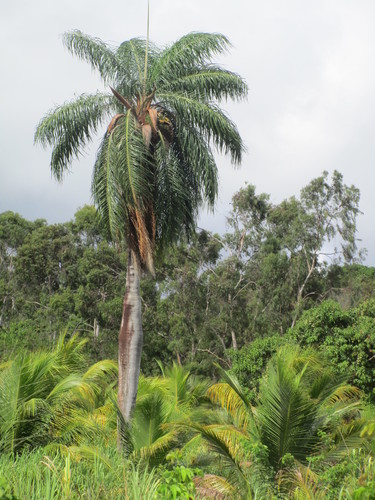
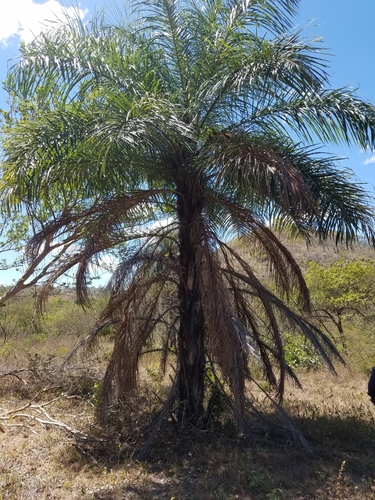
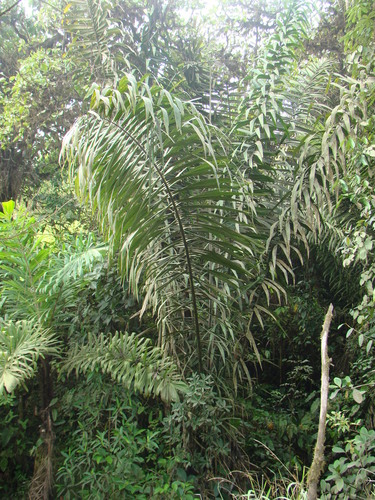
A solitary palm. It grows to 16 m high. The trunk is 30 cm across. The leaf crown is large and round. The dead leaves hang beneath the living leaves. The leaves are 5-6 m long. They are on short stout leaf stalks. There are a large number of leaflets. They grow in small groups and often at slightly different angles. The leaflets at the centre are 60-100 cm long. The leaflets are the base and tip are shorter. They are deep green on both surfaces and hang down slightly.
How to Grow
A dioecious species, both male and female forms need to be grown if fruit and seed are required.
Propagation: Seed.
Medicinal Uses
None known
Other Uses
The fully hardened endocarp of the seed is known as vegetable ivory and is used to make buttons, chess pieces, and various ornamental articles. The leaves are used as a thatch material.
Wikipedia
Source ↗The palm tree Phytelephas aequatorialis, commonly known as Ecuadorian ivory palm, is the main source of Ecuadorean vegetable ivory or tagua, a botanical alternative to ivory. It is found in the tropical rainforests of the western Andean slopes of Ecuador. It has a woody trunk which can grow to 20 metres (66 ft) tall, and has very long pinnate leaves.
Other Information
It is cultivated.
Notes
There are about 6 Phytelephas species.
Names & Synonyms
Cabeza de negor, Cade, Cadillo, Coroso, Din-chi, Garinha, Jarina, Mazorca, Tade, Tagua, Tiri, Trapa, Wakra ashanka
References (18)
- Balick, M.J. and Beck, H.T., (Ed.), 1990, Useful palms of the World. A Synoptic Bibliography. Colombia p 50
- Barfod, A. S. & Kvist, L. P., 1996, Comparative Ethnobotanical Studies of the Amerindian Groups in Coastal Ecuador. The Danish Academy of Sciences and Letters. p 77
- Eynden, Van den, V., & Cueva E., Cabrera, O., 2004, Edible Palms of Southern Ecuador. Palms. Vol 48(3):141-147
- Grandtner, M. M. & Chevrette, J., 2013, Dictionary of Trees, Volume 2: South America: Nomenclature, Taxonomy and Ecology. Academic Press p 496
- Henderson, A., Galeano, G and Bernal, R., 1995, Field Guide to the Palms of the Americas. Princeton. p 237
- J. Linn. Soc., Bot. 11:175-181. 1871
- Janick, J. & Paul, R. E. (Eds.), 2008, The Encyclopedia of Fruit & Nuts. CABI p 152
- Kermath, B. M., et al, 2014, Food Plants in the Americas: A survey of the domesticated, cultivated and wild plants used for Human food in North, Central and South America and the Caribbean. On line draft. p 653
- Koziol, M. J. & Pedersen, H. B., 1993, Phytelephas aequatorialis in Human and Animal Nutrition. Economic Botany, 47(4):401-407
- Marcia, M. J., et al, 2011, Palm Uses in Northwestern South America: A Quantitative Review. Bot. Rev. (2011) 77:462-570
- Riffle, R.L. & Craft, P., 2003, An Encyclopedia of Cultivated Palms. Timber Press. p 408
- Roa, J. A. G. & Boada, D. S. G., 2018, Fundación para el Fortalecimiento de la Fruticultura y Plantas Alimenticias no Convencionales en Colombia.
- Torre, de la L., et al, 2008, Enciclopedia de las Plantas Útiles del Ecuador. Herbario QCA. Pontificia Universidad Católica del Ecuador. p 207
- Van den Eynden, V., et al, 2003, Wild Foods from South Ecuador. Economic Botany 57(4): 576-603
- Van den Eynden, V. et al, 2004, Edible Palms of Southern Ecuador. Palms Volume 48(3):142-148
- Van den Eynden, V., 2004, Use and Management of edible non-crop plants in southern Ecuador. Ph. D. dissertation Faculty of Agricultural and Applied Biological Sciences, Belgium, 246pp
- Wickens, G.E., 1995, Edible Nuts. FAO Non-wood forest products. FAO, Rome. p170
- World Checklist of Useful Plant Species 2020. Royal Botanic Gardens, Kew