Phytelephas macrocarpa
Ruiz & Pav.
Ivory nut palm
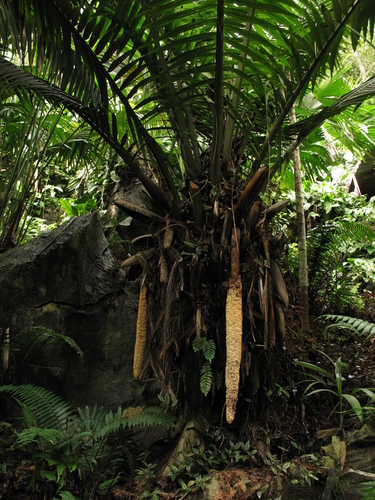
(c) Mateo Hernandez Schmidt, some rights reserved (CC BY-NC-SA), uploaded by Mateo Hernandez Schmidt
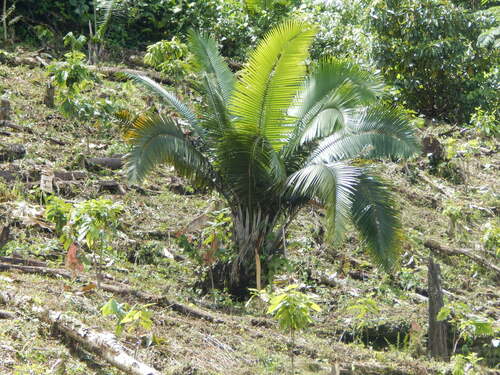
(c) Jhon Alexander Mantilla Carreño, some rights reserved (CC BY-NC)
What to Eat
Edible parts: Nuts, Leaves, Palm hearts, Cabbage, Fruit, Seed
The apical bud is cooked and eaten as a vegetable, though doing so kills the tree since it cannot form side branches. The seed tissue of immature fruits is liquid and sweet, used as a refreshing drink. Young fruits are also eaten. The fruit has been used as a coffee substitute.
Where to Find It
A tropical plant. It suits hot, humid tropical climates. It needs a sheltered position. It does best in low, damp areas with good drainage of humid shaded mountain forests. A temperature range or 20°C at night and 35°C by day are suitable.
Amazon, Asia, Australia, Bolivia*, Brazil*, Central America, Chile, Colombia, Ecuador, India, Indonesia, Panama, Peru*, SE Asia, South America,
How to Identify
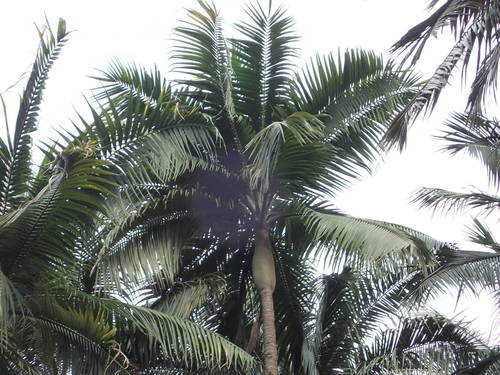
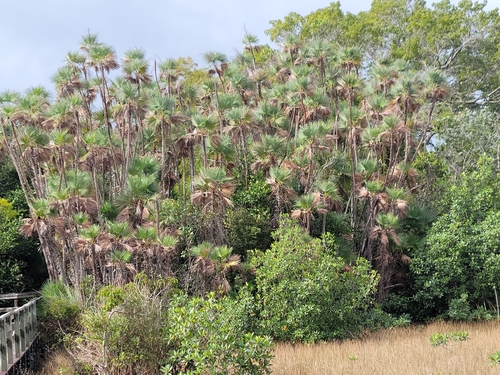
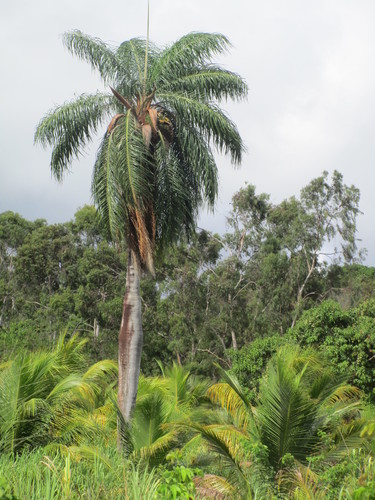
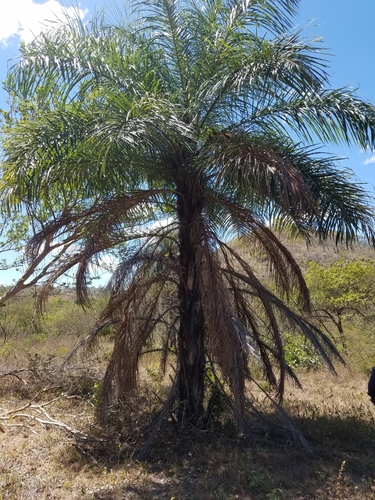
A palm with a short stout trunk. It has a large crown of erect dark-green fronds. These fronds have stiff long, narrow leaflets. They are 1 m long. The male flower arrangement is a long, sausage-like spike of small white fluffy flowers. The female flower arrangement is rounded and dense. It is made up of large white, fleshy flowers. The male and female flowers are borne on separate plants. The fruit is a composite fruit made up of four large seeds the size of a hen's egg. The seed contain a very hard layer of white food storage tissue. It resembles ivory and is carved into ornaments.
How to Grow
Plants are grown from seed. The seed are often slow and erratic to germinate. Germination can take 4-12 months. This may be improved by hot water treatment or by sowing shallowly and covering with sphagnum moss.
Propagation: Seed — germination can take 3 to 4 years.
Medicinal Uses
None known
Other Uses
The seed, roughly the size of a hen's egg, becomes extremely hard as it matures and closely resembles ivory; it is used to make buttons, chess pieces, and ornamental articles. The leaves are used for thatching native huts and for weaving into baskets and other domestic articles. A fibre obtained from the plant is used for making brooms, torches, fire starters, and blowgun bore-cleaners.
Wikipedia
Source ↗Phytelephas macrocarpa is a single-stemmed, unarmed, reclining or erect palm from the extreme northern coastal regions of South America, growing to some 12 m tall. It has been introduced and cultivated in tropical regions all over the world. The trunk is about 30 cm across, with prominent leaf scars. The crown is made up of about 30 plume-like leaves or fronds, each about 8 m long, dead leaves being persistent. It is one of some 7 species of palm in the genus Phytelephas, all of which have been exploited for vegetable ivory or tagua from the seed or corozo nut. The closely related Ammandra decasperma from Colombia, and Aphandra natalia from Ecuador, are also sources of vegetable ivory, but of inferior quality and therefore not commercially significant. 'Phytelephas macrocarpa' translates to 'elephant plant' with 'large fruit', the endosperm of the nut having the texture of elephant ivory, and consisting of large, thick-walled cells of two long-chain polysaccharides, mannan A and B.
Production
Palms fruit when 6 years old. They produce 4-9 fruit per year. Palms can fruit for 50 to 100 years. Each fruit weighs about 11 kg.
Notes
There are about 6 Phytelephas species.
Names & Synonyms
Anon de palma, Chapi, Chapijinkiai, Chincha, Homero, Jarina, Negro’s Head, Palem gading, Palmera marfil, Shishije, Tagua palm, Vegetable ivory palm, Wakra ashanka, Yarina
References (27)
- Ambasta, S.P. (Ed.), 2000, The Useful Plants of India. CSIR India. p 453
- Balick, M.J. and Beck, H.T., (Ed.), 1990, Useful palms of the World. A Synoptic Bibliography. Colombia p 50, 51, 91, 140,
- Burkill, I.H., 1966, A Dictionary of the Economic Products of the Malay Peninsula. Ministry of Agriculture and Cooperatives, Kuala Lumpur, Malaysia. Vol 2 (I-Z) p 1751
- Facciola, S., 1998, Cornucopia 2: a Source Book of Edible Plants. Kampong Publications, p 168
- Grandtner, M. M. & Chevrette, J., 2013, Dictionary of Trees, Volume 2: South America: Nomenclature, Taxonomy and Ecology. Academic Press p 496
- Haynes, J., & McLaughlin, J., 2000, Edible palms and Their Uses. University of Florida Fact sheet MCDE-00-50-1 p 11
- Hedrick, U.P., 1919, (Ed.), Sturtevant's edible plants of the world. p 493
- Henderson, A., Galeano, G and Bernal, R., 1995, Field Guide to the Palms of the Americas. Princeton. p 237
- Jernigan, K. A., 1997, An Ethnobiological Exploration of Sensory and Ecological Aspects of Tree Identification among the Aguaruna Kivaro. PhD thesis. Athens, Georgia.
- Johnson, D.V., 1998, Tropical palms. Non-wood Forest products 10. FAO Rome. p 20
- Jones, D.L., 1994, Palms throughout the World. Smithtonian Institution, Washington. p 56
- Jones, D.L., 2000, Palms of Australia 3rd edition. Reed/New Holland. p 199
- Lord, E.E., & Willis, J.H., 1999, Shrubs and Trees for Australian gardens. Lothian. p 99
- Marcia, M. J., et al, 2011, Palm Uses in Northwestern South America: A Quantitative Review. Bot. Rev. (2011) 77:462-570
- Martin, F.W. & Ruberte, R.M., 1979, Edible Leaves of the Tropics. Antillian College Press, Mayaguez, Puerto Rico. p 210
- Menninger, E.A., 1977, Edible Nuts of the World. Horticultural Books. Florida p 140
- Purseglove, J.W., 1972, Tropical Crops. Monocotyledons. Longmans p 430
- Riffle, R.L. & Craft, P., 2003, An Encyclopedia of Cultivated Palms. Timber Press. p 408
- Roa, J. A. G. & Boada, D. S. G., 2018, Fundación para el Fortalecimiento de la Fruticultura y Plantas Alimenticias no Convencionales en Colombia.
- Smith, N., et al, 2007, Amazon River Fruits. Flavors for Conservation. Missouri Botanical Gardens Press. p 88
- Sukarya, D. G., (Ed.) 2013, 3,500 Plant Species of the Botanic Gardens of Indonesia. LIPI p 803
- Syst. veg. fl. peruv. chil. 301. 1798
- Torre, de la L., et al, 2008, Enciclopedia de las Plantas Útiles del Ecuador. Herbario QCA. Pontificia Universidad Católica del Ecuador. p 207
- Vael, L., 2015, Ethnobotanical study of the plant use in the natural landscape of two mestizo communities in the Ucayali region of the Peruvian Amazon. Universiteit Gent.
- Vasquez, R. and Gentry, A. H., 1989, Use and Misuse of Forest-harvested Fruits in the Iquitos Area. Conservation Biology 3(4): 350f (Also as Phytelephas microcarpa)
- Wickens, G.E., 1995, Edible Nuts. FAO Non-wood forest products. FAO, Rome. p170
- World Checklist of Useful Plant Species 2020. Royal Botanic Gardens, Kew