Pinanga polymorpha
Becc.
ArecaceaeFruit

gbif · cc0
President and Fellows of Harvard College
President and Fellows of Harvard College
What to Eat
Edible parts: Fruit
Where to Find It
A tropical plant. It grows in thickets in moist areas in the highlands of Malaysia. It grows between 500-1600 m altitude. It needs a shady position.
Asia, Australia, Malaysia, SE Asia,
Countries: United Arab Emirates, Afghanistan, Armenia, Australia, Azerbaijan, Bangladesh, Bahrain, Brunei, Bhutan, China, Georgia, Indonesia, Israel, India, Iraq, Iran, Jordan, Japan, Kyrgyzstan, Cambodia, North Korea, South Korea, Kuwait, Kazakhstan, Laos, Lebanon, Sri Lanka, Myanmar, Mongolia, Maldives, Malaysia, Nepal, Oman, Philippines, Pakistan, Qatar, Saudi Arabia, Singapore, Syria, Thailand, Tajikistan, Timor-Leste, Turkmenistan, Turkey, Taiwan, Uzbekistan, Vietnam, Yemen
How to Identify
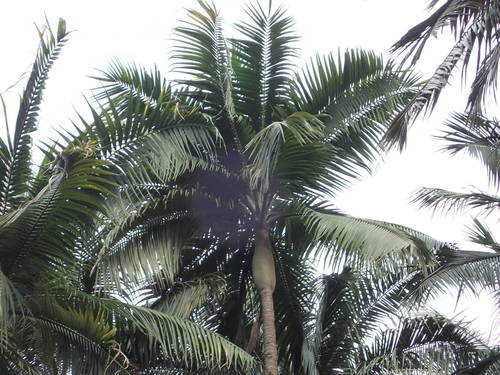
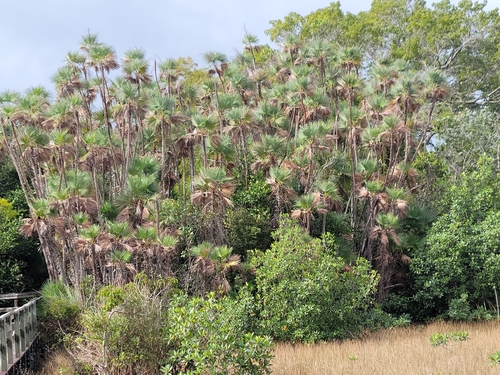
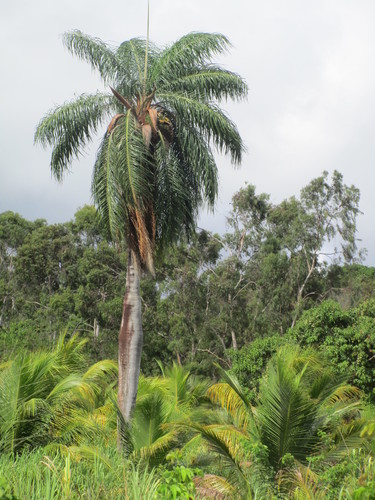
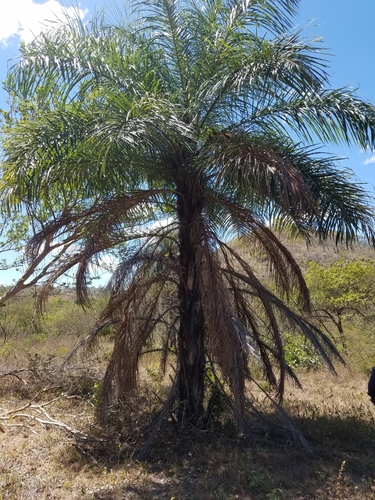
A palm which varies in form. The stems can be 3 m tall and 2 cm thick. They lean and twist through the surrounding vegetation. There are aerial roots near the base of the stems. The crown-shaft is 15 cm long. The leaves are short and crowded into a dense crown. The leaves can be 1-1.6 m long. The leaves can be divided into narrow or broad leaflets. The leaflets are dark green above with yellow mottling. They are greyish-green underneath. The flowers are cream. The fruit are dark bluish-green. They are edible.
References (2)
- Jones, D.L., 1994, Palms throughout the World. Smithtonian Institution, Washington. p 305
- Jones, D.L., 2000, Palms of Australia 3rd edition. Reed/New Holland. p 205