Andromeda glaucophylla
Link.
Bog rosemary
(c) F Quiec, some rights reserved (CC BY-SA)
(c) F Quiec, some rights reserved (CC BY-SA)
(c) F Quiec, some rights reserved (CC BY-SA)
What to Eat
Edible parts: Leaves - tea, Caution
The tender leaves and shoot-tips can be boiled to make an aromatic tea — a delicious drink. Some caution is advised, as boiling the plant or infusing it in hot water is said to release a toxic chemical. A safer method is to soak the leaves in a jar of water in direct sunlight to make 'sun tea'.
Known Hazards
Where to Find It
A cool temperate plant. It grows in the colder parts of the northern hemisphere. It grows in moist, well drained acid soils. They can tolerate frost. It cannot tolerate drought. It probably suits hardiness zones 2-9.
Arctic, Australia, Canada, Europe, North America, USA,
How to Identify
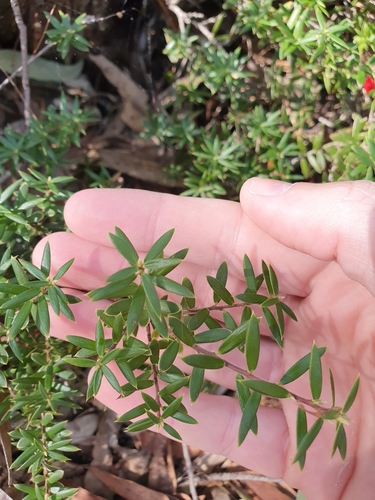
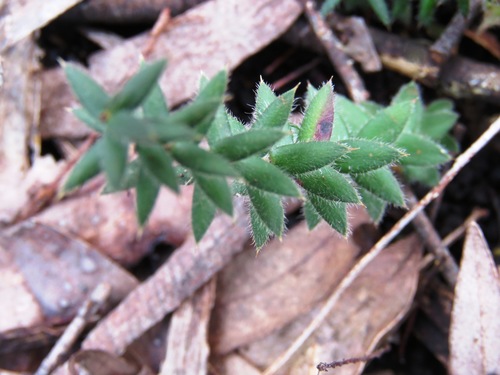
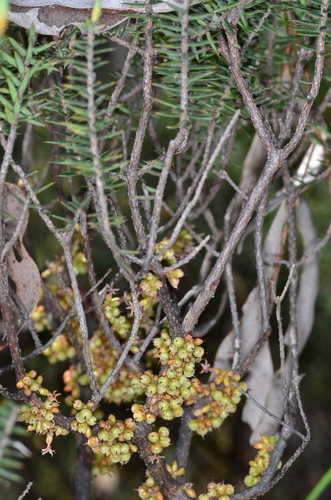
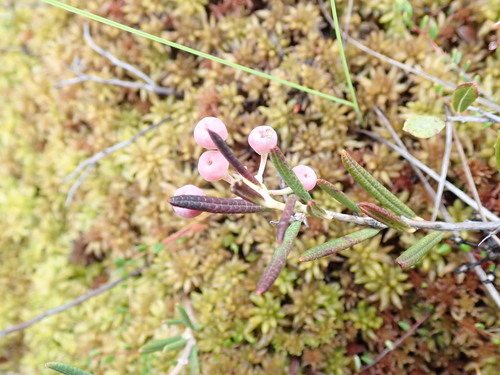
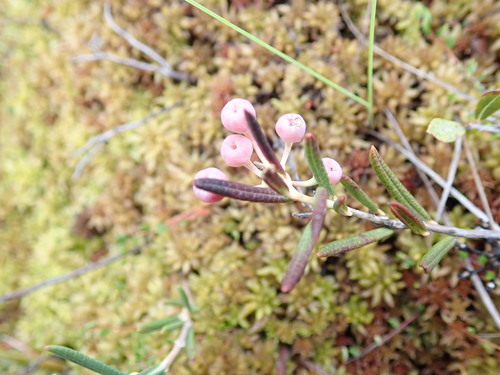
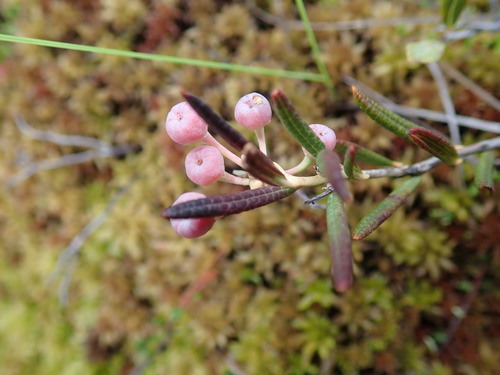
A low evergreen shrub. It has tough short branches. These root along the ground. The leaves are small, oblong and leathery. The flowers are small and in short sprays at the ends of the branches. The flowers are urn shaped with a narrow mouth.
How to Grow
Requires a well-drained, moisture-retentive, lime-free, humus- rich soil and a shady position. Plants spread slowly by means of suckers when they are grown in a suitable position. This plant is considered to be no more than a sub-species of A. polifolia, but with a more southerly range, by some botanists.
Propagation: Sow seed in February or March in an acid compost in the greenhouse. Surface sow or only just cover the seed and place in a lightly shaded position. Seed usually germinates in 1–2 months at 12°C. Prick out seedlings into individual pots as soon as possible, keeping them well ventilated as they are prone to damping off. Grow on in the greenhouse for at least their first winter and plant out in early summer once they reach 15 cm or more in height. Take cuttings of half-ripe wood, 5–7 cm with a heel, in July or August in a shaded frame — these take about 15 months. Layer in August in a semi-shaded position, allowing 18 months. Division can be done in early spring, but plants should be 'dropped' beforehand: dig them up 6–12 months earlier, replant somewhat more deeply, and the buried branches will root and form new plants ready for division.
Medicinal Uses
None known
Other Uses
None known
Wikipedia
Source ↗Andromeda glaucophylla is an evergreen shrub reaching 0.6 m tall. It remains in leaf year-round and flowers April to June. The hermaphroditic plant is bee-pollinated and self-fertile, also attracting moths and butterflies. It prefers light sandy and medium loamy well-drained soils in mildly acid to very acid pH. It tolerates semi-shade and prefers moist or wet conditions. Hardy to UK zone 2.
Notes
There are 2 Andromeda species.
Names & Synonyms
References (8)
- Beckstrom-Sternberg, Stephen M., and James A. Duke. "The Foodplant Database." http://probe.nalusda.gov:8300/cgi-bin/browse/foodplantdb.(ACEDB version 4.0 - data version July 1994)
- Bircher, A. G. & Bircher, W. H., 2000, Encyclopedia of Fruit Trees and Edible Flowering Plants in Egypt and the Subtropics. AUC Press. p 27 (As Andromeda polyfolia)
- Bodkin, F., 1991, Encyclopedia Botanica. Cornstalk publishing, p 79
- Cundall, P., (ed.), 2004, Gardening Australia: flora: the gardener's bible. ABC Books. p 150
- Etherington, K., & Imwold, D., (Eds), 2001, Botanica's Trees & Shrubs. The illustrated A-Z of over 8500 trees and shrubs. Random House, Australia. p 94
- Facciola, S., 1998, Cornucopia 2: a Source Book of Edible Plants. Kampong Publications, p 94
- Kermath, B. M., et al, 2014, Food Plants in the Americas: A survey of the domesticated, cultivated and wild plants used for Human food in North, Central and South America and the Caribbean. On line draft. p 64
- Toupal, R. S. & Hollenback, K., 2009, An Ethnobotany of Indiana Dunes National Lakeshore: Plant Uses of the Ojibwa People. Bureau of Applied research in Anthropology. University of Arizona