Podococcus barteri
Mann et Wendl.
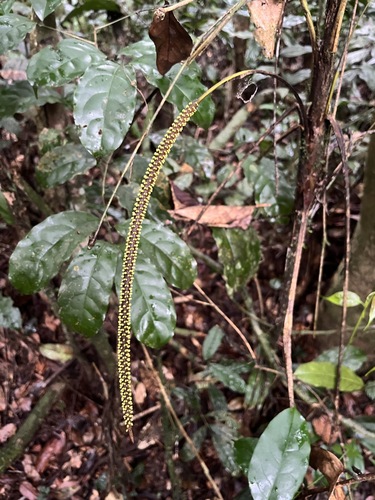
(c) Nick Ramsey, some rights reserved (CC BY-NC)

(c) Nick Ramsey, some rights reserved (CC BY-NC)

(c) Nick Ramsey, some rights reserved (CC BY-NC)
What to Eat
Edible parts: Nuts, Fruit
The seed kernel is eaten raw. The fruit is also eaten.
Where to Find It
It is a tropical plant. It grows in the equatorial lowland rain-forest. It needs plenty of moisture.
Africa, Cameroon, Central Africa, Congo, Congo R, Gabon, Nigeria, West Africa,
How to Identify
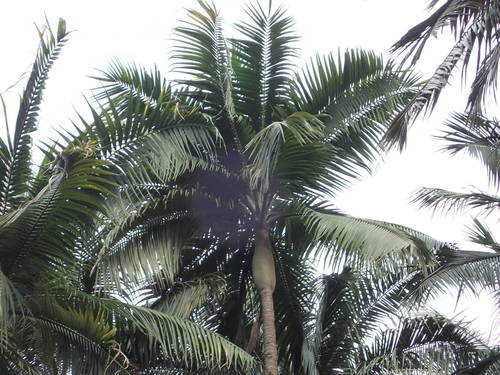
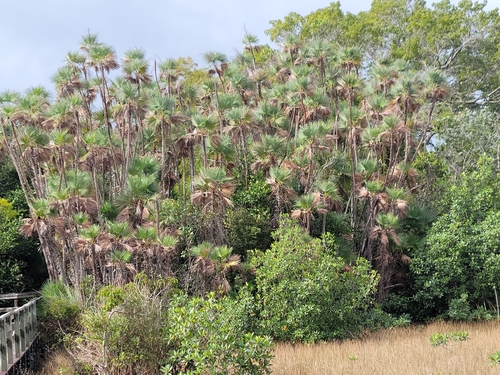
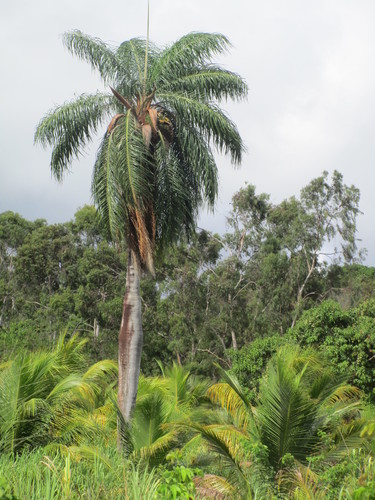
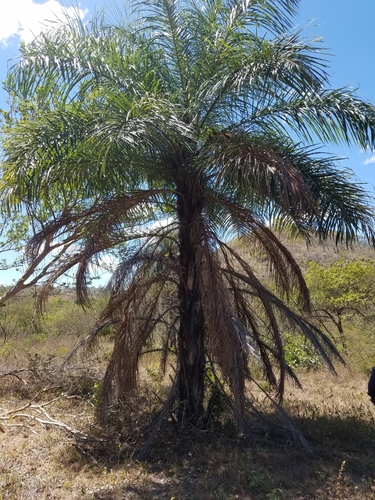
A clustering palm. It grows 3-5 m high. There are spiny stilt roots at the base of the stems. The leaf crown forms a half circle. The leaves arch over. The leaflets are widely spaced. They are a narrow diamond shape. They are light green on both surfaces. The end leaflet is larger than the others. The leaflets have lobes and teeth along the edge. The flowering stalks are like a spike. They are erect until the fruit develop. The flowers have both sexes. The fruit are 2.5 cm wide and are lobed. They have spindle shaped seeds inside.
Production
It is slow growing.
Notes
There is only one Podococcus species.
Names & Synonyms
Nyamvini
References (10)
- Balick, M.J. and Beck, H.T., (Ed.), 1990, Useful palms of the World. A Synoptic Bibliography. Colombia p 297, 383,
- Burkill, H. M., 1985, The useful plants of west tropical Africa, Vol. 4. Kew.
- Dalziel, J. M., 1937, The Useful plants of west tropical Africa. Crown Agents for the Colonies London.
- Hedrick, U.P., 1919, (Ed.), Sturtevant's edible plants of the world. p 509
- Jardin, C., 1970, List of Foods Used In Africa, FAO Nutrition Information Document Series No 2.p 35
- Nkeoua, G. & Boundzanga, G. C., 1999, Donnees sur les produits forestieres non ligneux en Republique du Congo. FAO. p 34
- Peters, C. R., O'Brien, E. M., and Drummond, R.B., 1992, Edible Wild plants of Sub-saharan Africa. Kew. p 39
- Riffle, R.L. & Craft, P., 2003, An Encyclopedia of Cultivated Palms. Timber Press. p 418
- Vivien, J., & Faure, J.J., 1996, Fruitiers Sauvages d'Afrique. Especes du Cameroun. CTA p 73
- World Checklist of Useful Plant Species 2020. Royal Botanic Gardens, Kew