Polyalthia longifolia
(Lamk.) Benth. & Hook.f.
“Custard apple", Indian Mast Tree, False ashoka

(c) Azhagarraja S, some rights reserved (CC BY-NC)
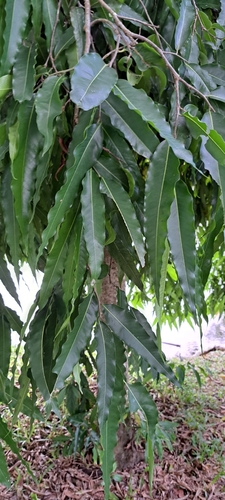
(c) dmitry_kishkinev, some rights reserved (CC BY-NC)
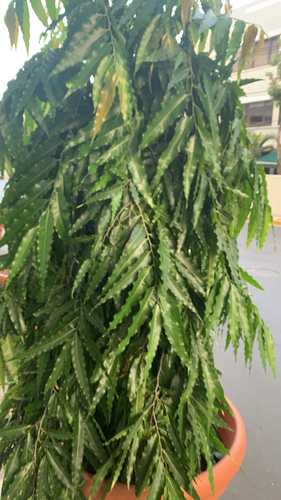
(c) thaven, some rights reserved (CC BY-NC)
What to Eat
Edible parts: Fruit, Leaves
The leaves are used for ornamental decoration during festivals. The tree is a focal point in gardens throughout India. The tree can be pruned into various shapes and maintained in required sizes. The flexible, straight and light-weight trunks were once used in the making of masts for sailing ships. Thus, the tree is also known as the Mast Tree. Today, its wood is mostly used for manufacturing small articles such as pencils, boxes, matchsticks, etc. The oil of the seed has been confirmed to possess anti-oxidant, anti-lipooxygenase and antimicrobial (against various microbe strains) activities, among others. Bankole et al 2016 find M. longifolium does control chloroquine resistant strains of Plasmodium berghei ANKA in mouse to some degree but is not an effective treatment. Methanolic extracts of Monoon longifolium have yielded 20 known and two new organic compounds, some of which show cytotoxic properties. The fatty acid composition of the seed has also been reported
Where to Find It
A tropical plant. It is native to India and Sri Lanka. It grows in India on the Deccan. It grows in lowland rainforest. It can grow in dry forest. It needs a fertile, well drained soil. It needs full sun. It is cultivated between 300-400 m altitude in southern China. It suits hardiness zones 11-12. In Yunnan. In the Cairns Botanical Gardens.
Andamans, Asia, Australia, Central America, China, Cuba, Hawaii, India*, Indochina, Indonesia, Malaysia, Maldives, Myanmar, Pacific, Pakistan, Philippines, SE Asia, Solomon Islands, Sri Lanka*, Taiwan, USA, Vietnam. West Indies,
How to Identify
This tree grows up to 14 to 28 m tall. It is an evergreen tree keeping its leaves throughout the year. The bark can become gnarled and distorted. The trunk is straight. The leaves are long and narrow with a wavy margin. They are 22 cm long. They are dark green and shiny. New leaf growth is yellow. It has small flowers 2 cm across. The flowers are greenish yellow and have an appearance like a star. They occur in bunches. The small plum like fruit which develop change from green to black when ripe. They contain a ringed seed. The fruit are 2 cm across. There is a variety where the branches hang down (var. pendula)
Nutrition Score: 28/100
| Part | Moisture | kJ | kcal | Protein | Vit A | Vit C | Iron | Zinc |
|---|---|---|---|---|---|---|---|---|
| Leaves | 87 | 150 | 36 | 4.6 | — | — | — | — |
How to Grow
It can be grown from seed which germinate in 2 to 6 weeks. The seedling trees grow quickly but older trees grow more slowly. It can also be grown from cuttings.
Production
It is slow growing. The fruit ripen quickly.
Other Information
A famine food.
Notes
The wood is used. There is some confusion over the species with 2 different authorities.
Names & Synonyms
Arana, Ashoka, Ashupal, Asoka, Asoothi, Asopalav, Assothi, Asupal, Cemetery tree, Chorana, Debdari, Debdaru, Devdaru, Dhebudhaaru, Hessare, Indian willow, Kambadamara, Nara maamidi, Netti-lingam, Ubbina, Unboi
References (20)
- Ambasta, S.P. (Ed.), 2000, The Useful Plants of India. CSIR India. p 476
- Barwick, M., 2004, Tropical and Subtropical Trees. A Worldwide Encyclopedic Guide. Thames and Hudson p 340
- Bole, P.V., & Yaghani, Y., 1985, Field Guide to the Common Trees of India. OUP p 81
- Burkill, I.H., 1966, A Dictionary of the Economic Products of the Malay Peninsula. Ministry of Agriculture and Cooperatives, Kuala Lumpur, Malaysia. Vol 2 (I-Z) p 1819
- Cundall, P., (ed.), 2004, Gardening Australia: flora: the gardener's bible. ABC Books. p 1066
- Engel, D.H., & Phummai, S., 2000, A Field Guide to Tropical Plants of Asia. Timber Press. p 88 (var. pandurata)
- Flora of Pakistan.
- Food Composition Tables for use in East Asia FAO http://www.fao.org/infoods/directory No. 538
- French, B.R., 2010, Food Plants of Solomon Islands. A Compendium. Food Plants International Inc. p 374
- Hearne, D.A., & Rance, S.J., 1975, Trees for Darwin and Northern Australia. AGPS, Canberra p 98, Pl 30
- Heywood, V.H., Brummitt, R.K., Culham, A., and Seberg, O. 2007, Flowering Plant Families of the World. Royal Botanical Gardens, Kew. p (As Guatteria longifolia)
- Hibbert, M., 2002, The Aussie Plant Finder 2002, Florilegium. p 237
- Hook. F., Fl. Brit. Ind. 1:62. 1872
- Krishen P., 2006, Trees of Delhi, A Field Guide. DK Books. p 116
- Li Ping-Tao, ANNONACEAE [Draft], Flora of China
- Llamas, K.A., 2003, Tropical Flowering Plants. Timber Press. p 61
- Sahni, K.C., 2000, The Book of Indian Trees. Bombay Natural History Society. Oxford. p 20
- Sujanapal, P., & Sankaran, K. V., 2016, Common Plants of Maldives. FAO & Kerala FRI, p 215
- Swaminathan, M.S., and Kochnar, S.L., 2007, An Atlas of Major Flowering Trees in India. Macmillan. p 21
- WATT. (As Guatteria longifolia)


