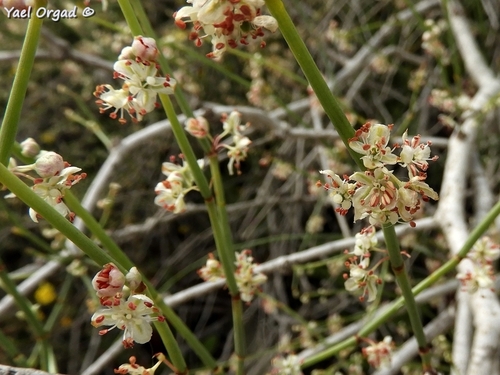
Polygonum douglasii
Greene
Douglas Knotweed, Mountain knotweed

(c) anthony, some rights reserved (CC BY-NC), uploaded by anthony
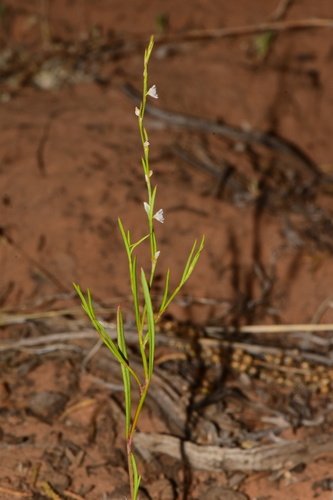
(c) Joey Santore, some rights reserved (CC BY-NC), uploaded by Joey Santore

(c) hsteger, some rights reserved (CC BY-NC)
What to Eat
Edible parts: Leaves, Seeds
Leaves can be eaten raw or cooked. Seeds can be dried, ground into a powder, and mixed with cornmeal or other cereals for use in bread and similar preparations. The seed is rather small and fiddly to work with, and is enclosed in a dry, papery hull.
Known Hazards
Where to Find It
It is a temperate plant. It grows in dry slopes in prairies and sub alpine zones in Canada.
Canada, North America, USA,
How to Identify
A slender annual herb. It grows 10-40 cm tall. The lower leaves are oval. There are sword shaped bracts up the stem. The fruit point downward.
How to Grow
We have very little information on this species and do not know if it is hardy in Britain, though judging by its native range it should succeed outdoors in most parts of the country. The following notes are based on the general needs of the genus. Succeeds in an ordinary garden soil but prefers a moisture retentive not too fertile soil in sun or part shade. Repays generous treatment. Plants seem to be immune to the predations of rabbits.
Propagation: Sow seed in spring in a cold frame; germination is generally free and easy. Once seedlings are large enough to handle, prick them out into individual pots and plant out during summer if they have reached sufficient size, or overwinter in a cold frame and plant out the following spring after the last expected frosts. Division can be done in spring or autumn and is very straightforward — larger divisions can go directly into permanent positions, while smaller ones do better potted up and grown on in light shade in a cold frame until well established before planting out in late spring or early summer.
Medicinal Uses
None known
Other Uses
None known Special Uses
Wikipedia
Source ↗Polygonum douglasii is a species of flowering plant in the knotweed family known by the common name Douglas's knotweed. It is native to much of northern and western North America, where it can be found in many types of habitat, including disturbed areas. It has been found in Canada from British Columbia north to Yukon and east as far as Québec, and in the United States as far south as California, New Mexico, Iowa, and New York. Polygonum douglasii is known as a species complex, as there are many subspecies that may be better treated as species in their own right. Polygonum douglasii is variable in morphology and the subspecies are often difficult to distinguish. In general, plants in this complex are annual herbs growing erect to maximum heights anywhere between 3 and 80 centimeters (1.2–32 inches) with thin, angular stems. High-elevation plants are smaller and sometimes trailing on the surface of the ground. The leaves are linear or widely lance-shaped, sometimes falling away to leave the plant mostly naked in flowering, or reduced to tiny scales at the stem tips. The flowers are a few millimeters long, pink to white, sometimes remaining closed or opening together in a cluster.
Notes
There are about 50 Polygonum species.
Names & Synonyms
References (8)
- Anderson, M. K., 2012, Edible Seeds and Grains of California Tribes and the Klamath Tribe of Oregon in the Phoebe Apperson Hearst Museum of Anthropology Collections, University of California, Berkeley. USDA p 10
- Beckstrom-Sternberg, Stephen M., and James A. Duke. "The Foodplant Database." http://probe.nalusda.gov:8300/cgi-bin/browse/foodplantdb.(ACEDB version 4.0 - data version July 1994)
- Duke, J.A., 1992, Handbook of Edible Weeds. CRC Press. p
- Kermath, B. M., et al, 2014, Food Plants in the Americas: A survey of the domesticated, cultivated and wild plants used for Human food in North, Central and South America and the Caribbean. On line draft. p 675
- Kiple, K.F. & Ornelas, K.C., (eds), 2000, The Cambridge World History of Food. CUP p 1797
- MacKinnon, A., et al, 2009, Edible & Medicinal Plants of Canada. Lone Pine. p 322
- Moerman, D. F., 2010, Native American Ethnobotany. Timber Press. p 423
- Plants for a Future database, The Field, Penpol, Lostwithiel, Cornwall, PL22 0NG, UK. http://www.scs.leeds.ac.uk/pfaf/